1The question, and five ways to answer it
The final project is a small research study in natural language processing. You choose one question, build a working baseline, and test one targeted change under a fixed budget. The deliverables are a poster presentation, a research report, and reproducibility materials. What is graded is not the size of the system but the clarity of the question, the fairness of the comparison, and the honesty of the write-up: a project that shows one clean success and one well-explained failure is a good project.
AI coding tools have changed what a four-week project can be. A team can now stand up a 3D scene, a game, a training run, a dataset pipeline or an agent harness in days instead of weeks. We therefore ask every team the same thing: what can you learn in a month that you could not learn without doing the experiment? Pick a format below; all formats share the same schedule, deliverables and rubric.
| Format | What it looks like | What you compare | Typical tracks |
|---|---|---|---|
| Build an agent or a system | A harness around a strong model that plans, calls tools and repairs its own output; a reusable skill; a campus with LLM characters; a lesson that a learner can rotate or run. | One-shot vs. feedback loop at a matched budget; two or three variants of the same system on held-out tasks, the rest fixed. | A, B, C |
| Train a model | A nanoGPT-scale architecture experiment, a vertical model built with the Tutorial 2 recipe, a new-modality adapter (speech, bio-signals, time series), or a checkpoint edited directly. | One data, architecture or training intervention at a matched token or compute budget; learning curves and held-out metrics. | D, H |
| Measure, collect, or argue | A benchmark where frontier models still fail, a rubric-based evaluation, a released dataset or evidence corpus, or a position paper on how AI reshapes society, with an audit behind it. | Models or methods on a frozen suite; two data policies at equal size; a claim tested against a controlled measurement. | E, F, G |
| Enter a competition | A live contest or an archived benchmark task, used as the test bed for a course research question. | A reproduced baseline against your change on a local held-out split; the public leaderboard as an extra result. | I |
| Prototype a startup | An AI tutor, seller, CEO, expertise trainer, game designer, VR experience or speech-to-3D-printing product with real users and a business memo. | Two product variants (onboarding, retrieval, pricing) on the same user tasks; activation and retention, plus a research comparison. | J |
Use strong models, and say so
We encourage you to use the strongest model you can access as a planner, coder, judge or research assistant:
an API model such as Claude Opus 5.5, or a strong open-weight model such as
GLM-5.x or Qwen3-VL served locally.
Log the model version and its role in every experiment. Where a model writes code or judges outputs, verify with executable tests, ground truth,
or a human audit of a sample. For hosted competitions, use only the models and tools the organizer allows. The report must describe material
uses of generative AI in coding, data, evaluation and writing.
The shape of a good four-week project
How to choose a topic from Lecture 8
🧠 Combine your expertise with AI
A previous major in mathematics, science, engineering, medicine, law or finance is an advantage, not a detour: AI for math, AI for materials, AI for the clinic you know.
🌍 Combine your background
If your native language or dialect is under-represented, train or audit a model for it. Local culture and heritage count: 黄梅戏, 甲骨文, 京剧, 中医, 相声.
❤️ A real need near you
A relative with diabetes who needs out-of-hospital management, a friend with a visual impairment, a family shop that needs a seller agent. Real needs make honest evaluations.
💡 Your interest matters most
Four weeks is long enough to notice whether you care. Pick the question you would read about on a Sunday.
2Schedule, deliverables and grading
Dates follow the course schedule (Shenzhen time, UTC+8). Submission links and presentation logistics are announced in class.
| Date | Milestone |
|---|---|
| October 30 | Final project released (with Lecture 6) |
| November 6 | Lecture 7: LLM Agents and Harness Engineering (background for Track A) |
| November 13 | Lecture 8: Final Projects and Research Sharing. Team formation and optional one-page proposal due. |
| December 17, 17:00 | Poster submission due (the teaching team prints posters submitted on time; late posters are printed by the team) |
| December 18 | Final project poster presentations: a 4-minute pitch per team, rated by other groups and TAs |
| December 25, 23:59 | Final report due |
Teams and topic selection
You may work alone or in a team; the suggested size is two or three. A larger team must explain how the workload and individual responsibilities justify it. Each student is assessed individually, and the report carries a contribution statement. If you collaborate with people outside the course, identify your own work.
The optional one-page proposal is worth writing whenever the research question, evaluation method or compute budget needs early feedback. State the question and motivation, the closest prior work, the data or environment, the baseline, the proposed change, the primary metric, the resource budget, and a smaller fallback experiment. A copyable template is in the research playbook.
Deliverables
📋 Poster and presentation (10)
State the question, baseline, main result and one limitation. A live demo or a recorded replay can illustrate the result. Use the sample poster template and look at the poster samples.
Poster quality 1 · oral presentation 4 · overall assessment 5. Rated by other groups and TAs.
📄 Final report (45)
At most six pages of main text in the course report template: motivation, related work, method, evaluation, results, failures and limitations, plus a contribution statement and a generative-AI use statement. Read the writing tips first.
Technical excitement 10 · technical soundness 15 · writing clarity 15 · individual contribution 5.
💻 Reproducibility
Code on GitHub with a README, environment and model versions, evaluation inputs (or instructions for obtaining them), and the commands that reproduce the main result. Competition entries add the dated score or submission link.
Reports are made public after the poster session unless you tell the teaching team. If you release the work later, please acknowledge the course.
The final project contributes 55 points to the course grade (poster 10, report 45). Bonuses: TA favourites (+2), instructor favourites (+1), early-bird submission (+2), code reproducibility (+1); a serious ethics concern costs 1 point; the project credit is capped at 55. Details are in the course grading policy.
Example contribution statement
Alice designed the evaluation and annotated the held-out cases. Bob implemented the baseline and the proposed method. Both ran experiments and wrote the report.
3Pick a track
The PDF guide's appendices and the Lecture 8 topics are merged here into ten tracks, ordered from the most popular and easiest to understand (agents, 3D worlds, education) to the more specialised (evaluation, datasets, society, efficiency), with competitions and entrepreneurship as the last two. Tracks are entry points, not fences: a campus NPC project is Track B but borrows memory designs from Track A and evaluation discipline from Track E. Every brief carries tags for the compute it needs, and the filter below hides briefs you cannot run. Click a brief title to expand its plan, comparison and links.
A
🤖
Agents, skills & iterative repair
Harness engineering: pelican-on-a-bicycle in three.js, playable games, machine design with simulators, a reusable skill people actually install, an agent that writes and audits a survey.
10 briefs · API model often enough B🎮
Interactive 3D worlds, AR/VR, embodied AI & digital humans
Campus with LLM NPCs, adaptive three.js scenes, dancing avatars, a WebXR assistant, a JEPA-style world model that decides in real time.
10 briefs · demo-heavy C🎓
Generative AI for education, special audiences & HCI
Textbook skits, math videos that follow the diagram, interactive 3D lessons, a content pipeline for K-12, special groups and professions, when to ask for clarification.
9 briefs · users optional D🧠
Train your own model: vertical models, new modalities & nanoGPT
A nanoGPT speedrun experiment, the Tutorial 2 recipe applied to a vertical domain, adapters for speech, bio-signals and time series, weight-space programming, SAE interventions.
12 briefs · GPU needed E🔎
Evaluation: where frontier models still fail, rubrics & safety
Build the benchmark the top models cannot pass yet, score with physician-style rubrics, audit judges, detect LLM text, defend a web agent from injections.
8 briefs · API model enough F📦
Datasets, corpora & evidence
Release pre-training, SFT, preference or RL data in the right format, build an evidence-based RAG corpus, let AI construct and verify a corpus, record auditable evidence chains.
6 briefs · CPU or API G🌎
AI for society: position papers, audits & interventions
Does AI widen gender inequality, silence minority languages, exclude people with disabilities, or leave the Global South behind? Argue it like an ICML position paper and measure it.
6 briefs · no GPU H⚡
Efficiency, on-device & GPU kernels
Kernel generation with feedback, serving mixed workloads, quantization, speculative decoding, a phone benchmark, and an evolutionary (RSI-style) loop that optimises your own code.
9 briefs · one GPU or a phone I🏆
Competitions (Chinese & international)
Tianchi, Kaggle, NeurIPS 2026 and archived NLPCC/CCKS tasks, with the course protocol for turning a contest into a research project.
20+ contests · dates checked Nov. 3 J🚀
AI entrepreneurship: run a startup prototype
AI tutor, AI seller, AI CEO, expertise training, text-to-game, AI + VR experiences, speech-based 3D printing, plus the business-model basics every AI founder should know.
7 briefs · users requiredTrack finder three questions, two suggestions
What do you most want to end up with?
Compute you can count on
Your team's strongest skill
Answer the three questions to see suggested tracks.
Show briefs that run on:
Tags: API a hosted or small local model is enough · 1 GPU a single 16–24 GB GPU for hours · multi-GPU several GPUs for days · competition has a matching live or archived contest. Posts from X cited as inspiration were located through search on Nov. 4, 2026 and could not all be opened directly; treat them as design prompts, not as verified results.
AAgents, skills & iterative repair
Lecture 7 framed an agent as model + harness. This track is about the harness: the loop that runs the model's output, observes what happened (compiler errors, failing tests, a rendered frame, a simulator measurement, a sealed grader), and feeds that evidence back. The question is almost always the same: at a matched budget, does a loop that sees executable feedback beat one-shot generation or independent sampling, and what does each success cost? Because the model is usually an API call, this track is the most accessible on the page; the engineering effort goes into isolation, replay and scoring. Two 2026 additions: skills, reusable instruction folders that any agent can load (brief A9), and agents that do research, from writing a survey to running a sealed self-improvement loop (A10, A5).
What "matched budget" means here
Fix the number of model calls, tokens, simulator evaluations or wall-clock time, and give the same budget to every condition. Report runtime separately.
Run every artifact in a clean, isolated environment (a fresh container or browser context), and store the full generation trace so the comparison can be replayed.
Research questions this track asks
- Which kind of feedback matters: error text, test results, rendered evidence, or a profiler trace? Which one gives the largest gain per extra call?
- Does staged planning (plan, then build, then replay and repair) beat a direct build agent on executable realization, not just on code volume?
- Can an agent revise a mechanism more successfully when it sees measured constraint violations than when it only sees "failed"?
- Under a sealed evaluation, does iterative revision that keeps successful changes transfer to hidden data, or does it overfit the visible split?
- How much of the quality–latency–cost frontier is reachable with test-time scaling alone (self-consistency, verifiers, search) before training anything?
- When a tool call fails, what recovery policy (plain retry, typed error feedback, bounded repair) gives the best recovery rate per unit cost?
- Does a packaged skill change what an agent produces on held-out tasks, and does the gain survive a change of agent or model?
- When an agent writes a literature survey, which pipeline stage removes the most fabricated citations per unit of cost: retrieval, outlining, or a post-hoc checker?
Featured briefs
A1From one sentence to an interactive 3D world: a procedural pelican on a bicycle and a hand-built harness
Adapt Simon Willison's "pelican riding a bicycle" drawing benchmark to a browser 3D coding task. The model must return a single runnable HTML file. Freeze the prompt:
Create a polished, interactive three.js scene of a pelican riding a bicycle. Construct the pelican, bicycle, and environment with procedural 3D geometry. Animate the pedaling so the legs follow the pedals, the wheels rotate consistently with movement, and the body moves in coordination. Set up the scene, lights, camera, and interactive controls in code. Return one runnable HTML file. Use no SVG, 2D canvas drawing, external models, or prerendered animation.
Then build the harness: run each artifact in an isolated browser, record console errors, capture fixed viewpoints and pedal phases, and replay a camera interaction. The harness is the research contribution; the pelican is the test case.
Compareone-shot generation · a repair loop that receives browser errors and rendered evidence, at a matched call budget; a few held-out prompt variants (another animal, another vehicle).
Measurelaunch success, visual recognizability, pedal–leg–wheel coordination, working controls: automated checks where possible, a short blinded rubric for visual criteria.
Deliverthe harness, all generated HTML files, screenshots per phase, rubric sheets, and a results table across models.
Week 1freeze prompt and rubric
Week 2harness: browser isolation, capture, replay
Week 3matched-budget trials, held-out variants
Week 4results, reproducible artifacts
Start from: the original SVG prompt and results ·
Willison's 2025 talk and 2026 update ·
three.js docs · Playwright for isolated rendering and screenshots.
A2Building playable games with an AI workflow on GameCraft-Bench our lab
GameCraft-Bench (FreedomIntelligence) asks whether a coding agent can turn a natural-language game spec into a complete, playable 2D Godot game: 140 tasks across 15 families (platformer, strategy, tycoon, roguelike, ...). A game counts only if scripts, scenes, assets and input all work together; a verifier launches the project, replays submitted input traces, and a rubric plus multimodal judge scores core mechanics, content depth, functional visuals and presentation. Wrapper scripts exist for Claude Code, Codex and Kimi Code.
Comparea direct build agent · plan-then-build · plan-build-replay-repair, on a fixed subset spanning two or three families, at a matched token or time budget.
Measureproject launch rate, implemented mechanics, held-out replay completion, cost per playable project.
Deliverlaunchable projects, replays, a failure taxonomy, and the harness configuration.
Week 1install, reproduce one task
Week 2implement the three agent variants
Week 3run the fixed subset
Week 4replays, failure analysis
A3AI designs a machine and iterates against a simulator
Give an agent a parameterized gear pair or linkage and a brief: a motion ratio, a clearance, a size limit. Let it propose dimensions, run a simulator or an independent kinematic checker, and revise from the measurements. Keep the whole project to one mechanism family, one checker, and one replay that shows the initial failure and the revised design.
Compareone-shot design · independent designs at the same generation budget · a parameter sweep · the revise-from-measurements loop; match simulator evaluations, report runtime separately.
Measurefeasible-design rate, objective error, calls or time to first feasible design on unseen briefs.
Deliverthe checker, all design traces, and an interactive rendering of the iteration.
Start from: demo inspiration ·
Airsup Machine Skill (one-line machine description → interactive three.js simulation) ·
Physics-in-the-Loop (IJCAI 2026) ·
CadQuery / build123d for parametric geometry ·
MuJoCo or Genesis for simulation ·
BuildArena S02 if your prototype is ready by Nov. 14.
A4A minimal agent with a recovery mechanism adapted from Stanford CS329Z
CS329Z's first homework builds a company assistant with no agent framework: a chat-completion call and code you write yourself. Do the same with one or two tools, then evaluate on tasks with controlled transient failures (timeouts, rate limits) and invalid arguments.
Compareplain retry · typed error feedback · a bounded repair policy, at the same tool-call and model budget.
Measurerecovery rate, cost per successful task, side effects (unwanted writes, duplicate actions).
Deliverthe harness, replay logs, and a table of failure classes.
Start from: CS329Z: Engineering AI Agents (lecture 6, design patterns and scaffolds) ·
Building effective agents ·
MCP for tool definitions · DSPy once the plain version works.
A5Improve a working method under a sealed evaluation (RSI-Exam)
RSI-Exam gives an agent a task, a visible development split, and an "autoresearch protocol": loop through experiments, record every version, aim for what transfers. The artifact (a method, or a harness driving a frozen model) is scored once on hidden data in a sealed verifier container. Use one public task with a grader, or define a small task of your own.
Compareindependent attempts · iterative revision that retains successful changes, under a resource cap; run each frozen artifact in a clean environment.
Measuredevelopment vs. held-out gain (the overfitting gap), cost, and at least one failure trace.
Deliverthe task bundle, a repeatable comparison, and the revision history.
Start from: rsi-exam.ai (88 tasks, six domains, leaderboard) · GitHub ·
task guidelines and contribution process
(the organizers list Dec. 15, 2026 for RSI-Exam 2.0 task contributions and review proposals before implementation).
A6Test-time scaling: the quality–latency–cost frontier
Improve solution quality by spending more compute at inference, at a stated latency and cost budget. Methods: self-consistency over diverse samples, reflection loops, solution + verifier dual tracks, beam or tree search, evidence sampling with self-checking. Tasks: grade-school to olympiad math, code generation or repair, knowledge QA with citations.
Comparea sweep over "thinking steps" and "verifier strength" for two or three methods on the same problems.
Measureaccuracy or Pass@k against latency and token cost; robustness across seeds.
Delivera minimal reproducible harness and the frontier plot.
Start from: Let's Verify Step by Step · outcome-supervised value models ·
the public AIMO 3 problems as a hard math set ·
Lecture 6 slides.
A7A repository-repair agent on real issues
Agents repair real repository issues and held-out tests score the patches. The Gemma 4 Developer Agent competition on Kaggle (entry Nov. 25, final Dec. 2) uses an offline scoring harness with an approved Gemma 4 variant (31B, 12B, E4B or E2B). Even without entering, SWE-bench-style tasks make a clean course project.
Comparerepository search alone · search plus a test-and-repair loop, on the same issues and budget.
Measurepass rate on held-out tests, tool calls, runtime, cost per solved issue.
Deliverthe agent, trajectories, and a per-issue failure analysis.
A8Program search vs. direct prediction on ARC, and memory in interactive ARC-AGI-3
The 2026 ARC Prize prediction tracks closed on Nov. 2, but the public tasks remain. Compare direct grid prediction with executable program search on ARC-AGI-2, or test how an agent's memory design affects progress in the public ARC-AGI-3 interactive environments. Allocate the search budget across tasks and report it.
Comparedirect prediction · program search · search with a verifier, at a matched call budget; or flat vs. summarised vs. retrieval memory in ARC-AGI-3.
Measuretasks solved, calls per solved task, failure categories.
Deliverthe harness and per-task logs.
A9Build a skill that people actually install, and prove it helps
Since Anthropic published Agent Skills as an open standard (Dec. 2025), a "skill" is a folder with a short description, instructions and optional scripts that an agent loads only when a task matches. The same file works in Claude Code, Codex, Cursor and others, and directories such as skills.sh rank installs. Lecture 8 showed frontend-slides as an example; Claude-Code-Game-Studios (49 agents, 74 skills, 30k+ stars) shows how far the idea can go. Pick one recurring task your classmates do badly by hand (slides from a paper, a poster from a report, a literature table, data cards, a Godot scene, a Manim lesson), write the skill, and treat it as a research object: does the skill change what the agent produces, and for whom?
Comparethe bare agent · skill v1 · skill v2 after eval-driven revision, on 20–40 held-out task prompts; same model, same budget. Bonus condition: the skill in a second agent (Codex or Cursor).
Measuretask success on a blinded rubric, tokens and wall-clock per task, failures by type; the skill's own token cost at load; installs, stars or classmates' repeat use as a secondary signal.
Deliverthe skill repository (SKILL.md, scripts, examples), the eval suite, the three-condition table, and a short "when not to use it" section.
Week 1task, 30 prompts, rubric, bare-agent baseline
Week 2skill v1; run evals
Week 3revise to v2; second agent; blinded rating
Week 4publish, write-up
Start from: Agent Skills specification · anthropics/skills (document, design and MCP-builder skills) ·
superpowers · vercel-labs/agent-skills · huggingface/skills ·
claude plugin eval for measuring whether a skill changes outputs · inspiration posts on X: 10 skills that turn Claude Code into a team,
the skill-eval playbook, video-studio skills,
slide-creation skills.A10An agent that writes the related-work survey, audited against a human one
Lecture 8 listed "a survey of a specific LLM topic" as a project; in 2026 the interesting version is to let an agent write it and to measure what it gets wrong. AutoSurvey (NeurIPS 2024) and the AI Scientist (Sakana, whose paper passed workshop peer review in 2025) are the references. Choose a narrow topic with an existing human-written survey of 100–300 references, hide that survey, and compare a one-shot prompt with a pipeline: retrieval from arXiv and Semantic Scholar, an outline step, section writers, and a citation checker that verifies every reference exists and says what the text claims.
Compareone-shot survey prompt · pipeline without the checker · pipeline with the checker, same topic, same model, same token budget.
Measurefabricated or mis-attributed references, coverage of the hidden survey's reference list, taxonomy agreement with the human survey (blinded rubric), cost.
Deliverthe pipeline, three generated surveys, the audit sheets, and a list of claims the agent made that no cited paper supports.
Start from: AutoSurvey (NeurIPS 2024) ·
The AI Scientist's first peer-reviewed publication · Semantic Scholar API ·
OWL and OpenManus for autonomous agent scaffolds · pairs with E4 (faithfulness of AI-written scientific statements).
Watch, read, play
Course material
Lecture 7: LLM Agents and Harness Engineering ·
Effective harnesses for long-running agents ·
Harness engineering (OpenAI) ·
Harness engineering for coding-agent users
Stanford CS329Z: Engineering AI Agents (Diyi Yang, Michael Ryan, John Yang; Fall 2026)
syllabus, slides and homework ·
Chinese study site with translated readings
Lecture 6 "Agent design patterns and scaffolds" is the backbone reading for Track A.
Simon Willison's pelican benchmark
The last six months in LLMs, illustrated by pelicans on bicycles (video + annotated slides) ·
2026 in LLMs (so far)
His rule: when models draw a perfect pelican, change the animal and the vehicle. Your held-out variants do the same.
GameCraft-Bench demos
website with playable trials and the leaderboard of harness/model configurations
Watch how the verifier replays input traces before you design your own replay-based scoring.
Agent benchmarks from Tsinghua / Z.ai
AgentBench and VisualAgentBench ·
Open-AutoGLM (open phone-agent model and framework) ·
slime (RL framework used for agentic post-training)
Inspiration posts (X)
give a coding agent a strong reference, the live URL and the source repo (Meng To) ·
25 open-source repos for vibe-coding games, 10+ agents in parallel ·
the 2026 Vibe Coding Game Jam rules (90% AI-written code) ·
/simplify and /batch as skills in Claude Code ·
"why isn't the nanoGPT speedrun fully AI-automated by now?"
Design prompts only; the posts were located through search and not independently verified.
Agent workflows and skills
Agent Skills standard · anthropics/skills · skills.sh leaderboard ·
Dify (workflow builder) · OpenManus · OWL ·
MCP and MCP servers
From the Lecture 8 "agent workflow" slide: Dify workflow, RAG corpora, MCP, tool hubs; autonomous agents OpenManus and OWL.
Tools for the harness
Claude Code · Codex CLI ·
OpenClaw · LangGraph ·
DSPy · MCP servers ·
OSWorld for computer-use tasks
More research questions in this area
- Full replanning vs. local plan repair after a failed step: which keeps task success higher at the same call budget?
- Robustness to DOM or UI changes and prompt injection for web agents: fix a task set, perturb the pages, measure success and side-effect rate (overlaps with E3).
- Memory compression for long-running agents: at what context size does summarisation start costing task success?
- Multi-agent vs. single-agent on the same tasks and total budget: does the division of labour pay for its coordination cost?
- Hospital-as-environment agents. Our lab's Agentic Hospital models a hospital as an actionable environment (mocked HIS, role simulation, governance); a bounded clinical or operational task with its rubric makes a Track A or F project.
Pitfalls we see every year
The repair loop sees the held-out tests. The judge model wrote the code it judges. Budgets differ between conditions ("the loop just ran longer"). No isolation, so flaky runs are counted as failures.
Reporting success rate without cost per success. Store traces; a reviewer should be able to replay any number in your table.
BInteractive 3D worlds, AR/VR, embodied AI & digital humans
Language models are leaving the chat box. This track puts an LLM inside a 3D scene, a game, a robot simulator or an animated character, and asks what the language model actually contributes: spatial language, memory, grounded action, or interaction. Every project here ends in something you can play in a browser or watch as a replay, but the report is graded on the controlled comparison behind the demo. The 2026 toolchain makes the demo part cheap: image-to-3D models export glTF assets that three.js loads directly, open world models produce editable scenes, and a frontier coding agent can scaffold a three.js project in an afternoon. Spend the saved time on the evaluation. Two 2026 additions: AR/VR as the interface (brief B9) and world models that decide in real time (B10), the direction that DeepMind's Genie 4 and Meta's V-JEPA 2 point to.
Ground rules for 3D studies
Start with one small environment and reuse assets. Hold out layouts, tasks or requests. Keep scene access identical between methods unless access itself
is the variable. Score with a separate checker that reads simulator state, not with the model that acted. Record replays so a reader can see the
failure, not just the number.
Research questions this track asks
- Does state-aware retrieval of approved scene facts beat a static briefing for an NPC on held-out routes and dialogues, and at what latency?
- When should a 3D assistant ask which object you mean instead of guessing? Does a trigger based on remaining plausible candidates beat always-ask and never-ask?
- Does a typed action schema with a geometry checker reduce invalid placements and unintended edits compared with free-form scene edits?
- Does question-guided camera control answer occluded questions with fewer observations than fixed or random exploration at the same action budget?
- Does conditioning on audio plus a short style instruction improve beat alignment and blinded style preference over beat-matched retrieval?
- Can a frozen manipulation policy be made robust to perturbations with a small adaptation or a recovery rule, without hurting the unperturbed case?
- How should a speech assistant handle interruptions (barge-in) and memory so that task success rises without end-to-end latency exploding?
- In AR/VR, does giving the assistant the scene graph plus the user's gaze and hand targets reduce wrong placements and clarification questions compared with language alone?
- For a real-time decision task, where does a small latent world model with model-predictive control beat an LLM planner, and does combining them (LLM sub-goals, latent execution) keep the best of both?
Featured briefs
B1A GTA-style CUHK-Shenzhen campus with LLM characters
Build a playable slice of the campus with a few recognizable landmarks, two NPCs, and three tasks such as finding a room, asking about an event, and following directions. The map can be extruded from OpenStreetMap building footprints or modelled by hand; the point is the characters, not the architecture. NPCs need a memory of what they saw and said, an action interface (walk to, point at, give directions), and a source of campus facts.
Comparea scripted NPC · an LLM with a static campus briefing · the same LLM with state-aware retrieval of approved campus facts. Both LLM variants get the same landmark queries and game commands.
Measurefactual accuracy, valid actions, quest completion and response latency on held-out routes and dialogue scenarios.
Delivera playable browser build, replays of each condition, the held-out scenario set, and the retrieval index.
Week 1map, landmarks, scripted baseline
Week 2dialogue + action interface, retrieval
Week 3held-out tests, latency logs
Week 4playable build, replays, write-up
Start from: Generative Agents (memory, reflection, planning) ·
Smallville code ·
AI Town starter kit ·
ai-npc-world (three.js village with LLM NPCs) ·
OpenStreetMap + ExtrudeGeometry for the campus footprint ·
AgentBench for action-format ideas.
B2A three.js world with AI-generated assets that adapts to its user
Build one browser scene and generate a small library of assets for it with an image-to-3D model, then import the meshes as glTF. The research question is how the scene should adapt to what a user asks for: free-text preferences interpreted by the model, or structured preferences the model fills in.
Comparea fixed layout · adaptation from free-text preferences · adaptation from structured preferences, all over the same asset library and with the same preview and undo controls.
Measurefraction of requests satisfied, unintended scene changes, user corrections, asset load failures, frame time.
Deliverthe playable scene, the asset library with generation prompts, and evaluation traces for a fixed request set.
Week 1asset + preference schema, 10–20 assets
Week 2two adaptation variants
Week 3same requests through all variants
Week 4playable scene, traces, figure
Start from: inspiration post ·
TRELLIS.2 (MIT, GLB with PBR) ·
Hunyuan3D 2.1 ·
three.js glTF loading ·
HY-World 2.0 for whole scenes (meshes / 3DGS).
B3A digital human that dances to audio
Retarget a small library of motion clips to a single rigged avatar and make it move to any input track. The language angle: a short style instruction ("sharper on the beat", "lazy hip-hop") should change which clips are chosen and how transitions are made.
Comparefixed playback · beat-matched retrieval · retrieval conditioned on both audio and a style instruction, on held-out tracks.
Measurebeat alignment between movement accents and audio beats, transition jerk or foot sliding, blinded style preference.
Delivera browser or recorded demo, 8–12 scored clips per condition, and the scoring scripts.
Week 1rig, clip library, fixed playback
Week 2audio + language conditioning
Week 3score 8–12 clips
Week 4demo with matched comparisons
Start from: inspiration post ·
AIST++ and AI Choreographer ·
EDGE (diffusion dance generation, the standard open baseline) ·
AtomicDance (ECCV 2026, built on EDGE) ·
three-vrm and Mixamo for rigs and clips ·
librosa beat tracking.
B4A 3D assistant that asks which object you mean
In a furnished room with several similar chairs, the user says "move that chair". Compare a policy that picks its best guess, one that always asks, and one that asks only when competing objects remain plausible after grounding. Same model, same scene observations for all three.
Comparebest guess · always ask · ask when ambiguous (a defined trigger).
Measurecorrect selections and questions asked on held-out rooms with ambiguous and unambiguous commands.
Delivera browser demo and a replayable test set.
B5Multi-turn language editing for 3D scenes
"Move the chair beside the desk without blocking the door." Compare direct generation of scene edits with a typed action schema whose outputs pass through a geometry checker (collisions, reachability, relation satisfaction). Include follow-up references ("no, the other one") and corrections.
Comparefree-form edit generation · typed schema + geometry checker, same model and same scenes.
Measurerelation satisfaction, unintended edits, invalid placements, turns to success.
Deliveran editor that reuses existing assets and replays its edit history.
Start from: EditRoom · three.js TransformControls.
B6An embodied agent that chooses where to look
Ask questions whose answers are initially occluded ("is the stove on?"). Compare a fixed viewpoint, random exploration, and question-guided camera actions under the same action budget. A simulator-state checker scores the answers, so the acting model cannot grade itself.
Comparefixed viewpoint · random exploration · question-guided camera actions at a matched action budget.
Measureanswer accuracy, observations used, navigation steps on held-out rooms.
Deliverreplays showing how the agent moves, observes and answers.
B7Make a frozen manipulation policy robust (OpenLET / LIBERO)
Take an existing vision-language-action policy on a single pick-and-place task in simulation. Do not train a new policy; instead test one small adaptation (a few LoRA steps on perturbed episodes) or one recovery rule (re-grasp on detected failure) against the frozen policy.
Comparefrozen policy · frozen + recovery rule · small adaptation, on seen and perturbed object placements.
Measuresuccess by placement and perturbation, extra steps used, regressions on the unperturbed case.
Deliverevaluation scripts, per-episode logs, and video replays of failures.
Start from: OpenLET Embodied Intelligence Challenge (simulation round to Dec. 31) ·
LeRobot and SmolVLA-LIBERO ·
LIBERO · ManiSkill ·
LLaVA-VLA (a plain VLA baseline meant for students).
B8A talking digital human: speech-to-speech with barge-in and memory
Build a voice assistant for a narrow task (campus directions, a vocabulary drill) with streaming ASR, an LLM, and streaming TTS. The variable is the interaction design: how interruptions are handled and what the assistant remembers across turns.
Compareturn-taking without barge-in · barge-in with immediate stop · barge-in plus a short memory of the interrupted intent.
Measuretask success, end-to-end latency breakdown (ASR / LLM / TTS), interruptions handled correctly.
Deliverdemo scripts, latency breakdowns, a scripted instruction set with expected outcomes.
B9An LLM assistant inside a WebXR scene: AR/VR editing by voice
Lecture 8 asked for an "open world experience using AI + VR". The research version: a user wearing a headset (or using a phone's AR view, or the browser's WebXR emulator) says "put a lamp on the desk, facing the window" and the assistant edits the scene. Microsoft's LLMR (CHI 2024) showed that scene understanding, task planning and self-debugging cut GPT-4's error rate four-fold in Unity; DecartXR (open source, Quest) restyles the room in real time from speech. Your variable is how much of the scene the model gets to see: nothing, a text scene graph, or the scene graph plus the user's gaze and hand targets.
Compareprompt-only · scene graph in context · scene graph + gaze/hand target, on the same spoken commands and rooms; same model and action schema.
Measurecommand success judged by a geometry checker (placement, relation, no collisions), unintended edits, clarification questions, end-to-end latency from end of speech to visible change.
Delivera WebXR page that runs on Quest or in the emulator, a replayable command set, and recordings of each condition.
Week 1scene, action schema, geometry checker
Week 2three context conditions, voice input
Week 3held-out commands, latency logs
Week 4headset recordings, write-up
Start from: LLMR (CHI 2024) and LLMER (JSON instead of code) ·
DecartXR (open-source real-time restyling on Quest) ·
WebXR with three.js VR or A-Frame ·
Immersive Web Emulator if you have no headset ·
Meta XR Operator (an agent that launches and tests Quest scenes, Aug. 2026) · reuse the checker from B5.
B10A small JEPA-style world model that decides fast: latent planning vs. an LLM planner
Language models plan slowly; a game NPC, a drone or a robot gripper needs a decision every few milliseconds. Meta's V-JEPA 2 (June 2025) learns a video world model by predicting in latent space and plans by rolling out candidate actions with a 300M-parameter action-conditioned head; DreamerV3 and TD-MPC2 are the model-based RL references. The project: in one small environment (PushT, a MetaWorld task, or a 2D game you write), train or fine-tune a compact predictive model and compare a latent planner against an LLM that is asked to choose the next action from a text description.
Comparea frozen LLM planner (text observations, one call per step) · a small learned world model with model-predictive control · the two combined (LLM sets sub-goals, latent planner executes), at matched wall-clock per episode.
Measuretask success on held-out starts, decisions per second, latency distribution, and how success degrades when the decision budget is cut.
Deliverthe environment, training scripts, replay videos, and a plot of success against decision latency.
Week 1environment, scripted baseline, LLM planner
Week 2train the predictive model, CEM/MPC planner
Week 3matched-latency comparison, ablate horizon
Week 4combined variant, plots, write-up
Start from: V-JEPA 2 (paper 2506.09985) ·
jepa-wms (what drives success in planning with JEPA world models; PushT, MetaWorld, DROID checkpoints) ·
jepa.cpp (V-JEPA 2-AC on a CPU) · DreamerV3 · TD-MPC2 ·
DreamDojo (NVIDIA, open-source robot world model at 10 FPS, Feb. 2026) ·
the CS25 world-modeling talk below.
Watch, read, play
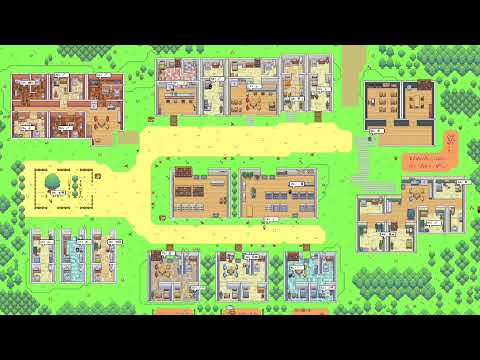
Generative Agents: Interactive Simulacra of Human Behavior (Park et al., Stanford). The memory stream, reflection and planning design that B1 builds on. Code

Genie 3 (Google DeepMind): a real-time interactive world model. Closed, but it sets the bar for what "a world from a sentence" means. Open alternatives: HY-World 2.0, awesome list.
Stanford CS25 V6: From Representation Learning to World Modeling. Background on JEPA-style world models for anyone thinking about Track B beyond the demo.
Inspiration posts (X)
three.js scene with AI-generated assets ·
digital human dancing to sound
Design prompts only; the posts were not independently verified.
World models in 2026 (X)
Genie 4 (DeepMind, Oct. 27, 2026: real-time steering by text, native audio; research preview) ·
Runway GWM Worlds 2 (720p, 24 fps, arbitrary actions) ·
PixVerse R2 (publicly playable) ·
DreamDojo (open source, robots) ·
Overworld (local-first, 60 fps)
Closed models set the bar; the open ones (DreamDojo, HY-World, V-JEPA 2) are what you can build on. Not independently verified.
AR/VR and three.js (X)
DecartXR: speak to restyle your room on Quest ·
Meta XR Operator lets agents test VR apps ·
ThreeUI: 160+ open three.js components ·
three.js Blocks: a 3D site or game from one prompt ·
three.js r183 tutorial for AI students ·
three.js at 11M downloads a week: the AI effect
Design prompts only.
Open 3D and world generation
TRELLIS.2 (MIT, image→GLB) ·
Hunyuan3D 2.1 ·
HunyuanWorld 1.0 ·
HY-World 2.0 (editable meshes / 3DGS) ·
World Labs World API (hosted)
Generated assets garble text, logos and faces; keep landmarks recognizable with hand-made signage.
Simulators and embodied benchmarks
AI2-THOR · Habitat 3.0 ·
ManiSkill · LIBERO ·
Genesis · MuJoCo ·
LeRobot
The course's Lecture 10 (Multimodal LLMs) covers the vision-language side.
More research questions in this area
- Viewpoint-dependent references. "The cup on my left" changes meaning with the camera. Measure how often a VLM resolves such references correctly from a fixed vs. a user-aligned view.
- Answer with geometric evidence. Make a 3D QA system cite the object and the measurement it used; score citation correctness separately from answer correctness.
- Adaptive screenshot cropping for GUI or 3D agents: does a model-chosen crop beat a fixed grid at the same token budget?
- Per-character event memory for NPCs: compare a flat log, a summarised memory, and a retrieval memory on dialogue consistency over long play sessions.
- Video captioning or editing with quality controls, from the multimodal research area: fix the clips and the rubric, vary the control mechanism.
Pitfalls we see every year
A beautiful scene with no held-out test. A single long play session reported as "it works". The acting model also grades the answers. Latency reported without the hardware.
Comparing an LLM NPC to a scripted one on tasks the script was never written for. Keep the environment small, the test set fixed, and the checker independent.
CGenerative AI for education, special audiences & human–AI interaction
Generation is cheap; faithful, useful generation is not. This track takes a concrete piece of teaching material (a textbook passage, one math concept, one molecule, one physics law) and builds a workflow that turns it into something a learner can watch, rotate, or experiment with: an English skit, an explanation video whose narration follows the diagram, an interactive 3D biology or physics scene. The research question is about source fidelity (does the output stay true to the material?), interaction (does the system know when to ask?) and transfer (can the learner apply the idea to a new case?). Human studies are welcome but optional; a scripted evaluation with a transfer quiz is enough for a strong report. Lecture 8 adds audiences beyond the classroom: young children, special groups, specific professions and majors, served by a content pipeline that is reusable by design and curated by hand (brief C9).
How to evaluate education projects without a classroom
Pair every generated artifact with (1) a fidelity check against the source (claims and target words mapped to passages), (2) a small blinded rubric for quality, and (3) a
transfer task on new material (a new sentence, a new graph, a different protein chain). Measure learning as transfer, not as "engagement". If you do recruit classmates, keep it
small, anonymous and free of sensitive data, and report the protocol.
Research questions this track asks
- Does a plan that first maps each target word and factual claim to the source produce more faithful and more usable dialogues than a direct script prompt?
- Does a structured storyboard that ties each narrated step to an equation and a visual event reduce narration–diagram mismatches in a math video?
- Does giving the model the learner's selected 3D component and structure annotations improve the correctness and evidence of its answers?
- Do typed simulator commands with trace-grounded explanations beat prompt-only interpretation for "change only the launch angle" requests?
- When should a tutoring assistant ask a clarifying question? Does an ask-when-triggered policy beat always-ask and never-ask on task success and questions asked?
- Do memory and reflection in an educational assistant change satisfaction or learning gain, or only the feeling of continuity?
- What moderation design keeps an LLM-simulated class forum civil without flattening disagreement?
- In a content pipeline for a specific audience, what does ten minutes of human curation per item add that automated checks do not, and which edits recur?
Featured briefs
C1Textbook passages as short English skits
Adapt one textbook passage into a 60–90 second dialogue that teaches four to six target words through context, then voice it with an open TTS model and, optionally, animate it. The Gaoyou duck-egg and WordsFunny posts are format references: a tiny story, a few characters, the words appearing naturally.
Comparea direct script prompt · a plan that maps each word and claim to the source before writing; same model, target words and running time.
Measurefactual fidelity to the passage, natural use of the words (blinded rubric), and whether learners can use the words in new sentences (transfer quiz).
Delivertwo versions of each skit, transcripts with source mappings, audio or video, and the quiz.
Week 1passage, word list, fidelity rubric
Week 2direct vs. planned pipeline, TTS
Week 3blind rating, transfer quiz
Week 4videos, write-up
Format references: Gaoyou duck egg · WordsFunny.
Tools: CosyVoice 3 (Apache-2.0, cross-lingual cloning) · IndexTTS 2 (emotion control) ·
Wan 2.2 or LTX-2 for clips ·
Remotion to assemble subtitles and scenes programmatically.
C2A math explanation video whose narration follows the diagram
Teach one concept, for example why a secant slope approaches the tangent slope. A single curve, two movable points and a line are enough. The variable is the storyboard: unconstrained, or structured so that each narrated step links to an equation and a visual event.
Compareunconstrained storyboard · structured storyboard, rendered with the same graphics and comparable running time.
Measuremathematical errors, narration–diagram mismatches (timestamped), and a transfer question on a new graph.
Delivertwo short videos, an editable storyboard, and the scoring rubric.
C3An interactive 3D biology lesson grounded in a molecular structure
Teach students to distinguish protein chains from bound ligands and to locate heme in hemoglobin (PDB 4HHB). Learners rotate the structure and ask "which heme is associated with this chain?". The model sees the lesson text in both conditions; only one condition also receives the viewer's selected component and structure annotations.
Comparelesson text only · lesson text + selected component and annotations, same model and queries.
Measurecorrect object identified, relevant structural evidence cited, and whether learners can locate the feature on a different chain.
Deliverone interactive molecule, annotated queries, a transfer task.
C4A language-controlled 3D physics experiment
Teach how launch speed and angle affect projectile range. One scene: a sphere, a ground plane, a trajectory trace. Learners request controlled changes, predict the outcome, run, and compare. Compare a prompt-only interpretation of requests with a model that issues typed commands and explains results from the simulator trace.
Compareprompt-only · typed commands + trace-grounded explanation, on paraphrased requests.
Measurevalid commands, experiments that change only the intended variable, explanation accuracy on unseen settings, a transfer question.
Deliverone scene, runnable experiment scripts, and a paraphrase evaluation set.
Start from: Web VPython (GlowScript) · or three.js with a hand-written integrator. Starter assets for other lessons:
a pendulum (pivot, rod, bob), or one model from NASA 3D resources with one measurable interaction. Keep asset sources and lesson assumptions in the README.
C5An AIGC-for-education workflow for one textbook unit, with reusable 3D assets
Pick one unit of a real textbook (one chapter of a middle-school science book, one lesson of an English coursebook) and build the pipeline from source to artifacts: a glossary, a short skit, a diagram animation, and one interactive 3D object generated once and reused across lessons. The research question is about the workflow: where does a source-mapping step pay for itself, and where does it not?
Comparepipeline with and without the source-mapping step, per artifact type.
Measurefidelity errors per artifact, generation cost, and a short transfer quiz per lesson.
Deliverthe workflow, a lesson pack, and a reusable asset library with provenance.
C6When should an assistant ask for clarification? adapted from Stanford CS329X
Pick one setting: 3D object selection (see B4), GUI actions, or document editing. Compare immediate execution, asking on every ambiguous case, and asking only when a defined trigger fires. Freeze the model, the task instances, and the information available before the decision.
Compareexecute · always ask · ask on trigger.
Measuretask success, questions asked, corrections; optionally a small human study on perceived helpfulness.
Delivera replayable task set and the comparison.
Start from: CS329X: Human-Centered LLMs (Diyi Yang) ·
Reflections and new directions for human-centered LLMs (the CS329X class paper) ·
Collaborative Gym.
C7Memory and reflection in an educational assistant
Build a tutoring assistant for one topic and vary only its memory: none, a running summary, or retrieval over past sessions plus a reflection step that updates a learner model. Script learners with known misconceptions so the evaluation is repeatable, then optionally run a small study.
Compareno memory · summary memory · retrieval + reflection.
Measuremisconceptions addressed, repeated explanations avoided, satisfaction (SUS/UMUX) and a learning-gain quiz if humans take part.
Deliverthe prototype, the scripted learner personas, and interaction logs.
Related: Generative Agents (reflection) · the Kaggle "root misconceptions in K–12 math solutions" task listed on ML Contests for data ideas.
C8An AI town or class forum: simulating group dynamics and moderation
Simulate a class forum with LLM personas and test moderation designs: none, rule-based, or an LLM moderator with a stated policy. The simulation is the test bed; the contribution is a replayable protocol and clear metrics for civility and diversity of opinion.
Comparemoderation designs on the same seeded discussions.
Measuretoxicity, participation balance, opinion diversity, moderator interventions, cost.
Delivera replayable simulation and the policy document.
Start from: AI Town · Generative agent simulations of 1,000 people.
C9A reusable AIGC content pipeline for K-12, special groups, or a profession, with a human in the loop
Most AIGC demos make one nice artifact. The useful research object is a pipeline that makes a hundred, plus the small manual step that turns the good ones into great ones. Choose one audience and one format: a picture book that explains AI to five-year-olds (a Lecture 8 "special topic"), audio-described science stories for blind pupils, simplified-Chinese safety cards for migrant workers, nursing-handover drills for nursing students, Cantonese-opera synopses for primary schools, or case vignettes for a specific major. Build the pipeline as a template (brief → outline → text → image/audio → checks) so a new topic takes minutes, then ask what the human curation step adds.
Comparefully automatic pipeline · pipeline + automated checks (reading level, source fidelity, safety) · pipeline + checks + 10 minutes of human editing per item, on the same 30 briefs.
Measurea blinded rubric scored by two people from the audience's world (a teacher, a parent, a nurse); reading-level and fidelity checks; cost and time per item; which edits humans make most (a taxonomy).
Deliverthe templated pipeline, 30 items in each condition, the rubric, the edit taxonomy, and a released content pack with provenance.
Week 1audience, format, 30 briefs, rubric
Week 2pipeline + automated checks
Week 3human-edit condition, blinded rating
Week 4content pack, write-up
Start from: happy-llm and Happy-Medical-AI (teaching content as open repos) ·
Bastani et al., PNAS 2025 (unguarded AI help can harm learning: design the checks accordingly) ·
image models: Qwen-Image, FLUX; TTS: CosyVoice 3 ·
accessibility references in Track G (G5) · posts on X: Gemini Live "Guided Vision" for blind users,
Visionauta, a free app by a blind engineer.
Watch, read, play
Generative Agent Simulations of 1,000 People: how interview-grounded personas were built and validated. Relevant to C7 and C8.
Stanford CS329X: Human-Centered LLMs (Diyi Yang, Fall 2026)
course site with public slides on human preferences, RLHF/DPO and design thinking ·
60-page class paper on design, data sourcing, training, evaluation and deployment
Suggested project categories there: apply an LLM to a real problem; new ways to use human feedback; fairness and bias; interactive systems; persona simulation.
AI tutors in 2026 (X)
StudentBench: AI and human tutoring yield equivalent GRE gains (n=2,383; paper, data on Hugging Face) ·
Harvard physics crossover study: AI tutor vs. active-learning class ·
Brilliant's Koji, a real-time STEM tutor ·
Aristotle: a tutor that refuses to give answers, and why that is a product bet
Read with Bastani et al. (PNAS 2025): AI help without guardrails raised practice scores and lowered exam scores.
Open generation stacks for lessons
TTS: CosyVoice 3, Qwen3-TTS, IndexTTS, Fish Speech (check licenses) ·
video: Wan 2.2, HunyuanVideo 1.5, LTX-2 ·
animation: Manim, Remotion, Motion Canvas
More research questions in this area
- Task-oriented UX for grounded report writing with inline citations: does showing the retrieved span next to the claim change how often users accept wrong claims? (overlaps with F1)
- How users interrupt a task: log interruption points in a long-running assistant and test two resumption designs.
- Pointing to resolve ambiguity in a 3D editor: compare language-only with language + pointer on the same ambiguous commands.
- Persona simulation for pilot studies: can simulated learners predict which of two explanations real learners prefer? Measure agreement on a small held-out set.
Pitfalls we see every year
Measuring "engagement" or "likes" instead of learning. Reporting a beautiful video with no fidelity check against the source. No transfer task, so there is no evidence of learning. Human studies that are
too small to say anything and too large to finish. Keep the artifact small and the comparison sharp.
DTrain your own model: vertical models, new modalities, nanoGPT experiments & internals
This is the track for teams who want to touch weights. The philosophy is borrowed from Stanford CS336 and from Tang Jie's Advanced Machine Learning course at Tsinghua: to understand it, build it. A 0.1B–0.5B language model trained from random weights is now a one-GPU, one-week exercise, and post-training with SFT, DPO or GRPO fits in a Kaggle session (see Tutorial 2). Two newer directions make the track more interesting than "train a small GPT": weight-space programming (a frontier model reading and editing a checkpoint directly) and mechanistic interpretability at scale (do sparse-autoencoder features have consistent causal effects?). Whatever you choose, change one thing at a fixed budget and plot the learning curve. Three briefs added this term follow Lecture 8 directly: a nanoGPT speedrun experiment in architecture engineering (D10), a vertical model built with the Tutorial 2 recipe (D11), and a new modality such as speech, bio-signals or time series (D12).
Compute reality check
A 0.1B model on 1–2B tokens trains in hours on one 24 GB GPU; 0.5B on a Chinchilla-style token budget needs several GPU-days. Establish throughput (tokens per second, peak memory) on the
small model first, then decide whether the 0.5B run is affordable. Free tiers: Kaggle (about 30 GPU hours per week, T4/P100), Colab; paid by the hour: AutoDL and cloud providers.
A report with a complete small-scale result beats an unfinished large one.
Research questions this track asks
- At a fixed token budget, what does one data intervention (deduplication, quality filtering, a code-to-text mixture change) do to held-out loss and a downstream task?
- Two model sizes at a matched approximate compute budget: which wins, and does the answer change with the data mixture?
- Can a frontier model repair a specified failure by editing a checkpoint directly, with a bounded edit budget and no gradients? How does the patch compare with a random edit of the same size and norm?
- Do SAE features that look interpretable on examples have a consistent causal effect across prompt templates, compared with random features and a neuron baseline?
- SFT vs. SFT + preference optimization on math or code: where does the extra stage help, and what does it cost?
- How much does a domain-adapted model forget, and does a small replay mixture fix it?
- How should a fixed LoRA parameter budget be allocated across layers?
- At matched wall-clock on your GPU, does one architecture or optimizer change from the nanoGPT speedrun changelog still help, and does the gain survive a change of scale?
- For a vertical domain, which post-training stage (continued pre-training, SFT, preference optimization, retrieval) buys the most at a fixed GPU budget, and are retrieval and training substitutes or complements?
- How should time-series or bio-signal data enter a frozen LLM: serialised text, a soft-prompt adapter or cross-attention, and which is most data-efficient on held-out subjects?
Featured briefs
D1From scratch to a 0.5B training experiment
Under a fixed token budget, compare random sampling with a single data intervention (deduplication, an educational-quality filter, a different code fraction), keeping architecture, tokenizer and optimizer fixed. Start with a small randomly initialized model to establish the learning curves, then run both conditions at 0.5B only if measured throughput and available compute permit.
Comparebaseline data vs. one intervention at the same token count, two seeds at the small scale.
Measureheld-out loss curves, one downstream task, measured tokens per second and peak memory.
Deliverconfigurations, matched checkpoints or logs, and a scaling note on what 0.5B would cost.
Week 1tokenizer, model, data loader; throughput
Week 2baseline run + intervention run (small)
Week 3seeds, downstream eval, optional larger run
Week 4curves, cost table, write-up
Start from: Chinchilla · nanochat (full pipeline, small budget) ·
CS336 assignment repos · FineWeb-Edu ·
datatrove for dedup and filtering.
D2Train and profile a small language model from scratch adapted from Stanford CS336
Follow the CS336 sequence: tokenizer, decoder, optimizer, training loop, all written by you. Then run a clean experiment: two model sizes at a matched approximate compute budget, or one throughput setting (sequence length, batch size, attention kernel, mixed precision) varied with the model held fixed.
Comparetwo sizes at matched compute, or one throughput knob.
Measureheld-out loss, actual tokens per second, peak memory, and the measured budget for any optional 0.5B run.
Deliverconfigurations, logs, a profiling summary.
Start from: CS336: Language Modeling from Scratch (Spring 2026 lectures on YouTube; Chinese subtitles on Bilibili, see below) ·
torch.profiler.
D3Reproduce a model result and test one data change adapted from Tsinghua AML (Tang Jie)
The Tsinghua course pairs implementation exercises (reproducing GLM-4-9B basics, fine-tuning plus RAG, visual LLMs, advanced reasoning) with a team research project. Reproduce a small published result with its configuration, then compare the original data with one deduplicated or quality-filtered variant. Keep tokenizer, architecture and token budget fixed.
Compareoriginal data vs. one filtered variant at the same budget.
Measurematched learning curves and a held-out comparison.
Deliverthe run configuration, curves, and a data card for the filtered set.
D4Weight-space programming: a language model reads and edits a checkpoint
Takehi, Teoh, Zhang and Khattab (MIT CSAIL, Nov. 2026) report that a frontier model can infer behaviour from raw weights and edit them to change it: identifying which game a PPO policy plays from its weights, fixing a Kinetix car policy by changing 3.5% of weights, and lifting Qwen3.5-0.8B from 7.9% to 48.1% on MATH-500 by editing 0.016% of its weights with 50 forward passes. The same method gave no gain on Gemma 3 270M. Replicate the idea at a scale you control.
Comparethe proposed patch vs. the original checkpoint vs. a random edit matched for parameter count and norm; add a simple task-specific repair baseline when one exists.
Measureheld-out task success, retention on unaffected cases, edit size, across seeds; log every forward pass used during editing.
Deliverone reproducible patch experiment on one model family (a tiny MLP or policy first; a small LM checkpoint is a stretch goal), with the exact tensor diff.
Week 1tiny model with a reproducible failure; edit interface
Week 2editing protocol with budget and dev set
Week 3baselines, seeds, retention
Week 4stretch: small LM; write-up
D5Mechanistic interpretability at scale: do SAE features have consistent causal effects?
Use released Gemma Scope sparse autoencoders to study one behaviour, such as copying a repeated sequence. Select features from activation examples on development prompts, then intervene on held-out prompts. The question is whether an explanation that looks right on examples survives a causal test across templates.
Comparefeature intervention vs. no-op vs. random features at matched magnitude vs. a simple neuron baseline.
Measurechange in target-token log odds, effects on unrelated prompts, results by template; two SAE widths at comparable sparsity only after the pipeline works.
Deliverthe intervention pipeline, feature lists, and per-template results.
Start from: Gemma Scope · Scaling and evaluating sparse autoencoders ·
SAELens · TransformerLens ·
the AIMO Interpretability Challenge (NeurIPS 2026) for a reasoning-model variant.
D6SFT vs. SFT + preference optimization on math or code
Start from the Tutorial 2 notebooks (SFT + reward model + PPO, GRPO with verifiable rewards, DPO) and turn one of them into a controlled study: same base model, same data budget, one extra stage.
CompareSFT only · SFT + DPO · SFT + GRPO at matched data and compute.
Measureaccuracy or Pass@k, instruction following, calibration, cost; and a small out-of-distribution set to see what each stage changes.
Delivertraining recipes, configs, seeds, learning curves.
D7Domain or low-resource language adaptation, with forgetting measured
Adapt a small model to a domain (medicine, law, a dialect) with a small curated corpus. The point is not the domain score alone but what is lost, and whether a replay mixture recovers it.
Comparebase · domain-adapted · domain-adapted with 10–20% replay of general data.
Measuredomain task gain, general-task regression, calibration.
Deliverthe recipe, data card, and a forgetting table.
D8Process rewards for stepwise reasoning
Train or prompt a step-level verifier and use it to re-rank or guide a small reasoning model. Compare outcome-only reward with process reward at the same number of labelled or generated examples.
Compareoutcome reward · process reward · both, same budget.
Measureaccuracy, verifier precision on held-out steps, cost per correct answer.
Deliverthe verifier, labelled steps, and the comparison.
Start from: Let's Verify Step by Step · DeepSeekMath (GRPO).
D9Where should a fixed LoRA budget go?
Given a fixed number of trainable parameters, compare uniform LoRA ranks with allocations that favour attention, MLP, or late layers; include LoRA vs. QLoRA vs. adapters under one evaluation protocol, as in the Tsinghua AML week-14 assignment.
Compareallocation schemes at equal parameter count.
Measuretask accuracy, memory, training time, variance across seeds.
Deliverconfigs and a results table.
D10A nanoGPT speedrun experiment: one architecture or optimizer change at a fixed budget
Keller Jordan's modded-nanogpt turned "train GPT-2 124M to 3.28 validation loss on FineWeb" into a public speedrun: 45 minutes in 2024, under two minutes by the end of 2025, about 40 seconds by August 2026, and a disputed 6.7-second entry in late October 2026 that uses n-gram hints built on idle CPUs. Every record is a documented change: the Muon optimizer, QK-norm, ReLU² MLPs, U-net skip connections, value embeddings, sliding-window FlexAttention, logit soft-capping, paired-head attention, fused Triton kernels. That changelog is a syllabus for architecture engineering. Pick one idea (or a new one from Lecture 4: MLA, gated linear attention, a hybrid Mamba block, nGPT normalisation, μP scaling), implement it in a single-GPU scaled-down version of the run, and measure it properly.
Comparethe current record script (scaled to your GPU and token budget) · the same script with your one change, at matched tokens and matched wall-clock, two seeds each.
Measurevalidation loss against tokens and against seconds, tokens per second, peak memory, and one downstream probe (HellaSwag or a small QA set); report whether the change helps at equal time, not only at equal steps.
Delivera pull-request-style diff, both learning curves, the hardware and timing protocol, and a note on whether the result should transfer to the 8×H100 setting.
Week 1reproduce the record at small scale; throughput
Week 2implement the change
Week 3matched-time runs, seeds, probe
Week 4curves, diff, write-up
Start from: modded-nanogpt (records and changelog) · nanoGPT and nanochat ·
Muon · Epoch AI record timeline ·
the n-gram-hint record and the rules debate · agents running the speedrun autonomously ·
records on X: 39.9 s → 6.7 s explained, paired-head attention,
a fused ReLU² Triton kernel, the medium track ·
Lecture 4: Transformer and beyond.
D11A vertical model with the Tutorial 2 recipe: continued pre-training, SFT, preference optimization, RAG
Lecture 8's first topic is the vertical LLM: medicine, law, finance, a trade, a university's own regulations. The four tools are continued pre-training on domain text, supervised fine-tuning on domain tasks, preference optimization (DPO or GRPO with a verifier), and retrieval. Tutorial 2 gives you the SFT, reward-model, PPO, GRPO and DPO notebooks on a 4-bit base with LoRA adapters; HuatuoGPT and HuatuoGPT-II are the lab's worked examples. The question is not "can we build one" but which stage buys what for your domain at a fixed budget.
Comparebase + RAG · SFT · CPT + SFT · SFT + DPO/GRPO, same base model, same held-out domain test, same GPU hours; add RAG on top of the best to see whether retrieval and training are substitutes or complements.
Measuredomain accuracy or rubric score, general-task regression (forgetting), hallucination rate on unanswerable questions, cost per stage.
Deliverthe recipe with configs, the domain test set with a data card, and a stage-by-stage table.
Week 1domain data, test set, base + RAG baseline
Week 2SFT, CPT runs
Week 3DPO/GRPO, forgetting checks
Week 4table, write-up
Start from: Tutorial 2 notebooks · HuatuoGPT, HuatuoGPT-II (one-stage domain adaptation) ·
ORLM (optimization modelling), GrammarGPT, RAG-Instruct (other lab examples from Lecture 8) ·
TRL · LLaMA-Factory · Lecture 9.
D12Teach an LLM a new modality: speech, bio-signals or time series through a small adapter
Lecture 8 (Topic 8) and Lecture 10 describe the recipe: a modality encoder, a small projector or cross-attention adapter, and an LLM that stays mostly frozen. The lab's Soundwave reached Qwen2-Audio quality on speech tasks with one-fiftieth of the data by adding a CTC alignment loss and better data engineering; OpenTSLM (Stanford, 2025) made 1B models reason over ECG, sleep and activity time series, beating GPT-4o on those tasks. The project: pick one signal type and one task family (speech commands, ECG rhythm QA, EEG sleep staging, accelerometer activity, sensor logs, stock or weather series) and ask how time should enter the model.
Comparetext-only baseline (numbers serialised as text) · soft-prompt adapter · cross-attention adapter, same frozen LLM and same training examples; ablate the alignment loss or the patch size.
Measuretask accuracy or F1 on held-out subjects (not held-out windows), data efficiency (curve over training-set size), and whether the model still answers text questions (retention).
Deliverthe adapter code, the subject-split evaluation, and the data-efficiency plot.
Week 1signal, task, subject split, text baseline
Week 2encoder + adapter v1
Week 3second adapter, data-efficiency curve
Week 4retention check, write-up
Start from: Soundwave (code, our lab) ·
OpenTSLM (checkpoints) · Time-LLM (ICLR 2024) ·
Chronos · ECG-FM · PhysioNet and MIMIC data ·
posts on X: an EEG foundation model on a $50 device, ECG-FM in JAMA Network Open ·
Lecture 10: Multimodal LLMs.
Watch, read, play
Stanford CS336 (Spring 2026), Lecture 1: Overview and Tokenization. Chinese subtitles: Bilibili (中英字幕); notes: cs336-blog.
Stanford CS25 V6: The Ultra-Scale Talk, scaling training to thousands of GPUs. Watch before claiming a multi-GPU run.
Tsinghua 高级机器学习 (Advanced Machine Learning), Tang Jie
2024 archive (HW1 reproduce GLM-4-9B basics; HW2 fine-tuning + RAG; HW3 visual LLMs; HW4 advanced reasoning; projects in reasoning, multimodal, recommendation, education, science, healthcare, business) ·
Fall 2026 edition (news): tokenizer and Transformer from scratch, a 0.1B model end to end, a hand-written Triton attention kernel, fitting a scaling law, LoRA/QLoRA/adapter comparison, and a long-horizon self-evaluating agent as the final deliverable.
Several of those assignments are briefs here: D1, D2, D9, H1, A5.
nanoGPT speedrun (X)
the 6.7-second record and the rules debate ·
39.9 s: a 65B-entry n-gram table, new softmax and optimizer ·
75.4 s from a faster ReLU² kernel ·
paired-head attention: 3% for zero parameters ·
why is this not fully automated yet?
Each record is one documented change at a fixed target: the discipline brief D10 asks for.
Bio-signals and time series (X)
an EEG foundation model paired with a $50 device ·
ECG-FM, 1.3M ECGs, JAMA Network Open ·
NeuroLM: bridging language and EEG ·
a one-lead wearable ECG foundation model
Evaluate on held-out subjects; window-level splits leak.
Weight-space programming
blog post · live demo · logs and code
Read the negative result on Gemma 3 270M as carefully as the positive one on Qwen3.5-0.8B.
Training stacks
nanochat · CS336 assignments · TRL · PEFT ·
verl · OpenRLHF · slime ·
lm-evaluation-harness
Pitfalls we see every year
Two things changed at once. Conditions compared at different token counts. A benchmark that overlaps the training data. One seed. "We trained a 0.5B model" with no throughput or cost numbers.
A learning curve that stops before the comparison is meaningful. Fix the budget, change one thing, show the curve.
EEvaluation: where frontier models still fail, rubrics & safety
Lecture 8's third topic is evaluation, and its list is still a good map of where the strongest models stumble: Chinese culture and idioms, regional stereotypes, sense-making, formal logic, humour, vision and speech, long context, emotional intelligence, multi-turn dialogue, ethics. In 2026 the twist is that the classic benchmarks are saturated and contaminated, so the valuable contribution is a small, fresh test where you can show a specific failure, scored in a way a reader can trust: executable checks, ground truth, or rubrics written by people who know the domain (HealthBench's 262 physicians are the template). The track also covers the safety side of evaluation: prompt injection in agents, detecting machine-written text, verifiers that accept unearned success. Pick one failure and one domain, and build the smallest evaluation that measures it.
Evaluation discipline
Include unanswerable and ambiguous cases, so abstention can be measured. Collect a human baseline from five to ten classmates; a benchmark without one cannot say "easy for humans". Audit a random
sample by hand and report agreement with the automatic metric. Never let the generator judge itself; if an LLM judge is unavoidable, use a different model and validate it against the audited sample.
Check for contamination by asking each model to continue a truncated item. Keep intermediate logs replayable.
Research questions this track asks
- On a fresh suite in one of the Lecture 8 areas (culture, humour, logic, EQ, dialect, multi-turn), where do three frontier models and one open model fail, and does the failure survive paraphrase and translation?
- Does a rubric judge agree with domain experts more than a holistic 1–10 judge, and do automatically generated rubrics close the gap with hand-written ones?
- Does a long-context evaluation that mixes "needle" retrieval with multi-step reasoning expose failures that needle tests alone miss?
- Do combined defenses (input sanitization + sandbox + policy model) reduce prompt-injection success in a web agent without blocking legitimate tasks?
- How separable are human-written, LLM-generated and LLM-refined texts, and which features survive a change of generator?
- Can a system tell whether an AI-written scientific statement faithfully reflects the evidence it cites?
- How often does an LLM verifier accept an unsupported success claim, and does the bias depend on who wrote the claim?
Featured briefs
E1A long-context evaluation that detects a specific failure
Design a small long-context suite where retrieval and reasoning are separable (find the facts; then combine them), run it across context lengths and models, and show which failure appears first.
Comparemodels or context lengths on the same suite; needle-only vs. needle + reasoning items.
Measureaccuracy by position and length, failure type, cost.
Deliverthe suite with seeds and replays.
Start from: LongBench · lm-evaluation-harness.
E2Combined defenses against prompt injection in a web agent
Take an agent benchmark with injected instructions in tool outputs and test defenses alone and combined: input sanitization, a sandboxed tool layer, a policy model that screens actions.
Compareno defense · each defense · combined, on the same tasks and attacks.
Measureattack success rate, benign task success (utility), false positives, cost.
Deliverthreat model, attack set, defense configs, results.
Start from: AgentDojo · Weak-to-Strong Jailbreaking.
E3Who wrote this? Detecting and attributing LLM-generated text
Two live or archived tasks fit: Kaggle's Name That LLM (identify which of 18 models wrote a passage; offline notebooks, nine-hour limit; entry Jan. 6, final Jan. 13, 2027) and NLPCC 2026 Shared Task 6 (three-way: human-written, LLM-generated, LLM-refined; Chinese news and academic text). Compare character n-grams with a small encoder on held-out prompts, and test transfer across generator families.
Comparen-gram features · a fine-tuned small encoder · an ensemble, with a held-out generator family.
Measurebalanced accuracy or macro-F1, confusion across families, robustness to paraphrase.
Deliverthe notebook, features, and a confusion analysis.
Start from: Name That LLM · NLPCC 2026 Task 6.
E4Reliability of AI-assisted scientific reporting
NLPCC 2026 Shared Task 10 asks: given scientific evidence and an AI-generated statement, does the statement faithfully reflect the evidence it summarizes or cites? Track 1 is claim-level faithfulness to experimental results; track 2 is citation-level faithfulness. The data and metrics are public; run it locally with your own comparison.
Comparea zero-shot judge · a judge with retrieved evidence spans · a fine-tuned classifier.
Measuresentence macro-F1 and paragraph exact match (track 1), label macro-F1 and Joint@3 (track 2).
Deliverthe system and an error analysis by claim type.
Start from: NLPCC 2026 Task 10.
E5Auditing verifier bias and unsupported success claims
Many agent results depend on an LLM verifier. Collect trajectories from one benchmark, have humans label success, and measure how often the verifier accepts unsupported claims ("I have fixed the bug") and whether its bias depends on the generator model or on the phrasing of the final message.
Compareverifiers (model, prompt, with/without execution evidence) against human labels.
Measurefalse-positive and false-negative rates, agreement, bias by generator.
Deliverthe labelled set and a verifier recommendation.
Related: Inspect AI · Predictive AI Evaluation Competition (NeurIPS 2026).
E6Steerability: does the model do what the instruction asked, and only that?
The NeurIPS 2026 Steerability Challenge measures whether a model can be moved to a requested target in a multi-dimensional output space without side effects. Build a small steerability suite for one domain (tone, length, reading level, citation style) and compare prompting strategies or a lightweight fine-tune.
Comparedirect instruction · decomposed instructions · a steering fine-tune.
Measuretarget attainment, side effects on untouched dimensions, consistency across seeds.
Deliverthe suite and results.
Start from: The Steerability Challenge · AlignBench (Chinese alignment evaluation).
E7Where do frontier models still fail? Build a small benchmark they cannot pass yet
Take one area from the Lecture 8 list (Chinese idioms and 歇后语, regional stereotypes, humour, formal logic, sense-making, EQ, speech or vision, long multi-turn dialogue, ethics) or one the 2026 leaderboards point to: tasks that are easy for people and hard for models (SimpleBench, ARC-AGI-3 interactive environments), predicting how specific cohorts behave (Kaggle's Human Behavior Bench), dialect speakers (Hofmann et al., Nature 2024), cross-cultural everyday knowledge (Naous et al., ACL 2024), long-horizon business tasks (Vending-Bench, TheAgentCompany). Write 100–300 fresh items with gold answers or rubrics, collect a human baseline, and run four models. The result is the failure taxonomy, not the leaderboard.
Comparethree frontier API models and one strong open model, with and without chain-of-thought, on the same items; the human baseline from 5–10 classmates; a paraphrased or translated copy of the suite to test robustness.
Measureaccuracy and calibration, agreement with humans, failure categories (knowledge, reasoning, instruction, refusal, format), contamination signal (can the model continue a truncated item?), cost per item.
Deliverthe dataset with a license and data card, the evaluation harness, the human-baseline protocol, and a one-page error analysis per model.
Week 1area, item template, 50 pilot items, human pilot
Week 2full suite, gold answers or rubrics
Week 3run models, human baseline, robustness copy
Week 4taxonomy, data card, write-up
Start from: the Lecture 8 slide lists Fresh bench, a speech-to-speech bench, OV-Odyssey, a user-centric benchmark, MedQA-pro, Patient-O1, Omni-Math, MileBench, MAMO, ACVA and MLLM-Bench as examples (search Google Scholar) ·
Humanity's Last Exam · ARC-AGI-3 · dialect prejudice (Nature 2024) ·
Having Beer after Prayer? (cultural bias, ACL 2024) · AlignBench (Chinese) ·
posts on X: Mollick on human baselines, Human Behavior Bench,
frontier models failing at nonlinear PDE solvers, expert re-grading: often the benchmark is broken, not the model,
contamination and "benchmaxxing".
E8Rubric-based evaluation: write rubrics, measure judge agreement, then use them as rewards
A rubric decomposes "is this answer good?" into criteria with points: HealthBench pairs 5,000 health conversations with 48,562 physician-written criteria and finds model–physician agreement close to physician–physician agreement. Rubrics then became rewards: Rubrics as Rewards (Scale AI, 2025) trains with checklist feedback beyond verifiable domains, Reinforcement Learning with Rubric Anchors scales rubric construction, OpenRubrics generates rubrics by contrasting preferred and rejected answers, and Checklists are better than reward models makes the case against scalar rewards. The 2026 follow-ups (ImpossibleRubrics, reward hacking in rubric RL) show what goes wrong. Pick one open-ended domain you can get two experts for (a medical sub-specialty, legal drafting, Chinese essay grading, code review comments, teaching feedback) and run the full chain.
Comparea holistic 1–10 judge · a judge with hand-written rubrics · a judge with automatically generated rubrics (contrastive generation), all on the same 100 responses from four models, against two expert raters; optionally use the best rubric as a reward for a short GRPO run (Tutorial 2) and check the policy on a held-out set.
Measureagreement with experts (Cohen's κ per criterion, Spearman overall), expert–expert agreement as the ceiling, discrimination between models, judge cost; for the RL step, held-out rubric score, a generic quality check, and any criterion the policy learned to game.
Deliverthe rubric set with authorship, the 100-response gold set, the agreement tables, and a list of criteria that judges apply inconsistently.
Week 1domain, 100 responses, expert recruitment
Week 2hand-written and generated rubrics; judges
Week 3expert ratings, agreement analysis
Week 4optional GRPO run; write-up
Rubric references: HealthBench (OpenAI, 2025; post) ·
Rubrics as Rewards · RL with Rubric Anchors · OpenRubrics (data) ·
Checklists are better than reward models · RubricHub · ImpossibleRubrics · Reward hacking in rubric-based RL ·
PaperBench (rubric trees) · Prometheus (ICLR 2024) and Prometheus 2 ·
MT-Bench / LLM-as-a-judge (NeurIPS 2023) · Fine-grained human feedback (NeurIPS 2023) · G-Eval ·
FLASK (ICLR 2024) · Rubric-based rewards for RL (overview).
Watch, read, play
Evaluation tooling
lm-evaluation-harness · Inspect AI ·
simple-evals (HealthBench graders) · LongBench · AlignBench ·
AgentDojo · OpenRouter for running many models through one API
Where models fail, 2026 (X)
benchmarks are losing their human baselines ·
Human Behavior Bench: fine on the average American, poor on specific cohorts ·
physics re-grading finds broken evaluations ·
what the weekly benchmark scores actually test ·
METR's task-horizon update
Design prompts only; not independently verified.
NeurIPS 2026 evaluation competitions
Steerability Challenge · Predictive AI Evaluation ·
QuantiPhy (quantitative physical reasoning for VLMs) · SimulacraBench (synthetic humanitarian surveys, closed evaluation)
Check each site for the submission date; the competition track meets Dec. 11–12.
Chinese shared tasks with public data
NLPCC 2026 shared tasks (Task 1 medical instructional video QA, Task 6 LLM-text detection, Task 9 AI Scientist Benchmark, Task 10 scientific reporting reliability) ·
CCKS 2026 evaluation tasks on Tianchi (cultural-tourism knowledge graph; LLM behaviour control)
Rubric reading list
HealthBench · Rubrics as Rewards · OpenRubrics ·
Checklists > reward models · Prometheus · MT-Bench ·
ImpossibleRubrics
The instructor's rubric survey groups these into evaluation, reward modelling, multi-aspect alignment, LLM-as-a-judge and constitutional methods; ask for it in office hours.
Course material
Lecture 8, Topic 3: evaluation ·
Lecture 9: Medical LLMs · Agentic Hospital (our lab)
More research questions in this area
- Speech and vision versions of a text failure: does the same model fail the same item when it is spoken or shown in a photo?
- EQ and multi-turn: a scripted user with a hidden emotional state; does the model notice, and does noticing change its answers?
- Memory compression in long conversations: what is lost first, facts or commitments?
- Risk, benefit and disclosure design in a regulated application: what must the interface say, and does saying it change user behaviour?
- Robustness under controlled input perturbations (typos, paraphrase, language mixing) for any system on this page.
Pitfalls we see every year
The same model generates and judges. No human baseline, so "hard" means nothing. No unanswerable questions, so abstention is never tested. Items copied from an existing benchmark, so contamination explains the result.
A rubric with twenty criteria and no inter-rater agreement. Audit a sample by hand and say how big it was.
FDatasets, corpora & evidence
Models come and go; a good dataset is cited for years. Lecture 8's fourth topic is dataset building, and each training stage wants a different artifact: documents for pre-training, instruction–response pairs for SFT, chosen/rejected pairs for preference optimization, prompts with verifiers for RL, trajectories for agents, rubrics for judges. This track also covers evidence: corpora whose every passage has provenance (source, date, version, span), retrieval pipelines that can show their work, and corpora that AI helped construct and that a verifier checked. The output is a released dataset or corpus with a data card, a loader, a validation script, and one experiment that shows what it changes.
Data discipline
Record the license of every source and respect it. Strip personal data and say how. Deduplicate against the evaluation sets you will use, and report the overlap you removed. Keep provenance per item (where it
came from, which prompt or person produced it, which checks it passed). Write the data card before the experiment, not after. A dataset nobody can load is not a deliverable; a validator that rejects malformed rows is.
Research questions this track asks
- At matched size, does a dataset built by your pipeline beat an existing public one for the same stage on a small model, and which step of the pipeline accounts for the difference?
- Does verifying each answer claim against a cited source span reduce unsupported answers at an acceptable cost in coverage?
- Which component of an agentic RAG pipeline (query planning, retriever ensemble, draft-and-critic, citation repair) moves groundedness most, per unit of latency?
- When should a system retrieve at all, and what happens with conflicting or stale sources?
- How much of an AI-synthesised corpus is wrong before verification, how much after, and does training or retrieving over it still help at matched tokens?
- Two deduplication or quality-filtering policies at the same output size: which yields the better downstream model, and what did each throw away?
Featured briefs
F1Auditable evidence chains for medical or legal QA
Choose one dated public medical guideline collection or one legal corpus. Build a replayable pipeline that records, for each claim, the retrieved passage, the document version, the exact supporting span, and the verifier's decision. Compare ordinary retrieval-augmented generation with the same retriever and model plus span verification and abstention.
CompareRAG · RAG + span verification + abstention, same retriever and model.
Measurespan recall, claim support, citation completeness, error rate among answered questions, coverage; on 50–100 held-out questions including ambiguous and unanswerable ones; manual audit of a sample.
Delivera source-inspection demo using public evidence and offline scenarios.
Week 1corpus, 50–100 questions, baseline RAG
Week 2span verifier + abstention
Week 3matched runs, manual audit
Week 4inspection demo, write-up
Start from: ALCE · LegalBench-RAG ·
clinical guideline QA benchmark · our lab's HuatuoGPT-II and
Lecture 9.
F2An agentic RAG pipeline with a regression suite
Implement the workflow pieces one at a time: query planner (decomposition), retriever ensemble, draft and critic, citation repair; then a regression suite of gold questions over a versioned corpus so that every change is measured. The research result is an ablation across components.
Compareclassical RAG vs. each added component, at matched latency where possible.
Measuregroundedness, citation correctness, regression pass rate, end-to-end latency.
Deliverthe pipeline, the suite, and the ablation table.
F3Retrieval triggers, conflicting sources, stale documents
Construct a corpus with deliberate version conflicts (an old and a new guideline) and questions whose answers changed. Test when the system retrieves, how it resolves conflicts, and whether it reports the version it used.
Comparealways retrieve · retrieve on uncertainty · retrieve with version-aware ranking.
Measurecorrect-version rate, conflict detection, unnecessary retrievals, latency.
Deliverthe versioned corpus and the test set.
F4A reproducible data pipeline with deduplication and quality scoring
Build a web or text cleaning pipeline (extraction, language ID, deduplication, quality scoring, PII and toxicity checks) and evaluate the choices downstream on a small training run or an existing model's fine-tune. Alternatives from the research area: construct a small preference dataset and study its effect on instruction following; compare synthetic vs. curated human data for one task; select the hardest SFT examples; audit train–test overlap.
Comparetwo deduplication or filtering policies at the same output size.
Measurecoverage and quality scores, downstream gain, PII and toxicity leakage.
Deliverscripts, data cards (sources, licenses, risks), ablations.
F5Build and release a training dataset for one stage, in the format that stage expects
Choose the stage first, because the format and the quality checks follow from it. Then choose a domain or audience nobody has covered well (a Chinese dialect, a vocational trade, a university's regulations, a hospital department's FAQs, a game engine's API, your own course's lecture notes) and build 2k–50k items with provenance. The Lecture 8 examples from the lab are Huatuo-26M, MedPajama and VLFeedback; the 2026 open releases to imitate are Tulu 3, HelpSteer, DAPO-Math and the K2 Horizon data drop. Validate the dataset by training: a small model on your data against the same model on an existing dataset of the same size.
| Stage | Row format | Quality checks that matter | Public examples |
|---|---|---|---|
| Pre-training / continued pre-training | One document per row: {text, source, url, date, license} | Language ID, exact + near deduplication, quality classifier, PII removal, contamination against eval sets, mixing ratios | FineWeb-Edu, Dolma, Nemotron-CC |
| SFT | {messages: [{role, content}, ...]} with a chat template; or prompt/response pairs | Response correctness, instruction diversity (taxonomy), length balance, decontamination, licence of the teacher model's outputs | Tulu 3 SFT, Magpie, Huatuo-26M |
| Preference (DPO, reward model) | {prompt, chosen, rejected} or ranked lists with rater IDs and rationale | Inter-rater agreement, position and length bias, rubric used, where the pairs came from | HelpSteer2, UltraFeedback, VLFeedback |
| RL with verifiable rewards | {prompt, answer, verifier} where the verifier is code or an exact-match rule | Verifier precision on a hand-checked sample, difficulty spread, no leakage from eval, unambiguous answers | DAPO-Math-17k, SWE-Gym |
| Agent trajectories | Prompt + tool schemas + turns of {action, observation} + outcome label | Executable replay, outcome verified by tests, failure cases kept, environment version pinned | ToolBench, SWE-smith |
| Rubric / judge data | {prompt, response, rubric: [{criterion, points, met}]} | Who wrote the criteria, agreement between judges, criteria that never fire | HealthBench, OpenRubrics |
Compareyour dataset vs. an existing dataset of the same stage and size, same base model and training recipe; plus an ablation that removes your main quality check.
Measuredownstream task score, contamination rate, validator rejection rate, cost per item, and a data-card checklist score (sources, licenses, risks, intended use).
Deliverthe dataset on Hugging Face with a card, the generation and validation scripts, and the matched-size comparison.
Week 1stage, domain, format validator, 500-item pilot
Week 2scale to the full set; checks
Week 3matched-size training comparison
Week 4card, release, write-up
Start from: datatrove · Dolma toolkit · dataset cards ·
synthetic data for instruction tuning · K2 Horizon's open pre- and post-training data pipelines (Oct. 2026) ·
Tutorial 2 for the training check.
F6An evidence-based corpus for RAG, and an AI-built corpus with a verifier
Lecture 8 asks you to "replicate OpenEvidence": a medical answer engine whose every sentence points at a guideline or trial. Part one builds the corpus such a system needs, in a domain you can access: one society's guidelines, a university's regulations, a city's public-health notices, a game's wiki. Every chunk carries source, date, version and section, and a question set with gold evidence spans measures retrieval. Part two asks whether AI can construct corpus text: rephrase documents into textbook style (Nemotron-CC, Cosmopedia), synthesise documents from a knowledge graph (EntiGraph), or let an agent build data (Meta's Autodata, the Hugging Face synthetic-data playbook), with a verifier that checks every generated claim against the source corpus.
Compareraw corpus · raw + AI-rephrased · raw + AI-synthesised without verification · the same with the verifier, at matched tokens; evaluated as a RAG knowledge base (and optionally as continued pre-training data).
Measureretrieval recall of gold spans, grounded answer accuracy, unsupported-claim rate, synthetic-claim error rate before and after verification, cost per thousand tokens produced.
Deliverthe corpus with provenance, the question set with evidence spans, the verifier, and the four-condition table.
Week 1sources, chunking with metadata, 100 questions with spans
Week 2rephrasing and synthesis pipelines
Week 3verifier; four-condition RAG runs
Week 4error analysis, release, write-up
Start from: OpenEvidence (the target) · Cosmopedia ·
Nemotron-CC synthetic rephrasing · EntiGraph: synthetic continued pre-training ·
posts on X: the Hugging Face synthetic-data playbook (90 experiments, 1T tokens), Meta's Autodata: an agent as data scientist,
the lineage of synthetic data · ALCE for citation evaluation · pairs with F1.
Watch, read, play
Data tooling
datatrove · Dolma · NeMo Curator ·
distilabel (synthetic data and feedback pipelines) · GraphRAG · DSPy ·
LangGraph · Tutorial 4 (RAG and agent development, Nov. 13)
Data releases and pipelines, 2026 (X)
K2 Horizon: 13T pre-training tokens and the generation pipelines, open ·
Hugging Face synthetic-data playbook ·
Meta Autodata ·
on the lineage of synthetic data ·
IrokoBench: human-translated benchmarks for 16 African languages ·
CulturaX, 167 languages
Design prompts only; not independently verified.
Lab datasets to study
Huatuo-26M · VLFeedback ·
BlendNet (CAD scripts) · FreedomIntelligence on Hugging Face
Read their data cards and ask what you would add.
More research questions in this area
- Better retrievers for one domain (AI for math, a legal code): do synthesised hard negatives improve a small embedding model more than more positives?
- Hallucination detection and warning at the sentence level: which signal (retrieval disagreement, self-consistency, entropy) warns earliest at a fixed false-alarm rate?
- Scene constraints and collisions as an evaluation corpus for 3D editors (pairs with B5).
- Selecting the hardest SFT examples: does training on the 20% the model gets wrong beat training on all of them at matched steps?
- Auditing train–test overlap in a popular public dataset and publishing the cleaned split.
Pitfalls we see every year
A dataset with no license and no provenance. Teacher-model outputs released under a licence the teacher forbids. Synthetic text that nobody checked, so the "improvement" is contamination.
A citation metric that checks format, not support. Keep the validator, the card and the overlap report in the repository.
GAI for society: position papers, audits & interventions
AI is reshaping work, language, education and public services faster than the evidence can keep up. This track asks you to take a clear position on one question about that future and to back it with a measurement you ran yourself. The questions Lecture 8 raised are the ones below: does AI widen gender inequality; does it reduce the voice of minority languages and dialects; does it cut or extend the welfare of people with disabilities; does it leave the Global South behind; does it concentrate wealth or spread productivity? The deliverable can be a position or perspective paper in the style of the ICML and NeurIPS position tracks (a claim, the evidence for and against, the alternative views, and what should change), an audit study with a controlled design, or an intervention that measurably helps a group. All three are graded on the same thing: a falsifiable claim and an honest test of it.
What a position paper needs
A one-sentence claim that someone could disagree with. The strongest version of the opposing view, stated fairly. Evidence from the literature, organised by theme rather than listed (the "related work is not a
shopping list" rule from the writing tips). One piece of evidence you produced: an audit, a replication, a survey, a cost calculation. A concrete recommendation with who should act.
ICML's position track asks reviewers to judge "is the argument well-supported and does it advance the discussion?", not "is the method novel?".
Reading by question top-venue starting points
| Question | Papers to start from | What you could measure |
|---|---|---|
| Gender inequality | Wan et al., EMNLP Findings 2023 (gender bias in LLM-written reference letters) · Blodgett et al., ACL 2020 (what "bias" in NLP means) · UNESCO 2024 (bias against women and girls in LLMs) · Bolukbasi et al., NeurIPS 2016 · Caliskan et al., Science 2017 | Recommendation letters, hiring summaries, salary advice or career suggestions generated for matched male/female personas in Chinese and English; who gets "warm" and who gets "competent". |
| Minority languages and dialects | Hofmann et al., Nature 2024 (dialect prejudice in decisions) · Ahia et al., EMNLP 2023 (do all languages cost the same?) · Joshi et al., ACL 2020 (the state and fate of linguistic diversity) · Blasi et al., ACL 2022 (systematic inequalities across languages) · Naous et al., ACL 2024 (cultural bias) · Nekoto et al., Findings 2020 (Masakhane participatory research) · NLLB Team, Nature 2024 | Token cost, latency and accuracy for 粤语, 闽南语, 藏语, 维吾尔语, 壮语 or your hometown dialect against Mandarin and English; whether a model's advice changes when the same question is asked in dialect. |
| People with disabilities | Gadiraju et al., FAccT 2023 (disability-centred perspectives on LLMs) · Hutchinson et al., ACL 2020 (social biases as barriers) · Glazko et al., FAccT 2024 (disability bias in GPT-based resume screening) · ASSETS 2024 (how users with disabilities use chatbots) · Be My AI and Gemini Live Guided Vision as the benefit side | Resume screening with and without a disability-related award; image descriptions rated by blind users; sign-language or dysarthric-speech recognition accuracy against typical speech. |
| The Global South | Sambasivan et al., FAccT 2021 (re-imagining algorithmic fairness in India) · Mohamed, Png & Isaac, 2020 (decolonial AI) · Ahia et al., Findings 2021 (the low-resource double bind) · Durmus et al., 2023 (GlobalOpinionQA) · Santurkar et al., ICML 2023 (whose opinions do LMs reflect?) · Kapoor et al., ICML 2024 position (open foundation models) | Health, agriculture or legal advice for a Kenyan, Bangladeshi or Peruvian user versus a Californian one, scored by people from each place; which countries' sources a model cites. |
| Wealth, work and inequality | Eloundou et al., Science 2024 (GPTs are GPTs) · Noy & Zhang, Science 2023 (productivity effects) · Brynjolfsson, Li & Raymond, QJE 2025 (generative AI at work: novices gain most) · Brynjolfsson, Chandar & Chen, 2025/26 (early-career employment in exposed jobs) · Humlum & Vestergaard, NBER 2025 (small labour-market effects so far) · Anthropic Economic Index · Bastani et al., PNAS 2025 (AI without guardrails harms learning) · Doshi & Hauser, Science Advances 2024 (creativity up, diversity down) | Who gains from an AI assistant on a real task: novices or experts, in your own class; whether AI-written outputs converge on the same ideas; task exposure of the jobs your classmates want. |
| Pluralism and whose values | Sorensen et al., ICML 2024 position (a roadmap to pluralistic alignment) · Bender et al., FAccT 2021 (stochastic parrots) · Weidinger et al., FAccT 2022 (taxonomy of risks) · Kirk et al., Nature MI 2024 (personalised alignment) · Kleinberg & Raghavan, PNAS 2021 (algorithmic monoculture) · Costello et al., Science 2024 (AI dialogues reduce conspiracy beliefs) | Whether alignment reduced the diversity of opinions a model will voice; whether a model persuades students in your class on a contested campus issue, and how durably. |
Research questions this track asks
- Does the same request, asked by matched personas that differ only in gender, dialect, disability or country, get systematically different answers, and does the difference survive a change of model and language?
- How much more do speakers of a Chinese dialect or a minority language pay in tokens, latency and errors for the same service, and does a tokenizer or prompt intervention close the gap?
- Who gains more from an AI assistant on a real task, novices or experts, and does the gain persist when the assistant is removed?
- Does an accessibility feature built on a multimodal model (image description, speech for dysarthric users, sign-language glossing) help the intended users on tasks they chose?
- Which of a model's answers would change if it were trained or retrieved on sources from the Global South, and can you show it with a small retrieval intervention?
- When a position paper argues from the literature, which claims are supported by replicated evidence and which rest on a single study?
Featured briefs
G1A position paper with an audit behind it: "AI will widen (or narrow) X unless Y"
Choose one of the six questions above and write a six-page position paper in the ICML position-track format: claim, context, evidence organised by theme, the best counter-argument, and a recommendation. The course adds one requirement: at least one section reports a measurement you ran (a small audit from G2–G6, a replication of a published finding on a current model, or a survey of 30 classmates). Models change every quarter, so a replication of a 2023–2024 finding on 2026 models is itself a contribution.
Compareyour claim against its strongest alternative, using the literature plus your own measurement; for the replication option, the original paper's effect against the same probe on two 2026 models.
Measureeffect size and confidence interval of your probe; coverage of the literature (how many of the key papers you engage with); whether the recommendation is actionable (who, what, by when).
Deliverthe paper, the probe's code and data, and a one-page "if I am wrong" section listing what evidence would change your mind.
Week 1claim, counter-claim, reading plan
Week 2probe design and data collection
Week 3analysis; draft argument
Week 4revise against the counter-argument; poster
Start from: ICML call for position papers · Sorensen et al. and Kapoor et al. as model position papers ·
International AI Safety Report 2026 for the state of the evidence · the writing tips.
G2Do all languages cost the same? A dialect and minority-language audit of 2026 models
Ahia et al. (EMNLP 2023) showed that speakers of many languages pay more tokens for worse results; Hofmann et al. (Nature 2024) showed that models judge people more harshly when they write in African American English. Replicate both designs for languages close to you: 粤语, 闽南语, 客家话, 藏语, 维吾尔语, 壮语, or a Southeast Asian language, against Mandarin and English. Use matched-guise probing: the same content, two language varieties, and decisions (job, credit, medical urgency) that should not change.
Comparefour models (two API, two open) on matched content across varieties; a tokenizer-level intervention (byte-fallback, vocabulary extension) or a prompt-level one (translate-then-answer) as the fix condition.
Measuretokens per sentence, latency and price per task, task accuracy, and the decision gap between varieties with confidence intervals; agreement of two native-speaker raters on answer quality.
Deliverthe parallel probe set with native-speaker validation, the audit scripts, and a cost-and-quality table per variety.
Start from: Ahia et al. · matched-guise probing code · Petrov et al., NeurIPS 2023 (tokenizers introduce unfairness) ·
AceGPT (our lab: vocabulary expansion and native alignment for Arabic) · IrokoBench as a format reference · pairs with D7.
G3Matched-persona audits: gender and disability in generated decisions and recommendations
Generate the texts that shape people's lives (reference letters, resume screens, performance reviews, loan explanations, career advice, triage notes) for personas that differ only in gender or in a disability cue, in Chinese and English. Wan et al. found "warm" language for women and "competent" language for men in LLM-written letters; Glazko et al. found resumes with a disability-related award ranked lower. Check whether 2026 models still do this, whether the pattern differs by language, and whether a mitigation (a rubric in the prompt, a critique pass) removes it without flattening everything.
Comparematched personas across three models and two languages; baseline prompt vs. a rubric-guided prompt vs. a critique-and-revise pass.
Measurelexical measures (warmth/competence, agentic/communal), ranking gaps, length and hedging differences, with bootstrap confidence intervals; a blinded human rating of a sample.
Deliverthe persona templates, the generated corpus, the analysis notebook, and a mitigation recommendation with its side effects.
Start from: Wan et al. · Glazko et al. · Gadiraju et al. ·
Blodgett et al. (define the harm before you measure it) · pairs with E8 for the rubric.
G4Who gains? Novices vs. experts with an AI assistant on a real task, and what remains when it is removed
Brynjolfsson, Li and Raymond (QJE 2025) found that customer-support novices gained most from an assistant; Bastani et al. (PNAS 2025) found that high-school students who practised with unrestricted GPT-4 scored lower when it was taken away, while a tutor-style version with guardrails did not hurt. Run a small version in your own cohort: one task (debugging, data analysis, a translation, a proof), two assistant designs, and a follow-up without the assistant.
Compareno assistant · unrestricted assistant · a guardrailed assistant that explains but does not solve, between participants matched on a pre-test; a delayed post-test without any assistant.
Measuretask score and time with the assistant, post-test score without it, the novice–expert gap in both, self-reported reliance; keep n small (20–40) and report confidence intervals honestly.
Deliverthe protocol (pre-registered in your proposal), anonymised data, the analysis, and a note on what you would need to make the result reliable.
Start from: Generative AI at Work · Bastani et al. (data) ·
Noy & Zhang · StudentBench · follow the ethics guidance in the FAQ.
G5An accessibility intervention, evaluated with the people it is for
The benefit side of the disability question: multimodal models now describe images, read documents aloud, transcribe atypical speech and gloss sign language. Build one narrow tool with an accessibility organisation or a classmate who needs it, and evaluate it on tasks the users choose, not on a generic benchmark. Candidates: image descriptions for campus notices and lecture slides; a reading assistant for dyslexic students; speech recognition tuned to one dysarthric speaker; a Chinese Sign Language glossing aid; a plain-language rewriter for government forms.
Comparethe off-the-shelf model · your adapted or prompted version · the user's current workaround, on 20–30 user-chosen tasks.
Measuretask completion and time, error types that matter to the user (a missed warning is not the same as a missed adjective), satisfaction, and cost; with consent and anonymity throughout.
Deliverthe tool, the user-chosen task set, the evaluation protocol, and a short account of what the users said that the metrics missed.
Start from: how users with disabilities use chatbots (ASSETS 2024) · Whisper and Qwen3-VL ·
posts on X: Guided Vision in Gemini Live, ESP32 smart glasses from Kano, Nigeria, Visionauta ·
pairs with C9.
G6Whose knowledge? A Global South audit with a retrieval intervention
Ask practical questions (a fever in a child, a crop disease, a tenancy dispute, a scholarship deadline) as a user in Nairobi, Dhaka, Lima, Lagos and Lanzhou, and compare the answers with those for a user in San Francisco: which sources are cited, which institutions are assumed, how often the advice is wrong or unusable locally. Then test the smallest fix: retrieval over local sources (ministry guidelines, local-language news, regional NGO documents) in front of the same model.
Comparethe bare model · model + retrieval over local sources · model + retrieval over global sources, for each location, same questions and model.
Measurelocal correctness and usability rated by people from each place, source provenance (country of origin of cited sources), refusal and hedging rates, cost.
Deliverthe question set, local source corpora with licenses, rater protocol, and a provenance map of who the model listens to.
Start from: Sambasivan et al. · GlobalOpinionQA · Santurkar et al. ·
the low-resource double bind · pairs with F6 for the evidence corpus.
Watch, read, play
Position-paper venues and examples
ICML position papers (since 2024) · NeurIPS position papers (since 2025) ·
ACL theme tracks · FAccT, CHI and ASSETS for audits with people · Science, Nature and PNAS for the economics and the large experiments
Read two accepted position papers before writing one; note how each states its claim in the title.
Economics of AI, current
Canaries in the Coal Mine (Aug. 2026 revision: early-career employment in exposed jobs about 19% below trend, experienced workers flat) ·
Anthropic Economic Index · Humlum & Vestergaard ·
International AI Safety Report 2026
Accessibility in 2026 (X)
Google's Guided Vision for blind and low-vision users ·
AI smart glasses built on an ESP32 in Kano ·
Visionauta, by a blind engineer ·
Seeing AI
Design prompts only; not independently verified.
Course and lab material
TA Rao Siqi's research direction is responsible AI and human value alignment; TA Liang Juhao works on multilingual models · AceGPT (Arabic localisation, NAACL 2024 and NeurIPS 2024) ·
Lecture 8, Topic 6: adapt an LLM to a new language
Pitfalls we see every year
A position paper with no position. An audit with ten prompts and no confidence intervals. "Bias" measured without saying what harm it causes to whom (read Blodgett et al. first). A human study with sensitive data and
no consent. Claims about "the Global South" tested only in English. State the claim, measure it, report the interval, and say who should act.
HEfficiency, serving, on-device & GPU kernels
Inference is where most of the compute in the world now goes, and it is a track where a single GPU and a careful measurement protocol produce publishable numbers. Projects here study a systems trade-off: kernel generation with feedback, scheduling short and long requests together, quantization, speculative decoding, or edge deployment. Fix the workload and the measurement protocol before comparing methods; report latency distributions, not averages; and check correctness on fresh inputs, because a fast wrong kernel is the most common result in this area (the KernelBench-Verified paper is required reading on why reported speedups often evaporate). Two additions this term: an on-device protocol for phones and laptops (brief H8), and an evolutionary, RSI-style loop that optimises your own kernel or configuration under a sealed test (H9).
Measurement protocol
Warm up, synchronize, repeat; report median and 95th percentile; pin the GPU clock or report its state; log the driver, CUDA and library versions; compare against both eager PyTorch and a compiled
baseline where supported. Record power with
nvidia-smi if you report energy. Keep the replay script in the repository.Research questions this track asks
- On a fixed KernelBench subset, does iterative repair with compiler, correctness or profiler feedback beat independent candidates at a shared generation budget, and how many results are both correct and faster than each baseline?
- Which batched-token budget meets a stated time-to-first-token target at each request rate for a mixed short/long workload?
- Under identical prompts, how do serving engines differ in throughput, p50/p95 latency and energy per token?
- What accuracy does quantization or distillation cost on the tasks you care about, and where does it break first?
- How does speculative decoding's acceptance rate, and therefore its speedup, vary across domains and draft models?
- Can a real-time pipeline run on a laptop or phone with a bounded memory budget, and what is dropped to get there?
- On a phone, which runtime, quantization and drafting setting meets a stated latency target, and what does each cost in accuracy and energy?
- When an evolutionary agent optimises a kernel or a serving configuration, how much of the measured gain survives a sealed held-out test, and what did it try to game?
Featured briefs
H1Feedback for GPU kernel generation on KernelBench
KernelBench asks a model to replace a PyTorch reference module with a faster kernel: level 1 single operators, level 2 fused operators, level 3 full architectures. Pick a fixed subset and compare independent candidates with iterative repair that receives compiler errors, correctness failures on fresh inputs, or profiler traces, under a shared generation budget.
Compareindependent sampling · repair with error feedback · repair with profiler feedback, same budget.
Measurecorrectness on fresh inputs, compilation time (separately), speedup against eager and compiled PyTorch, fraction of tasks both correct and faster than each baseline.
Deliverthe harness, generation traces, and the per-task table.
Week 1install, reproduce one level-1 task end to end
Week 2feedback loop variants
Week 3run the subset, fresh-input checks
Week 4profiles, table, write-up
Start from: KernelBench · KernelBench v0.1 ·
KernelBench-Verified · TritonBench ·
GPU MODE lectures · for Ascend NPUs: CANN Bench.
H2Serving short and long requests together
Replay a mixed workload (short interactive requests, long prompts) on one model and one GPU. Vary the serving engine's batched-token budget and other scheduler knobs, and measure what each setting does to the two populations.
Comparescheduler settings on the same arrival trace.
Measuremedian and p95 time to first token, inter-token latency, throughput, by request class.
Delivera replay script and a note on which settings meet a stated latency target at each request rate.
H3Engine comparison under identical prompts, with energy
vLLM, SGLang, llama.cpp (and TensorRT-LLM if available) on the same model, prompts and hardware. The contribution is a careful protocol and an honest table, including joules per token.
Compareengines and their default vs. tuned settings.
Measuretokens per second, latency distribution, power and energy per token, output equivalence.
Deliverbench harness, profiles, tuning guidelines.
H4What quantization and distillation cost
Quantize one model with two or three backends (AWQ, GPTQ, FP8) and optionally distil a smaller student; measure accuracy deltas on tasks that matter (long-context, math, code) rather than only perplexity. Pruning variants: LLM-Pruner, ShortGPT.
Compareprecision levels and backends at matched memory.
Measureaccuracy deltas per task, memory, throughput, where it breaks first.
Deliverrecipes and a break-point table.
H5Speculative decoding across domains
Measure acceptance rate and wall-clock speedup of speculative decoding (EAGLE-style or n-gram drafts) on code, chat, and long-form writing, with the same target model.
Comparedraft strategies and draft sizes.
Measureacceptance rate, speedup, output equivalence, memory.
Delivera benchmark script and a per-domain table.
Start from: EAGLE · vLLM speculative decoding.
H6An edge real-time pipeline with limited memory
Run a small model (ASR + LLM, or a VLM) on a laptop or phone under a stated memory budget and latency target. The research question is what to drop (precision, context, model size) and what it costs.
Compareconfigurations under the same budget.
Measureend-to-end latency, memory, accuracy on a fixed task set, battery or power if possible.
Delivera runnable app and the trade-off table.
H7Prefix-cache reuse for agent workloads
Agent loops resend long, mostly identical contexts. Measure how much prefix caching and context layout (stable system prompt first, tool results last) save in an agent trace replay, and what it does to latency under concurrency.
Comparecaching on/off and two context layouts on the same replayed traces.
Measurecache hit rate, prefill tokens, time to first token, throughput.
Deliverthe replay and a layout recommendation.
Start from: vLLM automatic prefix caching · context engineering for agents.
H8An on-device benchmark: measure, then improve, a small model on a phone or laptop
Gemma 4 E2B (2.3B effective, audio and vision input, Apache-2.0) runs on an iPhone 17 Pro at roughly 40 tokens per second with MLX; Qwen3-0.6B/1.7B, SmolLM3 and Liquid's LFM2.5 are the other usual suspects. The research question is a protocol, not a demo: on your device, which runtime, quantization, context length and speculative-decoding setting meets a stated latency target, and what does each setting cost in accuracy and battery? A fixed task set (50 prompts: QA, summarisation, a tool call, one image) and a fixed measurement script make the numbers comparable across teams.
Compareruntimes (llama.cpp, MLC-LLM, ExecuTorch, MNN-LLM, MLX, Android AICore) · quantization levels (Q8, Q4, 2-bit) · with and without speculative or n-gram drafting, on the same model and prompts.
Measuretime to first token, decode tokens per second, peak memory, energy per 100 tokens (battery API or a USB power meter), accuracy on the task set, thermal throttling over a 10-minute run.
Delivera measurement script anyone can run on their phone, the trade-off table, and a recommended configuration per latency target.
Week 1task set, measurement script, one runtime
Week 2other runtimes and quantizations
Week 3speculative decoding, energy, throttling
Week 4table, recommendation, write-up
Start from: llama.cpp · MLC-LLM · ExecuTorch ·
MNN-LLM · MLX · Gemma 4 in Android AICore ·
Gemma 4 E2B/E4B · posts on X: Gemma 4 on an iPhone at 40 tok/s,
M5 Max community benchmarks vs. the "4×" claim, LFM2.5-2.6B, an agentic on-device model,
the local LLM playbook (Raspberry Pi to RTX 5090) · mllm-NPU for NPU prefill.
H9Let an evolutionary agent (RSI-style) optimise your kernel or serving config, under a sealed test
DeepMind's AlphaEvolve (May 2025) and its open-source counterpart OpenEvolve run a loop: an LLM proposes code edits, an evaluator scores them, a database keeps the best diverse programs, and the loop continues for hours. OpenEvolve's Metal-kernel experiment reported a 12.5% attention speedup on Apple silicon; Sakana's "AI CUDA Engineer" is the cautionary tale, where the loop found a way to cheat the benchmark. Apply the loop to one efficiency target you own, such as a Triton kernel from H1, a llama.cpp or vLLM configuration from H2/H3, or the on-device settings from H8, and measure whether the gains are real on inputs the loop never saw.
Compareexpert-tuned baseline · independent LLM proposals (same number of evaluations) · the evolutionary loop, with the evaluator seeing only the development inputs; a sealed held-out set and fresh random inputs for the final score.
Measurespeedup on development vs. sealed inputs (the overfitting gap), correctness failures, evaluations to the first real improvement, GPU hours spent by the loop itself, and at least one reward-hacking attempt found in the traces.
Deliverthe loop configuration, the program database, the sealed-test script, and the best program with a human-readable explanation of why it is faster.
Week 1target, evaluator, sealed set, expert baseline
Week 2run the loop; inspect traces
Week 3independent-proposal control; fresh-input checks
Week 4explain the winner, write-up
Start from: OpenEvolve · OpenEvolve GPU-kernel discovery post ·
AlphaEvolve · AI CUDA Engineer and its reward-hacking postscript ·
ShinkaEvolve · RSI-Exam (brief A5) · autonomous nanoGPT speedrun agents ·
TA Ke Ji's research direction is recursive self-improvement; ask in office hours.
Watch, read, play
Stanford CS25 V6: Serving Transformers, Lessons from the Trenches. What production serving teams measure, and why.
Live competitions in this area
FlagOS / IEEE: optimise LLM operators and inference across AI chips (listed as closing mid-November; verify) ·
AMD + GPU MODE: optimise LLM inference on MI355X (listed on ML Contests; verify dates) ·
public KernelBench CUDA and KernelBench Mega leaderboards
See Track I for the full list with dates.
2026 reading on kernel agents
KernelBench-Verified · KernelArc · FastKernels ·
KernelGenBench
Common thread: reward hacking and measurement noise; your fresh-input checks are the defence.
On-device numbers (X)
Gemma 4 E2B on iPhone 17 Pro, about 40 tok/s with MLX ·
M5 Max: dense 27B at 23 tok/s, MoE 122B at 65 tok/s ·
LFM2.5-2.6B runs tools on-device ·
"watch the tokens per second: that number is your reality check"
Numbers quoted from posts; reproduce them with the H8 protocol before citing them.
Evolutionary optimisation and RSI
OpenEvolve · ShinkaEvolve ·
AI CUDA Engineer (read the reward-hacking addendum) · RSI-Exam ·
auto-nanoGPT (Codex and Claude Code iterating for two weeks)
The sealed test is the whole method; without it the loop optimises your evaluator.
Pitfalls we see every year
Timing without warm-up or synchronization. Correctness checked on the inputs the model saw. A speedup against an unoptimized baseline only. Averages instead of distributions.
A thermal-throttled GPU in one condition. Keep the protocol in the repo and run both conditions back to back, interleaved.
ICompetitions: a formal final-project option
A competition project uses a contest task, dataset or simulator to answer a course research question. You may enter an open competition or run an archived task locally; both count as final projects and use the course poster and report requirements. The leaderboard is a bonus result, not the grade: what we assess is the controlled comparison you ran on a local held-out split. A contest whose final deadline falls after Dec. 25 is fine, as long as the course deliverables are on time.
- Register a course plan. Identify the contest, track, task, official metric, and the change you will test. Note the model, data, runtime and submission rules (offline notebooks, allowed models, API bans).
- Run a controlled comparison. Reproduce one baseline, keep a local held-out split or fixed simulator scenarios, and compare your method at a matched budget. Use the public leaderboard for an additional result when available.
- Submit course deliverables. Report local results, resource use and error analysis; include code and instructions to reproduce the baseline and the proposed method; add a dated competition score or submission link if you entered.
Dates below were checked on November 3, 2026. Unless marked AOE (Anywhere on Earth, UTC−12), Kaggle deadlines are 23:59 UTC. Always confirm on the organizer's page before planning around a date. open entry open now · closing soon within two weeks · verify listed by aggregators, date not confirmed · archived run locally.
Chinese competitions 中文比赛
| Competition | Dates | Task and a research change to test | Track |
|---|---|---|---|
| 知乎知学堂 复杂表格识别与理解 Tianchi · listing |
open through Dec. 31, 2026 |
Recover complex tables from images and PDFs; automatically scored Excel answers. Compare a vision-language model with an OCR-plus-structure pipeline; report merged cells, value extraction and arithmetic separately. | F, multimodal |
| Qoder 高校创意大赛 rules |
open register and post by Nov. 30, 2026, 18:00 Beijing |
University teams of 1–3 build an application with Qoder, deploy it on Qoder Sites, and post a write-up. For a StudyHack-style entry, compare a document assistant with and without evidence citations on a fixed set of research tasks. | F, C |
| OpenLET 具身智能挑战赛 competition and schedule |
open winter simulation round Sep. 29 – Dec. 31, 2026 |
Simulation-based manipulation with a provided policy. Compare the frozen policy with a small adaptation or a recovery rule; report success by placement and perturbation (brief B7). Hardware rounds come later. | B |
| CCKS 2026 评测任务 (知识图谱与语义计算大会) CCKS 2026 · hosted on Tianchi |
verify per task |
Tasks include a cultural-tourism knowledge graph (entity extraction and disambiguation, cross-modal knowledge expansion) and an LLM behaviour-control evaluation. Even after deadlines, the task definitions and data are useful local benchmarks. | F |
| NLPCC 2026 shared tasks official list |
archived evaluation closed June–Sep. 2026; conference Nov. 2026, Macau |
Public data and metrics: Task 6 three-way LLM-text detection (brief E3); Task 10 reliability of AI-assisted scientific reporting (E4); Task 1 medical instructional video QA; Task 9 AI Scientist Benchmark. | F |
| 多模态客服 Agent 设计 (DataFountain) archived specification |
archived ran Mar. 16 – Aug. 31, 2026 |
A text-and-image chat endpoint backed by a knowledge base. Recreate the task with documents and images you may use; compare text-only and image-aware retrieval; measure grounded accuracy and appropriate abstention. | F |
| 蚂蚁灵波具身大模型挑战赛 Tianchi |
archived online round closed Oct. 26, 2026 |
Embodied VLA tasks; the released task format is a ready-made local benchmark for Track B manipulation studies. | B |
| CCF BDCI 2026 (大数据与计算智能大赛) 息壤 platform |
archived registration closed Sep. 10, 2026 |
Three Agent tasks (for example, quantitative investment report generation and automatic research-paper generation on the JiuwenSwarm framework). Task specifications define evaluation you can reuse. | A |
| 讯飞 AI开发者大赛 智能体赛道 / 星火杯 agent track · 星火杯 |
verify last agent cycle Dec. 26, 2025 – Apr. 9, 2026 |
Campus agent-building contests on the 星辰 Agent platform; the previous cycle opened in late December, so a new cycle may open during the project window. | A, C |
| 中国高校计算机大赛 C4-AI 2026 (鸿蒙 / 昇腾 tracks) official site |
archived 2026 finals announced; next edition spring 2027 |
Teams of up to three; AI application projects on HarmonyOS or Ascend. A Track B or C prototype built this term can be carried into the 2027 edition. | any |
Kaggle, NeurIPS 2026 and other international competitions
| Competition | Dates | Task and a research change to test | Track |
|---|---|---|---|
| Google DeepMind: Gemma 4 Developer Agent competition · model update · paper track |
open paper track Nov. 12; entry Nov. 25; final Dec. 2, 2026 |
Post-train an open model into a coding agent that repairs real repository issues; held-out tests score patches offline with an approved Gemma 4 variant (31B, 12B, E4B, E2B). Compare repository search alone with search plus a test-and-repair loop (brief A7). | A |
| BuildArena S02: Human–AI Engineering Challenge tracks and rules |
closing soon Nov. 14, 2026 AOE (see Kaggle countdown) |
Agent-only design vs. natural-language copilot guidance in a physics simulator. Only for teams with a working prototype; deliver a controller, telemetry and an interaction transcript (brief A3). | A |
| ARC Prize 2026 Paper Track Kaggle · arcprize.org |
closing soon papers due Nov. 8 (arcprize.org) / Nov. 9 (Kaggle), 2026 |
A write-up documenting a real ARC-AGI-2 or ARC-AGI-3 submission; the prediction tracks closed Nov. 2. The public tasks remain available for program-search and memory studies (brief A8). | A |
| Name That LLM competition and rules |
open entry Jan. 6; final Jan. 13, 2027 |
Identify which of 18 models generated a passage; offline notebooks, nine-hour limit; public data and pretrained models allowed. Compare character n-grams with a small encoder; report confusion across model families (brief E3). | F |
| Pokémon TCG AI Battle Challenge Playground competition |
open entry Jan. 1; final Jan. 8, 2027 |
Use the simulator SDK to compare a heuristic policy with one that searches over legal actions; report win rate against fixed opponents and time per move. Verify execution restrictions before designing around a hosted model. | A |
| NeurIPS 2026 Smart Buildings Challenge Kaggle · site |
open entry Jan. 3; final Jan. 15, 2027 |
Compare a fixed HVAC controller with a learned or model-assisted policy in simulation; measure comfort, energy cost and emissions on held-out scenarios. Offline notebooks, nine-hour limit. | A |
| FlagOS / IEEE: optimise LLM operators and inference across AI chips ML Contests listing |
verify listed as closing Nov. 15, 2026 |
Operator and inference optimization across hardware; pairs with brief H1. Confirm the date and rules on the organizer page. | H |
| AMD + GPU MODE: LLM inference on MI355X ML Contests listing |
verify | Inference performance optimization on AMD GPUs with a large prize pool; requires access to the hardware through the organizer. Protocol lessons apply to brief H3. | H |
| Google Quantum AI: optimise quantum circuits (Kaggle) Kaggle competitions |
verify about three months to go |
Tagged agents / code / optimisation on ML Contests; an agentic program-optimization problem for teams comfortable with the domain. | A |
| NeurIPS 2026 competition track all 16 competitions |
verify most close in November; track meets Dec. 11–12 |
Relevant entries: Steerability Challenge, Predictive AI Evaluation, QuantiPhy (VLM physical reasoning), SimulacraBench, AIMO Interpretability, RoboSynChallenge, Agenthon (verifiable AI for finance), Speech Accessibility Project Challenge 2. | F, D, B |
Archived tasks and benchmarks you can run locally
| Benchmark | What it gives you | Track |
|---|---|---|
| ARC-AGI-2 and ARC-AGI-3 | Public grid tasks and interactive environments; the 2026 prediction tracks closed Nov. 2, winners announced Dec. 4. | A |
| AIMO Progress Prize 3 | 50 public olympiad-style problems selected to be "AI-hard"; closed Apr. 15, 2026. A hard set for test-time scaling studies. | A, D |
| KernelBench · TritonBench | 250 kernel tasks in three levels; public leaderboards for CUDA and megakernel variants. | H |
| GameCraft-Bench our lab | 140 Godot game tasks with a replay-based verifier and rubric judge. | A |
| RSI-Exam | 88 sealed self-improvement tasks across six domains; contributions for 2.0 listed for Dec. 15, 2026. | A |
| SWE-bench · Terminal-Bench · OSWorld | Repository repair, terminal tasks and computer-use tasks with executable checks. | A |
| AgentBench · VisualAgentBench | Multi-environment agent evaluation from Tsinghua; function-calling variant based on AgentRL. | A |
| LIBERO · ManiSkill | Manipulation benchmarks with released VLA checkpoints (SmolVLA-LIBERO on LeRobot). | B |
| LongBench · AlignBench | Long-context and Chinese alignment evaluation suites. | F |
| AgentDojo | Prompt-injection attacks and defenses for tool-using agents. | F |
| ML Contests · Kaggle · Tianchi · DataFountain · 讯飞 · Codabench | Where to look for contests that open after this page was written. | any |
Rules that bite
Many Kaggle tasks score notebooks offline with no internet and a nine-hour limit: an API-model pipeline cannot be submitted, though it can still be your local baseline. Read the allowed-models clause before choosing a brief.
Chinese contests often require real-name registration and platform accounts (Tianchi, 息壤, 星辰); start that in week 1.
JAI entrepreneurship: run a startup prototype
Lecture 8's last topic invites you to run a prototype for a startup: an AI CEO, an AI seller, an AI tutor, AI for expertise training (simulated patients for medical students, interview coaching), an AI game designer (text-to-game, text-to-app), an open-world experience with AI and VR, or speech-based 3D printing. Two student companies from this lab show the scale that is possible: 薯塔AI, an AI study platform for Sino-foreign universities, had covered 60% of CUHK-Shenzhen undergraduates by April 2025 (3,579 registered on campus, 4,680 in total, 1,239 daily active users and about 2,900 AI answers a day) and is expanding to seven other universities; 网事, a tennis app by 朱宇轩, has served over a thousand players and saved them more than 5,000 hours. A startup project is still a course project: it needs real users, a controlled comparison, and a report. What changes is the evidence you collect: activation, retention, willingness to pay, and a business memo that survives a sceptical reader.
What counts as a research result here
Two versions of your product on the same user tasks (onboarding A vs. B, retrieval over course materials vs. a generic model, free vs. paid tier), with the metric decided in advance. Ten user interviews written up
with the Mom Test rules (ask about their life, not your idea). A unit-economics table: cost per active user per month (API tokens, hosting, support) against what they pay or would pay. A one-page
business memo. The poster shows the comparison and the retention curve, not the logo.
AI startup basics what every founder in this track should be able to explain
🎯 Problem before product
Write the customer's problem in their words before touching a model. Interview ten people with the Mom Test rules: past behaviour, not opinions about your idea. The lab's successful teams started from a course they were failing and a sport they played.
📊 Business model canvas
Customer segments, value proposition, channels, revenue, cost structure, key activities and partners. The canvas or the Lean Canvas fits on one page; fill it in week 1 and again in week 4 and show what changed.
💰 AI unit economics
Cost per active user per month = tokens × price + hosting + human review. Compare with ARPU (average revenue per user) and CAC (acquisition cost). Gross margins of AI apps are lower than classic software because inference is a cost of goods; caching, small models and routing are product decisions.
🔒 The "wrapper" question
If the model vendor ships your feature tomorrow, what remains? Proprietary data, a workflow embedded in a customer's day, distribution (a campus, a hospital, a WeChat group), trust and brand, switching costs. Name your moat in one sentence or admit you have none yet.
📈 Product-market fit signals
Retention curves that flatten rather than decay to zero; organic referrals; users complaining when it breaks; the Sean Ellis test ("very disappointed" if it disappeared ≥ 40%). Vanity metrics: sign-ups, demo views, likes.
💵 Pricing
Per seat, per usage, per outcome, freemium. AI products are moving toward outcome and usage pricing because costs scale with use. Test one price with a real "buy" button even if you refund everyone; stated willingness to pay is not a measurement.
⚖ Compliance in China and abroad
Generative AI services facing the public in China fall under the 生成式人工智能服务管理暂行办法 (2023) and algorithm filing rules; personal data under PIPL; the EU AI Act for European users. Education and health products have extra rules. Write the one paragraph that says what applies to you.
🚀 Build fast, measure faster
Vibe-coding tools make a prototype a weekend's work; the scarce resource is users and the discipline to measure. Ship to 20 users in week 2, not 2,000 in week 4. Read Paul Graham's "Do things that don't scale" and the YC library.
Research questions this track asks
- Does retrieval over a course's own materials beat a general model for a student tutor on correctness and on the student's willingness to return next week?
- Can an AI seller raise conversion in a real small shop without raising refund or complaint rates, and which messages it sends make the difference?
- When an agent runs a business end to end, which decisions does it get wrong first (pricing, inventory, promises to customers), and does a rule layer fix them without killing revenue?
- Do simulated patients or interviewers improve a trainee's performance with real humans, or only their comfort with the simulator?
- From a sentence to a playable game or a printable object: what fraction of prompts yields something usable, and what does a repair loop add per attempt?
- Which onboarding, pricing or guardrail variant keeps more users after two weeks, at what cost per retained user?
Featured briefs
J1AI tutor for one course, with retention as the metric
Build a tutor for one real course (ask the instructor), grounded in its slides, notes and past assignments, and give it to classmates. 薯塔AI grew from exactly this. The product variable is grounding; the business variable is whether students come back. Design the tutor so it explains rather than solves (Bastani et al., PNAS 2025) and measure whether that costs you users.
Comparea generic chat model · the same model with retrieval over the course corpus · the grounded tutor with a "no final answers on graded work" guardrail, assigned to matched groups of students.
Measureanswer correctness on 50 course questions (graded by the TA), week-2 retention, questions per active user, cost per active user, a learning check on a quiz without the tutor.
Deliverthe deployed tutor, the retention table, ten user interviews, a one-page unit-economics memo.
Week 1course corpus, interviews, baseline deployed to 20 users
Week 2grounded and guardrailed variants
Week 3retention and learning measures
Week 4memo, poster
Start from: C7 for memory design · StudentBench · Bastani et al. ·
posts on X: Brilliant's Koji, Aristotle refuses to give answers, a $6M seed round for a tutor that makes kids figure it out.
J2AI seller: a sales and support agent for a real small shop
Find one small business (a campus café, a family's online store, a tutoring centre) and build the agent that answers product questions, recommends, and closes orders in its chat channel, with a human approving anything irreversible. The research question is what the agent may say: a free conversational policy against one constrained by an approved product sheet and a refund policy.
Comparehuman-only (baseline week) · agent with free policy · agent with a constrained policy and escalation rules, on the same channel in alternating weeks or A/B by customer.
Measureconversion, average order, response time, complaints and refunds, hallucinated promises caught by the human reviewer, cost per conversation.
Deliverthe agent, the escalation rules, the week-by-week table, and the shop owner's verdict in their own words.
J3AI CEO: an agent runs a tiny business, and you measure where it fails
Anthropic's Project Vend let Claude run a small office shop for a month: it found suppliers and answered customers, but it also sold at a loss, gave discounts to anyone who asked, invented a supplier contact and had an identity crisis. Andon Labs' Vending-Bench turns the same setting into a simulator. Run an agent as the manager of a tiny real or simulated business (a vending box in your dorm, a print-on-demand shop, a weekly snack pre-order) and study its decisions.
Comparethe bare agent · agent + a rule layer (price floors, inventory limits, a human sign-off on promises) · agent + a daily self-review memo, over the same simulated weeks or alternating real weeks.
Measureprofit, stock-outs, pricing errors, promises it could not keep, customer satisfaction, and a timeline of the first serious mistake under each condition.
Deliverthe agent, the ledger, replays of the failures, and a memo on which decisions an AI manager should never make alone.
Start from: Project Vend (thread) · Vending-Bench ·
TheAgentCompany · the "startup simulator" idea from Lecture 8.
J4AI for expertise training: simulated patients, interview coaches, exam examiners
Medical students practise on simulated patients; job seekers practise interviews; law students practise moots. The lab's AI Hospital and Agentic Hospital papers simulate patients and examiners with LLMs. Build the trainer for one skill with a partner who teaches it (a clinical teacher, a career centre, a debate coach), and measure transfer to a human assessor, not just scores inside the simulator.
Compareno practice · practice with a scripted simulator · practice with the LLM simulator plus rubric feedback, followed by an assessment with a real person using the same rubric.
Measurerubric score with the human assessor, number of practice sessions, trainee confidence, simulator realism rated by the teacher, cost per session.
Deliverthe simulator with persona library, the rubric, the transfer results, and the teacher's assessment of where the simulator misleads.
Start from: AI Hospital and Agentic Hospital (our lab) · HuatuoGPT ·
E8 for rubric design · Lecture 9.
J5AI game designer: text-to-game and text-to-app as a product
The lab's GameCraft-Bench measures whether agents can turn a spec into a playable Godot game; vibe-coding jams show solo builders shipping multiplayer games in a weekend. The product question is the user, not the model: a teacher who wants a quiz game, a parent who wants a story game for a child, a small brand that wants a promotional mini-game in WeChat. Build the generator with a repair loop and test it with ten such users.
Compareone-shot generation · generation + automatic replay-and-repair · generation + repair + one round of user edits in plain language, on the same 30 user prompts.
Measurelaunchable rate, playable rate judged by the user, time to an accepted game, cost per accepted game, and what users asked to change.
Deliverthe generator, 30 games, the user-edit log, and a pricing experiment with at least one real payment.
Start from: A2 and GameCraft-Bench · Claude-Code-Game-Studios ·
posts on X: a capybara delivery game, solo in 14 days, a Hong Kong jump game from text prompts, 20 hours, 500 prompts, 20 euros.
J6Open-world experience: an AI + VR product people pay for
A VR experience generated or narrated by AI: a guided tour of a historical site with a character who answers questions, a language-immersion café, a calming space that adapts to the visitor. Build on B9 (WebXR assistant) and B2 (generated assets), then run sessions with real visitors and ask what they would pay for.
Comparescripted experience · AI character with a static briefing · AI character with memory and retrieval, with visitors assigned to one condition.
Measuresession length, questions asked, a recall quiz afterwards, motion sickness and comfort, willingness to pay (a real price test), cost per session.
Deliverthe experience on Quest or WebXR, session logs, the visitor survey, and a memo on cost per session against price.
J7Speech-based 3D printing: from a spoken wish to a printed object
"A phone stand that also holds my earbuds." The pipeline is speech recognition, a CAD-code generator (parametric CadQuery or build123d, or Blender Python as in the lab's BlenderLLM), a printability check (manifold, overhangs, dimensions), and a slicer. Open-source text-to-CAD agents appeared in 2026 for Claude Code and Codex; Adam CAD sells speech-to-3D. Your product variable is the repair loop and the questions the system asks before it prints.
Compareone-shot generation · generation + printability repair loop · the loop plus one clarifying question about dimensions or use, on 30 spoken requests from 10 users.
Measureprintable rate (manifold, fits the bed), dimension error against the user's stated numbers, user acceptance of the printed object, filament and time per accepted object.
Deliverthe pipeline, 30 STL files with provenance, photos of printed objects, and the acceptance table.
Start from: BlenderLLM (our lab; model) · Text2CAD (NeurIPS 2024) ·
CadQuery / build123d · PrusaSlicer CLI ·
posts on X: text-to-cad in the Codex plugin directory, a /render skill with build123d,
an open-source CAD engineer for Claude Code and Codex, Adam CAD speech-to-3D · pairs with A3.
Watch, read, play

Andrej Karpathy, "Software Is Changing (Again)", YC AI Startup School, June 2025. Software 3.0, partial autonomy and why "vibe coding" is a product strategy question.
Founder reading
YC Startup Library and Requests for Startups · Do things that don't scale ·
The Mom Test · Lean Canvas · Sequoia: AI's $600B question ·
a16z on the AI app layer · 奇绩创坛 (MiraclePlus) for a Chinese accelerator's view
Lab startups and brainstorm slides
薯塔AI (AI study platform; 60% of CUHK-Shenzhen undergraduates by April 2025) · 网事 (tennis app, 1,000+ users) · Lecture 8 brainstorm slides: robot bar, AI seller, expertise training, open-world VR, text for 3D printing, text2game, a startup simulator
Teams with a working prototype can ask the instructor about incubation contacts and the CUHK-Shenzhen hospital deployment track (email wangbenyou@cuhk.edu.cn).
Product demos on X
Project Vend · text-to-cad · a vibe-coded game that shipped ·
a vibe-coded weekend project on Hacker News · "show me one vibe-coded game worth playing"
Both the enthusiasm and the scepticism are data about your market.
Pitfalls we see every year
A pitch deck instead of a measurement. "Users" who are the team's friends and never return. A chatbot wrapper with no moat and no cost table. Promises to customers that an agent made and nobody caught.
Collecting personal data without consent. Ship to twenty real users, measure retention and cost, and write the memo a sceptical investor would want.
4Learn from other courses and labs
Several courses run projects very much like ours. Their public project archives, assignment chains and final-project lectures are worth an evening each: they show what a four- to ten-week team can finish, and what reviewers reward. Links were checked on Nov. 3, 2026.
Stanford CS224N: NLP with Deep Learning (Diyi Yang, Winter 2026)
- Project page with award-winning projects and links to every past report archive (2015–2024).
- 2026 lecture on choosing a final project and the report instructions.
- Recent outstanding projects to study: FlashAttention / Longformer / cosFormer for GPT-2; KV caching and speculative decoding at GPT-2 scale; TRACE (tool-augmented reasoning via atomic cheatsheet editing); dynamic token merging for encoder–decoders.
- Their default project ("efficient adaptation of GPT-2 via LoRA") is a template for a bounded Track D study.
Stanford CS336: Language Modeling from Scratch (Liang, Hashimoto; Spring 2026)
- Course site; Spring 2026 lectures on YouTube; 中英字幕 on Bilibili; assignment repos.
- Five assignments: tokenizer + Transformer + optimizer from scratch; Triton FlashAttention and hand-rolled DDP; scaling laws from small runs; data curation from Common Crawl; SFT, DPO and reasoning RL.
- Maps to briefs D1, D2, D10, F4 and H1. Their advice applies here: disable AI autocomplete while learning the core pieces, then use agents for the scaffolding.
Stanford CS329X: Human-Centered LLMs (Diyi Yang, Fall 2026)
- Course site with public slides (human preferences, RLHF/DPO crash course, design thinking).
- Project categories: apply or extend an LLM to a real problem; new ways to learn from human feedback; fairness and bias; interactive systems; persona simulation. Top projects have become conference papers.
- Class-wide paper: Reflections and New Directions for Human-Centered LLMs (60+ student authors). Maps to Track C and brief C6.
Stanford CS329Z: Engineering AI Agents (Diyi Yang, Michael Ryan, John Yang; Fall 2026)
- Syllabus, slides and homework: RAG, tool use, agent loops, DSPy and LangGraph, data curation, evaluation; final demos Dec. 7–11.
- Structured around three challenges: decomposition, data, evaluation. Lecture 6 (design patterns and scaffolds) and lecture 8 (multi-agent systems) are the Track A readings.
- HW1 builds a company assistant with no framework, "just a chat-completion call and code you write yourself" (brief A4). Chinese study site.
Stanford CS25: Transformers United V6 (Spring 2026)
- Course site · YouTube playlist (V1–V6) · Bilibili (V1–V4).
- V6 talks used on this page: world modeling (Track B), the ultra-scale training talk (D), serving transformers (H), native multimodal intelligence, collaborative science agents.
Tsinghua 高级机器学习 (Advanced Machine Learning) (唐杰 Tang Jie)
- 2024 archive (original pages on aminer.cn): HW1 reproduce GLM-4-9B basics; HW2 fine-tuning and RAG; HW3 visual LLM understanding and generation; HW4 advanced reasoning. Team projects in reasoning, multimodal models, recommendation, education, science, healthcare and business.
- Fall 2026 edition (as reported): 16 weeks from base models through scaling, synthetic data, preference and RL, agents, continual learning; assignments from a hand-written tokenizer and Transformer to a 0.1B model, a Triton attention kernel, scaling-law fitting, a LoRA/QLoRA/adapter comparison, and a long-horizon self-evaluating agent; teams of 2–3, NeurIPS-format English report, live demo in week 16.
- Open-source projects from the group and Z.ai to build on: GLM-5.x, slime (asynchronous RL), Open-AutoGLM (phone agent), AgentBench, CogVideoX, CogAgent (GUI agent VLM), LongBench, AlignBench, GLM-V.
Our lab: FreedomIntelligence CUHK-Shenzhen
- GameCraft-Bench (playable-game generation benchmark, brief A2) · Agentic Hospital and AI Hospital (hospital as an agent environment, brief J4).
- Other lab work used by briefs on this page: Soundwave (speech, D12), AceGPT (Arabic localisation, D7/G2), BlenderLLM (CAD, J7), ORLM, RAG-Instruct, Happy-Medical-AI (C9), Huatuo-26M (F5), MileBench and MLLM-Bench (E7).
- Medical LLMs: HuatuoGPT, HuatuoGPT-II; see Lecture 9.
- Teams who want to extend a lab benchmark or environment can ask the TAs for a scoped sub-task during office hours.
5Toolbox & media
A curated set of models, libraries, simulators and compute options that the briefs above assume. Prefer tools with permissive licenses and active maintenance; record the exact version you used.
🧠 Frontier and open models
- API: Claude Opus 5.5 and other frontier models as planner, coder, judge; log model and role.
- Open weights: GLM-5.x (MIT for most releases), Qwen3.x, DeepSeek, Gemma 4.
- Small models for one GPU: Qwen3-0.6B/1.7B/4B, Gemma 4 E2B/E4B, SmolLM, the Tutorial 2 bases.
🖼 Vision, speech, video, 3D
- VLMs: Qwen3-VL (2B–235B, Apache-2.0), GLM-4.6V, InternVL3.5, DeepSeek-OCR for documents.
- Speech: Whisper, CosyVoice 3, Qwen3-TTS, IndexTTS.
- Video: Wan 2.2, HunyuanVideo 1.5, LTX-2, CogVideoX.
- 3D and worlds: TRELLIS.2, Hunyuan3D 2.1, HY-World 2.0, interactive world models list.
- Dance and motion: EDGE, AtomicDance, AIST++.
🎮 Web 3D, games, lessons
- three.js (glTF loading, TransformControls), three-vrm, Mixamo.
- Godot 4 for GameCraft-Bench; Playwright for isolated browser runs and screenshots.
- Mol*, GlowScript, Manim, Remotion, Motion Canvas.
- Prototyping UIs: Gradio, Streamlit.
🤖 Agents and harnesses
- Claude Code, Codex CLI, OpenClaw, Cline, Roo Code.
- DSPy, LangGraph, MCP, A2A.
- Benchmarks: SWE-agent, Terminal-Bench, OSWorld, AgentBench, ToolBench.
🔧 Training and data
- nanochat, CS336 assignments, TRL, PEFT.
- RL: verl, slime, OpenRLHF, SimpleRL.
- Data: datatrove, FineWeb-Edu, Dolma.
- Interpretability: Gemma Scope, SAELens, TransformerLens.
⚡ Serving and kernels
🔎 Evaluation and safety
🤖 Simulators and robots
📱 On-device and XR
- MLC-LLM, ExecuTorch, MNN-LLM, Android AICore (Gemma 4), Gemma 4 E2B/E4B.
- WebXR, A-Frame, Immersive Web Emulator, LLMR.
- World models: V-JEPA 2, jepa-wms, DreamDojo, DreamerV3.
💻 Compute
- Kaggle: free T4/P100 sessions (about 30 GPU hours per week); the Tutorial 2 notebooks run there.
- Colab; AutoDL (hourly GPUs in China); Hugging Face Spaces for demos; Modal for burst jobs.
- Ask the teaching team early if a brief needs more than one GPU for days; plan the small-scale version first.
- Huawei Ascend: Lecture 8 announced possible access to Ascend NPUs for training and inference adaptation; teams interested in porting a brief to CANN should say so in the proposal.
🎥 Course material to revisit
- Lecture 7: Agents and harness engineering · Lecture 8: Final projects (Fall 2026 deck) · Writing tips, poster and paper samples.
- Lecture 9: Medical LLMs · Lecture 10: Multimodal LLMs · Lecture 11: Efficiency.
- Tutorial 1 (PyTorch, embeddings) · Tutorial 2 (SFT, LoRA/QLoRA, PPO, GRPO, DPO) · AI tools for research.
6Research playbook
Experiment design
Before writing anything, read the writing tips page (from Lecture 8): a report should read like a film with no dull stretch. Begin with one working baseline and one measurable outcome. Compare your method on the same held-out tasks and report the variables that affect interpretation: model version, prompts, training tokens, time limits, hardware, API spend. Include at least one comparison that isolates the main change, and show both a success and a failure with your explanation. A table of three numbers with seeds and a replay script is worth more than a page of screenshots.
- One change. Everything else fixed: model, prompts, data, budget, seeds, evaluation code.
- Matched budget. Same number of calls, tokens, simulator evaluations or training tokens per condition; wall-clock reported separately.
- Held-out. A split (or scenarios, rooms, prompts, briefs) that nobody tuned on; frozen in week 1.
- Independent checker. Executable tests, simulator state, ground truth, or a different model validated against a human-audited sample.
- Seeds and variance. At least two seeds for anything stochastic; report the spread.
- Negative result kept. If the change does not help, the error analysis is the contribution.
- Replayable. Traces, logs and configs in the repository; one command reproduces the headline number.
Proposal template
Optional, one page, due with team formation on Nov. 13. Submit through the channel announced by the teaching team.
Title:
Team (names, student IDs, course codes):
Track and brief (e.g., Track A, brief A2) or custom:

1. Question and motivation (2–3 sentences). What will we know at the end that we do not know now?
2. Closest prior work (2–4 references) and what we do differently.
3. Data / environment / benchmark, and the held-out split we will freeze in week 1.
4. Baseline (what, from where, expected number).
5. The one change we test.
6. Primary metric (+ one cost metric: calls, tokens, GPU hours, latency).
7. Resource budget: compute (GPU type × hours), API spend, data access, accounts needed.
8. Four-week plan (W1 freeze, W2 build, W3 compare, W4 reproduce + demo).
9. Fallback experiment if the main change fails or the budget runs out.
10. Risks and what we need from the teaching team.
Report structure (six pages of main text)
| Section | What reviewers look for |
|---|---|
| Abstract and introduction | The question in one sentence; the main result in one sentence; one limitation. |
| Related work | The three to six papers or systems you build on, and the gap you fill. Cite benchmarks and tools you used. |
| Method | Enough detail to reimplement: prompts, schemas, architectures, budgets, hyperparameters (appendix for the long version). |
| Evaluation | Data or environment, held-out split, metrics, checker, seeds, hardware, cost. |
| Results | The matched comparison, the ablation, the frontier or curve; variance; one figure a reader remembers. |
| Failures and limitations | A concrete failure case with your explanation; what the result does not show. |
| Contribution and AI-use statements | Who did what; where generative AI materially helped in coding, data, evaluation and writing. |
Reproducibility checklist
- Public GitHub repository with a README that states the question and the headline number.
- Environment file and exact model versions (checkpoint hashes or API model IDs and dates).
- Evaluation inputs, or a script that downloads them, plus the frozen held-out split.
- The commands that reproduce the main table, and the replay script for any trace-based metric.
- For competitions: the dated score or submission link and the notebook or bundle that produced it.
How to present at the poster session
- Lead with the question and the comparison figure; the architecture diagram comes second.
- Bring a live demo or a recorded replay on a laptop; have the failure case ready to show, not only the success.
- Prepare a 90-second version and a 5-minute version of the story; posters are rated by other groups and TAs.
7FAQ
Can I work alone?
Yes. The suggested team size is two or three; a solo project should be scoped like one brief, not two.
Can we propose something that is not on this page?
Yes. Use the proposal template, name the closest track, and make sure there is a baseline, a held-out split and one change to test. The optional proposal exists for exactly this case.
Do we need a GPU?
Not for most briefs in Tracks A, B, C, E, F, G, I and J, which run on an API model plus a laptop (or a phone, for H8). Tracks D and H assume at least one GPU; Kaggle and Colab are enough for the small-scale version of every brief there.
Is a position paper (Track G) really a final project?
Yes, if it contains a falsifiable claim and at least one measurement you ran: an audit, a replication on current models, or a small survey. A literature review alone is not enough; a survey written by an agent and audited by you (brief A10) is.
Can a startup prototype (Track J) be our project?
Yes. Treat it as a product experiment: two variants on the same user tasks, a metric fixed in advance, real users, a cost table and a business memo. Keep user data minimal and consented.
Can we read the page in Chinese?
Yes: the 中文 button at the top right switches the text (links and citations stay in English). Deliverables are written in English.
How much API spend is reasonable?
Plan it in the proposal and report it in the paper. A matched-budget design keeps spend predictable; most projects fit in a modest budget because the held-out set is small and fixed.
Can we use AI coding agents to write the code?
Yes, and we expect you to. Describe material uses in the report, keep humans responsible for the experimental design and the claims, and verify generated code with tests.
Can we continue our own thesis or lab research?
Yes, if the four-week study is a clearly delimited piece with its own baseline and comparison, and you identify your own contribution versus prior work by you or collaborators outside the course.
Is a human user study required for Track C or G?
No. Scripted evaluations with a fidelity check and a transfer task are enough. If you do run a study, keep it small, anonymous and free of sensitive data, get consent, and describe the protocol in the report.
The competition ends after Dec. 25. Can we still use it?
Yes. Course deliverables follow the course schedule; report your local held-out results and add the public score when it exists.
What if our main change does not work?
Report it. A clean negative result with an error analysis and a working fallback experiment is a complete project. What fails a project is an unfinished baseline or a comparison that was never matched.
Will our report be public?
Reports are made public after the poster session unless you notify the teaching team. If you release the work later, please acknowledge the course.
Next steps: pick a track · download the PDF guide · Lecture 8 slides · writing tips and samples · course schedule