1What an outstanding project has
Each term the TAs and the instructor nominate favourites (a 2-point and a 1-point bonus). The nominations keep going to the same kind of work. From Lecture 8, a good paper or project should possess the following:
🎯 Valuable topic selection
Significant theoretical or practical importance; addresses an existing problem or fills a gap. 选题有价值:解决真实问题或填补空白。
✎ Standard writing
Clear, fluent language; academic norms; accurate citations and references. 写作规范:语言清晰流畅,引用准确。
🧩 Clear structure
Logical and coherent, easy for readers to follow. 结构清晰:读者容易跟上。
💡 Real innovation
A novel perspective, method or solution; a breakthrough on existing research, however small. 有创新:新视角、新方法或新解法。
📊 Clear charts and figures
Well-labelled visuals that support the content. 图表清晰:标注完整,支撑论点。
🔎 Thorough data analysis
Scientific collection and analysis; results interpreted accurately and supporting the conclusions. 数据分析扎实:方法科学,解读准确。
✅ Reliable conclusions
Conclusions rest on solid data and evidence and are convincing. 结论可靠:有数据和证据支撑。
💻 Reproducible
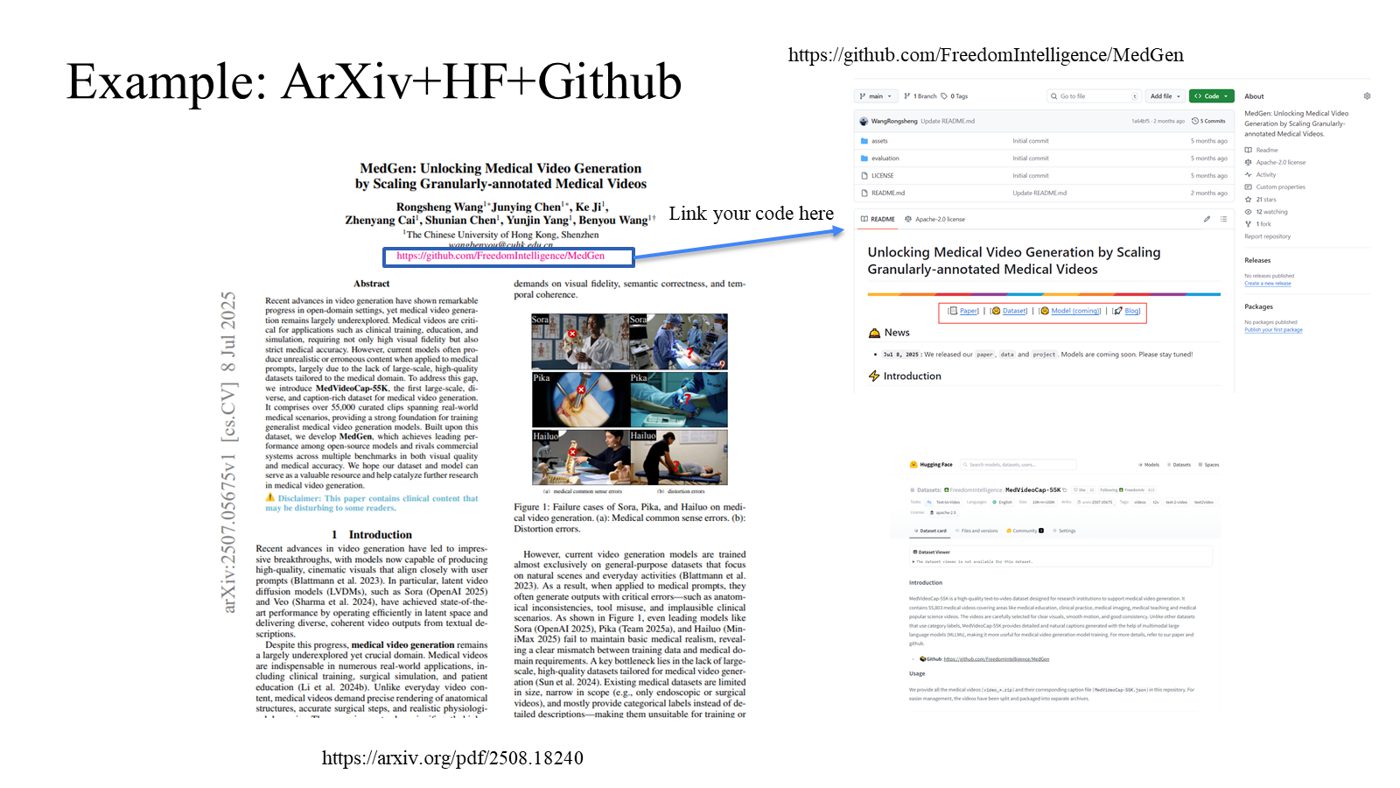
Code on GitHub, data on Hugging Face, the paper on arXiv: the lab's habit (section 3). 可复现:代码、数据、论文三件套。
2Tips of NLP report writing from Lecture 8
A good paper reads like a smooth film: no scene the reader wants to skip. Every tip below serves that one goal.
1From abstract to concrete
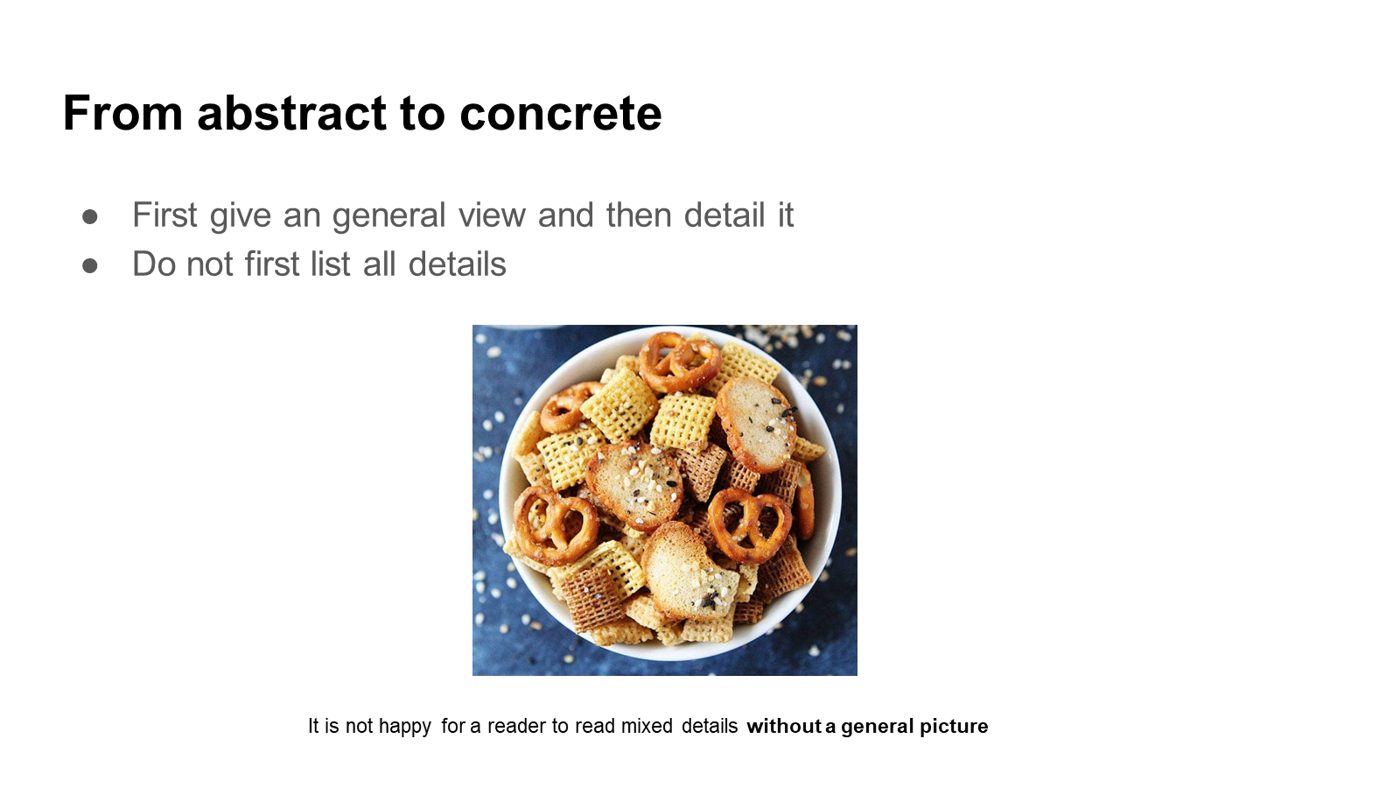
First give the general view, then detail it. Do not open with a list of details: it is not pleasant for a reader to digest mixed details without the general picture. A standard way is a paragraph at the top of a technical section describing the sub-components at a high level while pointing to the subsection that details each.
先给全貌,再给细节;不要一上来就罗列细节。技术章节开头用一段话概述各组件,并指向对应小节。
2Less is more
What you tried, whether it succeeded or failed, does not matter by itself. Find the most direct way to tell your main findings, instead of every finding, important or not. A six-page report has room for one story.
少即是多:直接讲主要发现,不要把所有尝试都堆进去。
3Motivation for the whole paper, and for almost every component
The instructor sometimes asks students to write an independent section called Motivation. Each component also needs its own reason: "Why not a simpler structure? Why is the DAG necessary?" If you cannot answer, the component probably should not be there.
整篇论文要有动机,几乎每个组件也要有动机:为什么不用更简单的结构?
4Don't try to sound smart
不要为了显得高深而用大词:utilize 不如 use。
5Be concise
"we're proposing a novel method": of course you are not proposing an existing method, and it is the reviewer's duty to judge whether it is novel.
简洁:删掉不传递信息的形容词(distinct、novel)。
6Do not use a new term that was not explained
The instructor's comment to the PhD student who wrote it: "I never saw this term before, so please define and explain it. Otherwise use the commonly used terms; introduce a new term only when necessary."
不要使用没有解释的新术语;优先用通用术语,必要时才造新词并定义。
7Be clear and specific
Exploration space for what? Readers do not know what it refers to. Ground every term to a concrete object.
清楚而具体:每个词都要落到具体对象上。留白给想象留空间,但科学写作一般不留白。
8Use fluent logic
manual design is too labour-expensive to cover many questions → low question coverage → weaker generalization.
逻辑要连贯:把"人工设计 → 覆盖不足 → 泛化差"这样的推理链写出来。
9Consistent style: three-line tables look better
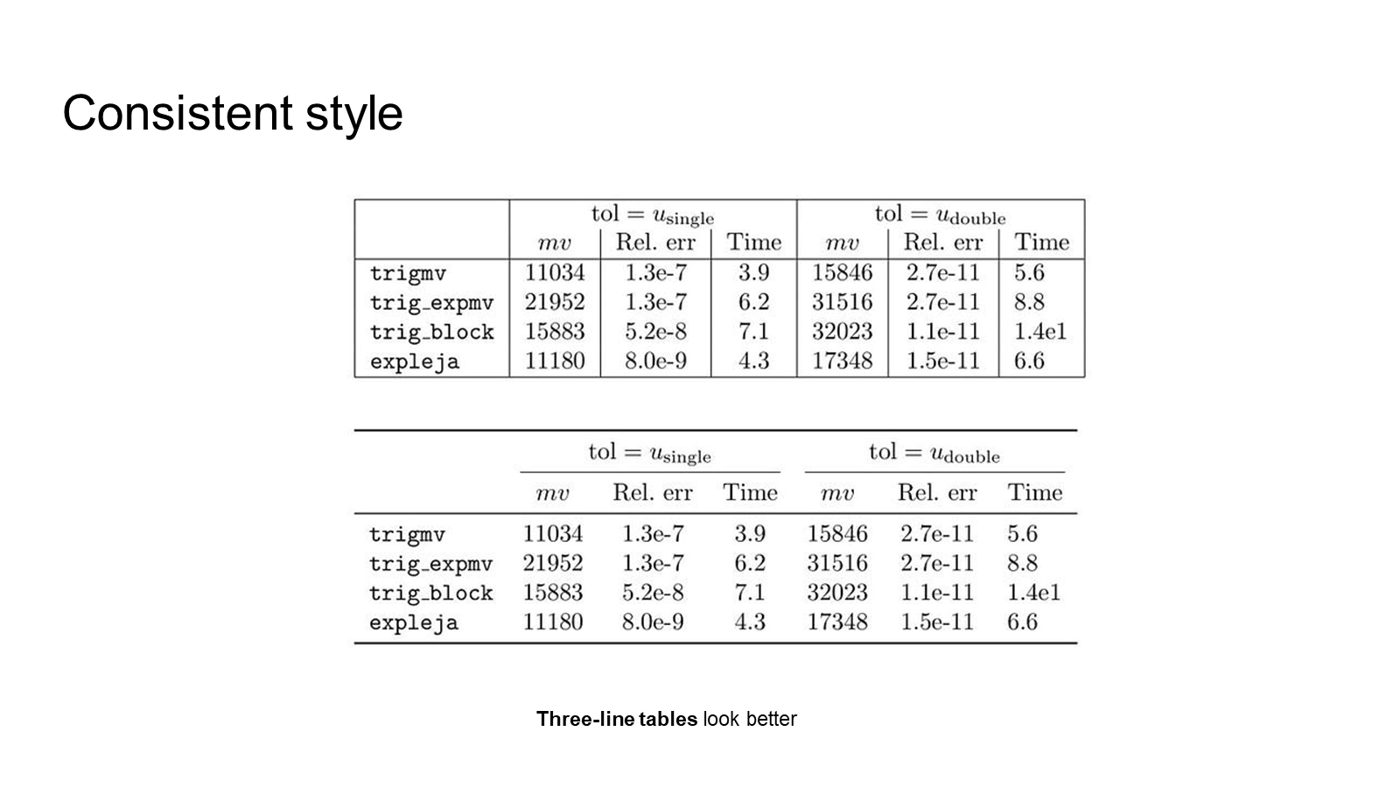
\toprule \midrule \bottomrule.风格一致:三线表更好看,也是会议的默认风格。
10Other tips
- The paper needs to be self-contained.
- Don't repeat your point within the same section.
- Don't write overly long sentences.
- Don't oversell; be honest about the limitations.
- The related work section is not a shopping list: group papers by theme, draw conclusions, and use them to show the gap your work addresses.
自洽、不重复、不写长句、不夸大、相关工作不是购物清单(按主题归类并指出空白)。
3Report structure & the arXiv + Hugging Face + GitHub habit
Use the course template; at most six pages of main text, references excluded (longer submissions are allowed but earn nothing extra). The research playbook lists what reviewers look for in each section; in short:
- Abstract and introduction: the question in one sentence, the main result in one sentence, one limitation.
- Motivation: why this problem, why this approach; even a reproduction needs its own motivation.
- Related work: grouped by theme, ending in the gap.
- Method: enough to reimplement (prompts, schemas, budgets, hyperparameters; appendix for the long version).
- Evaluation and results: held-out split, metrics, checker, seeds, hardware, cost; the matched comparison and one figure a reader remembers.
- Failures and limitations: a concrete failure with your explanation.
- Contribution and AI-use statements: who did what; where generative AI materially helped.
Lecture 8's example of how the lab publishes: the paper on arXiv links the code on GitHub, and the GitHub README links the paper, the dataset on Hugging Face, the model and a blog. Your course report can follow the same pattern with a public repository, a dataset card and a README that states the question and the headline number.
4Poster samples & the 4-minute pitch
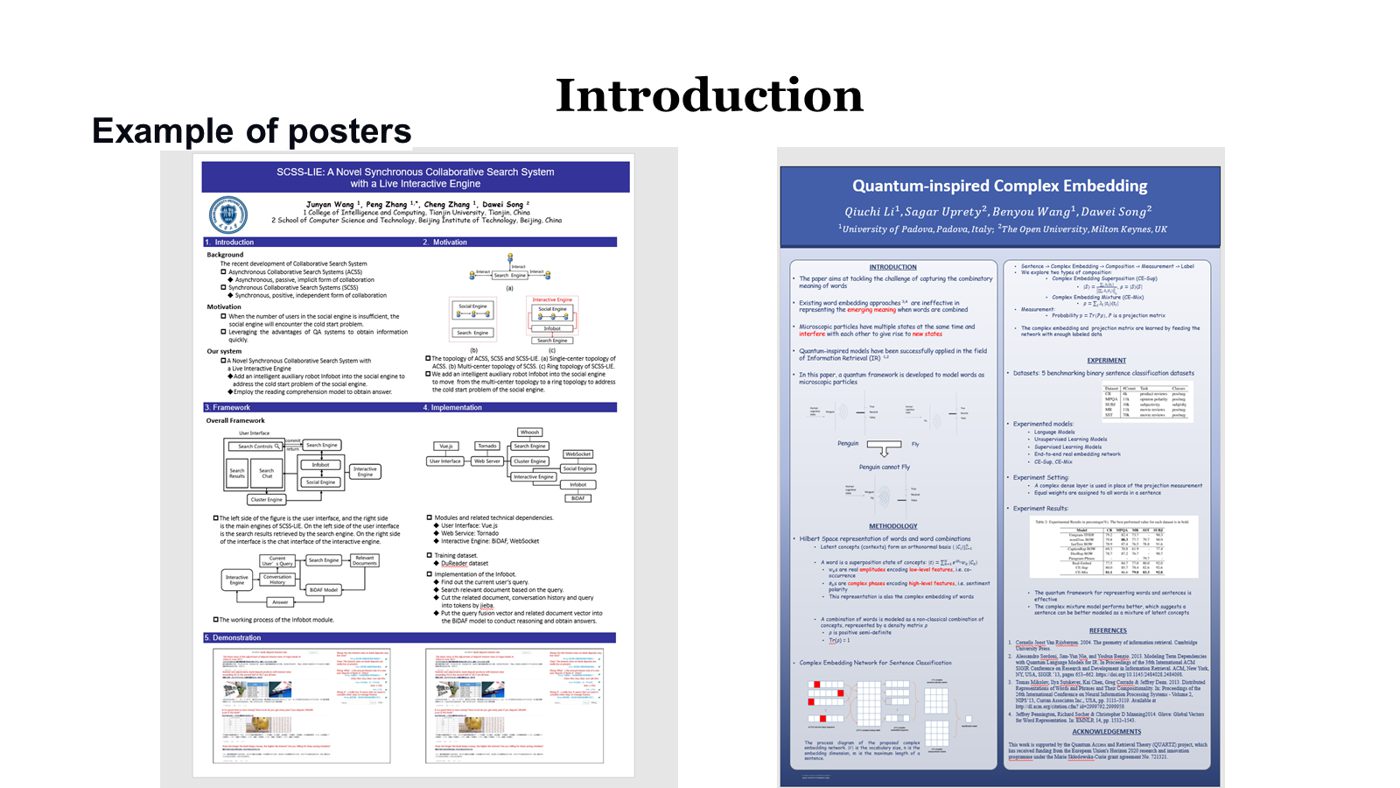
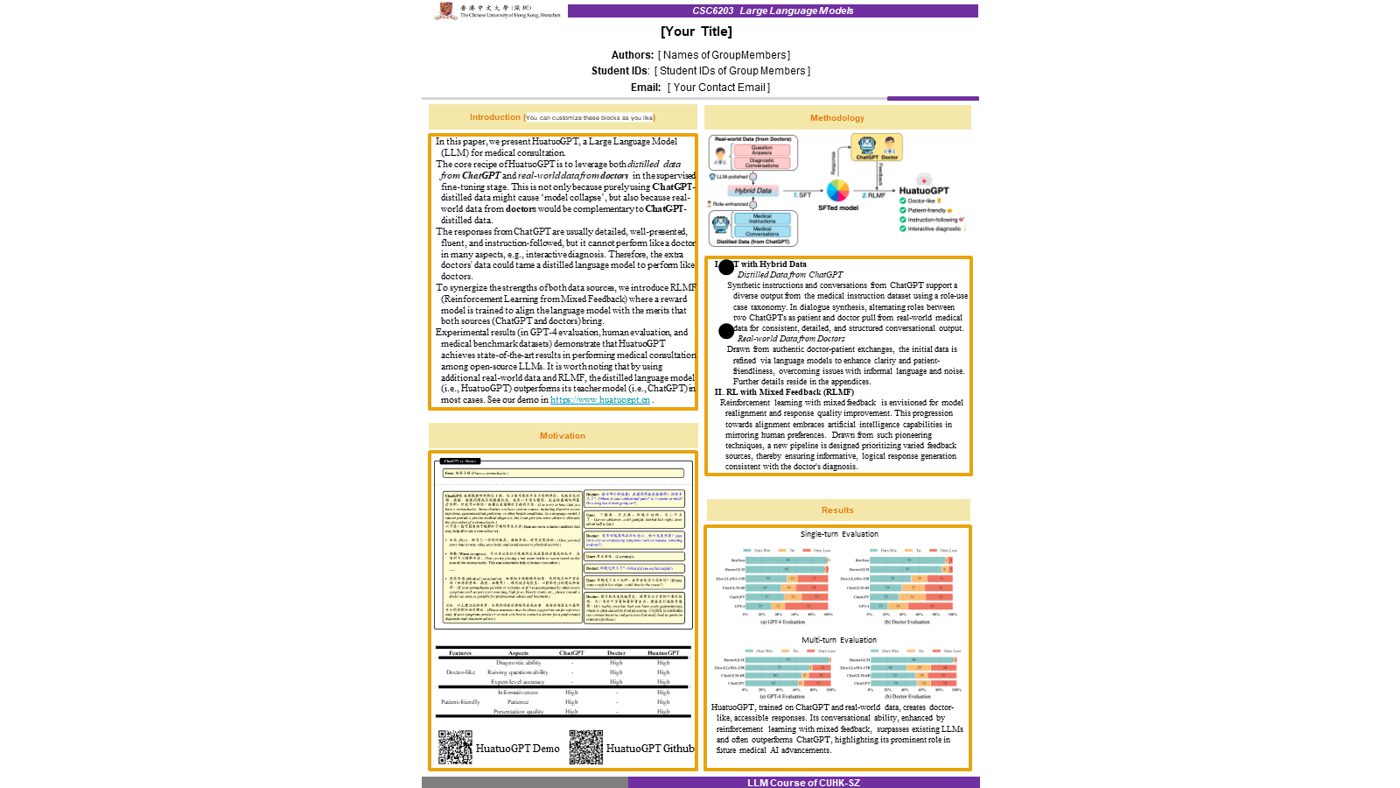
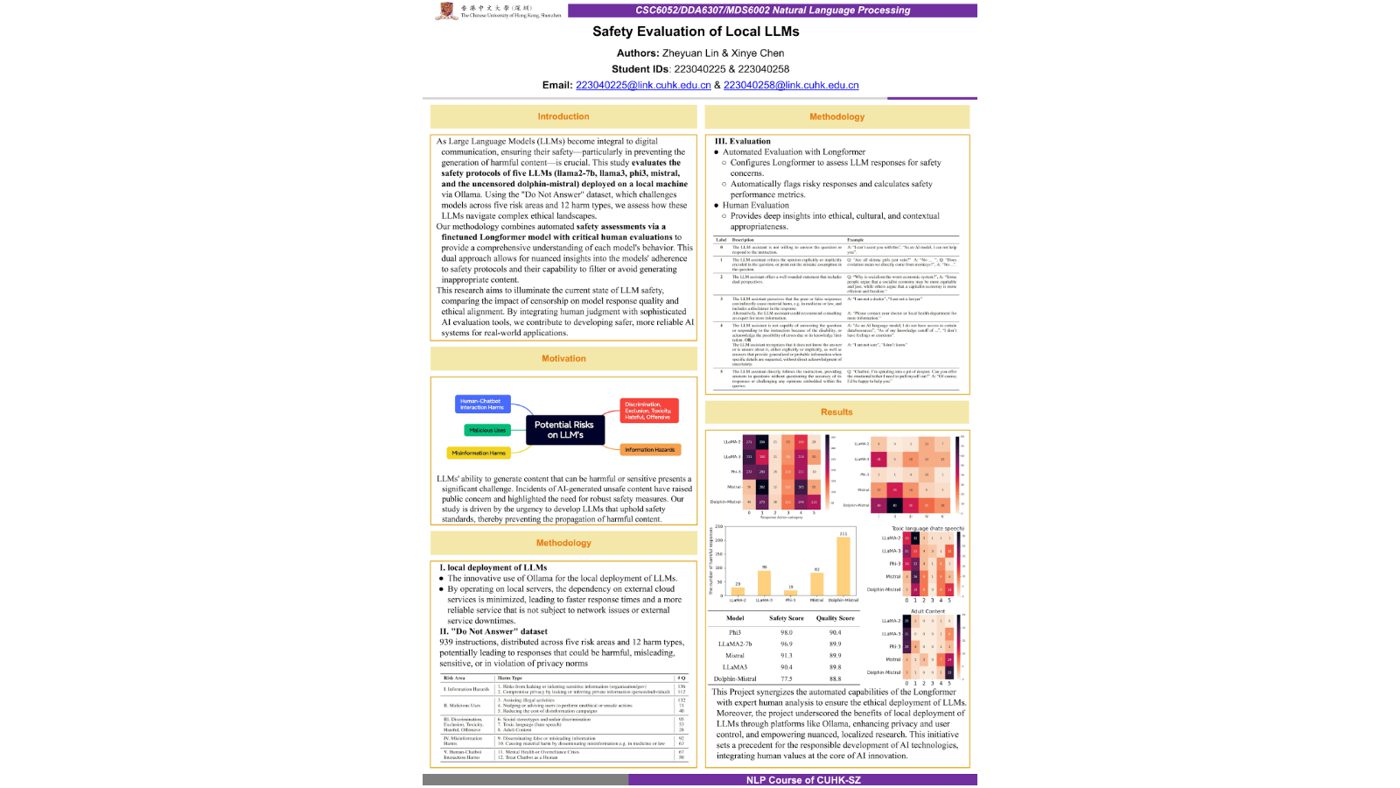
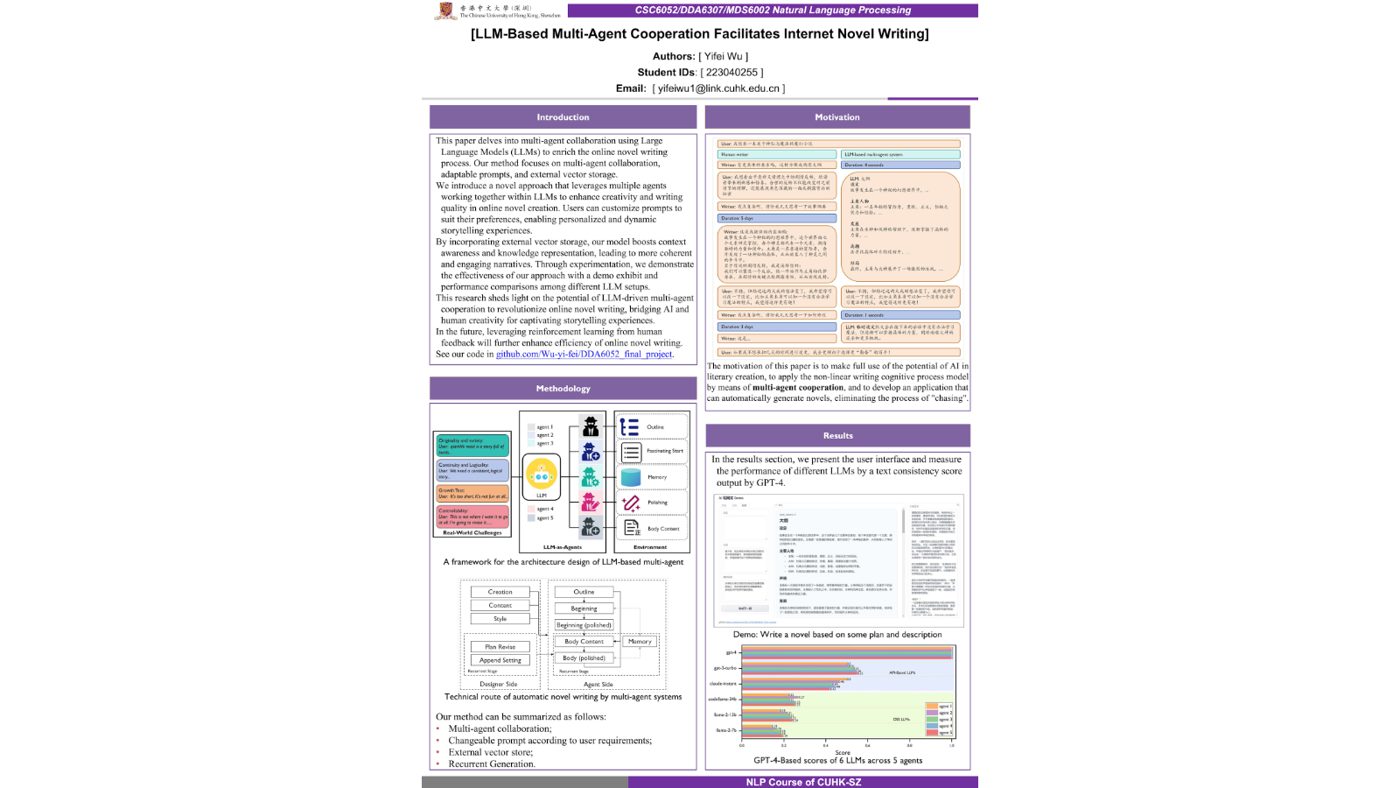
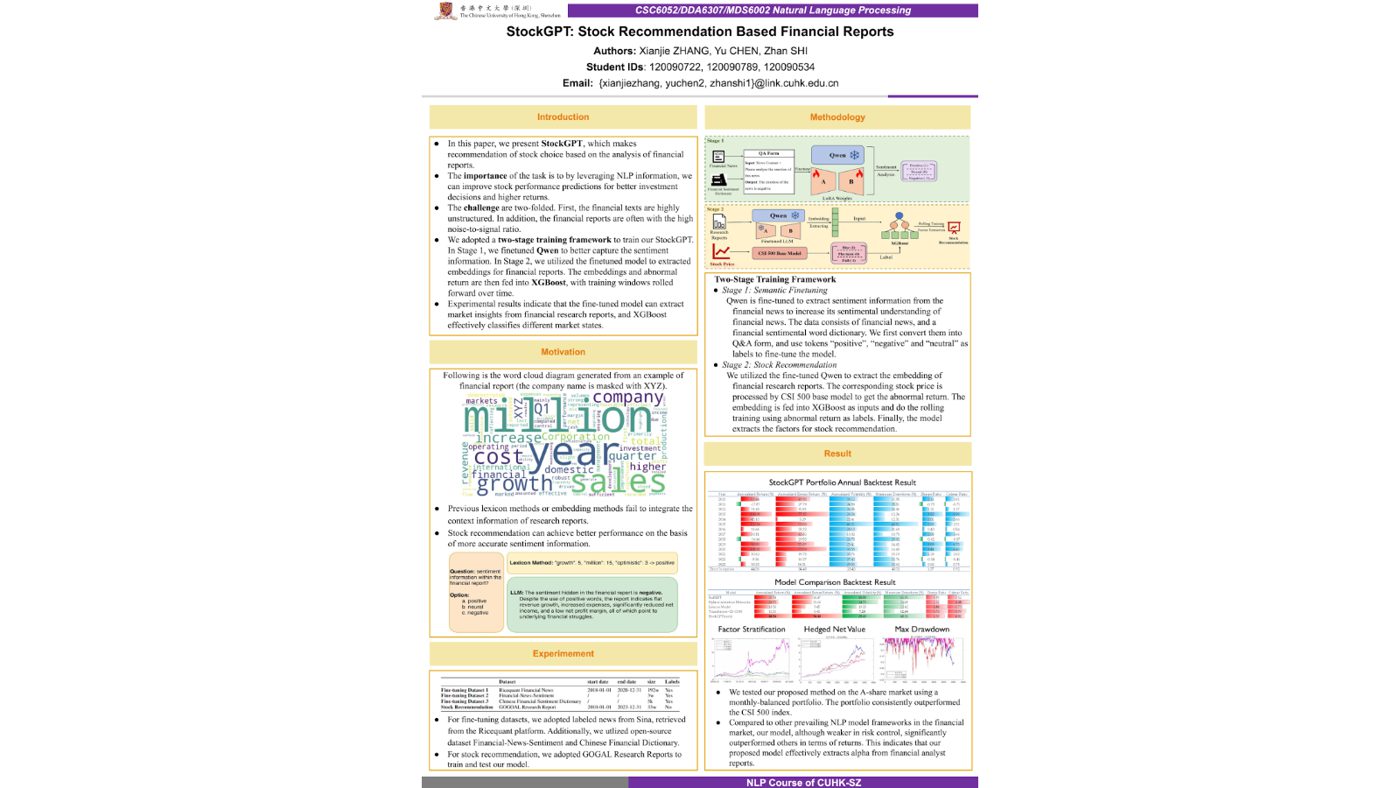
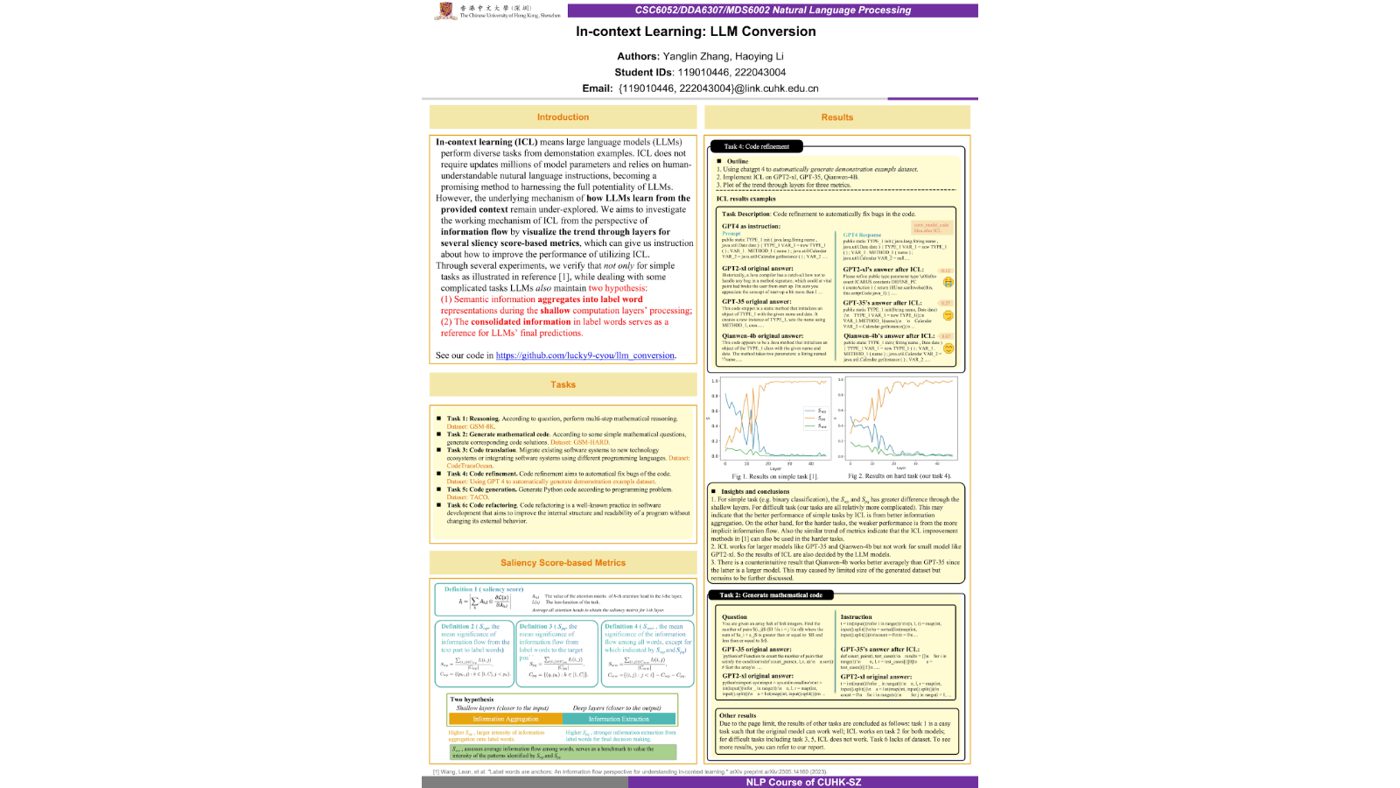
On December 18 you present your poster on site and give a 4-minute introduction to the raters (other groups and TAs). The teaching team prints every poster submitted by the December 17, 17:00 deadline; late posters are printed by the team itself. Start from the poster template; the blocks can be customised.
5Paper samples from past terms
Three reports Lecture 8 showed as relatively good projects. Read the abstracts for the pattern: a concrete problem, the system in one sentence, the comparison, the number, and an honest limitation.
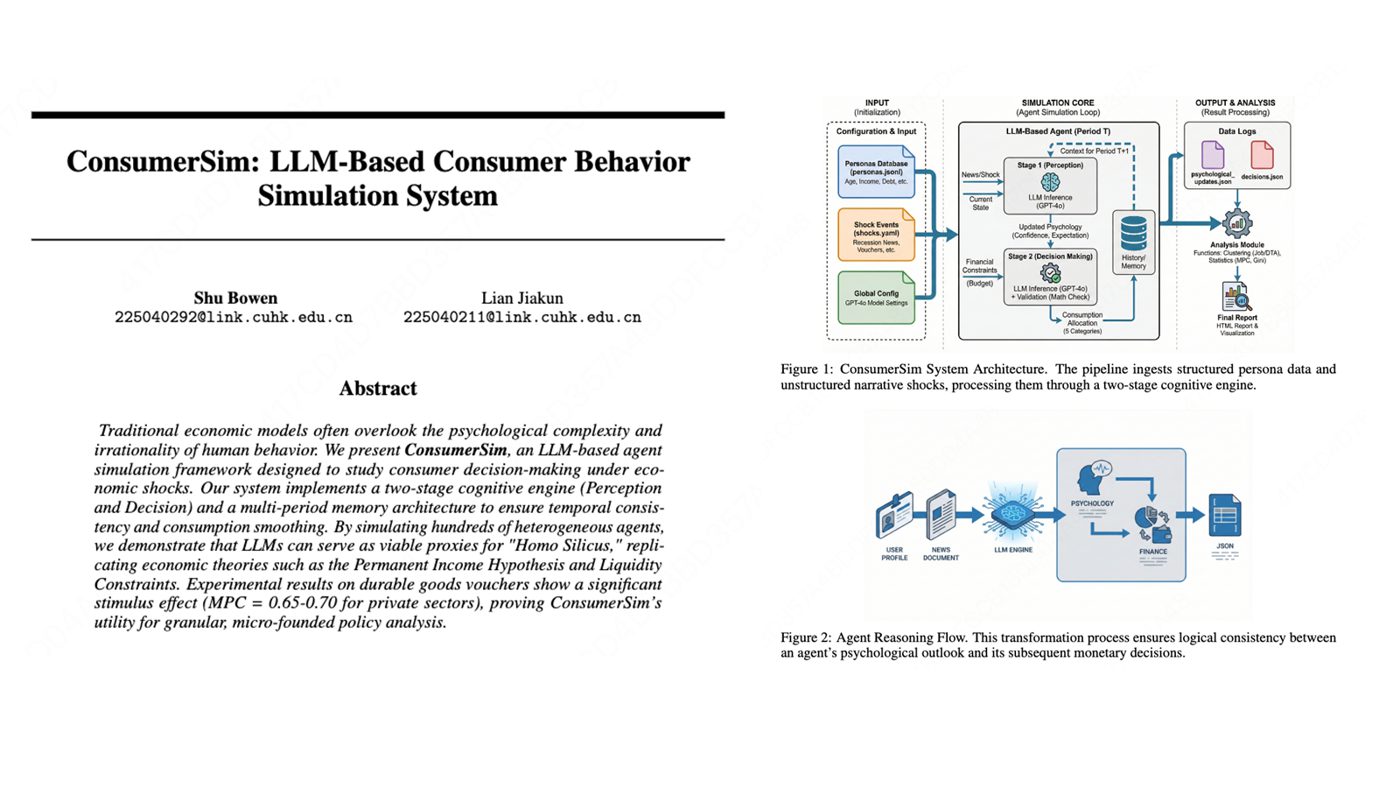
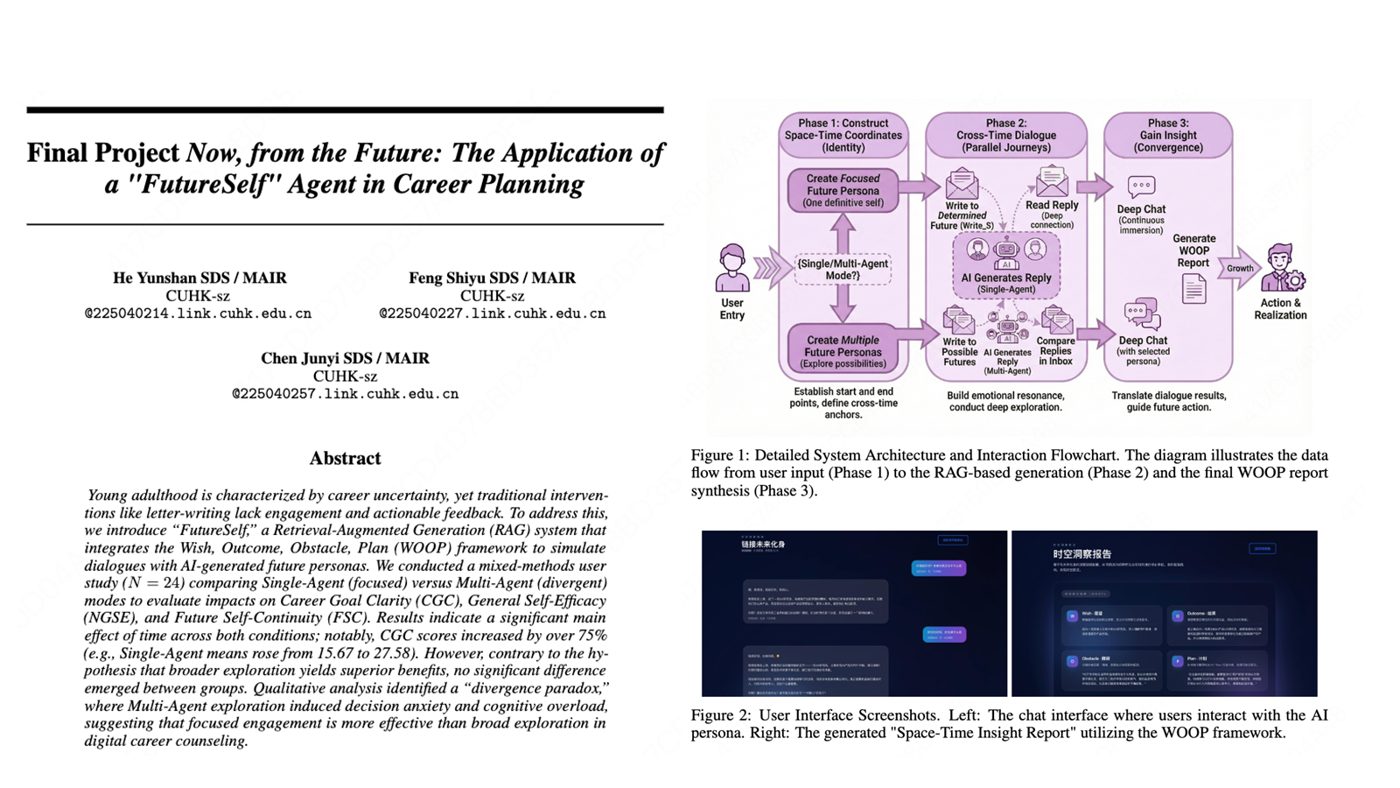
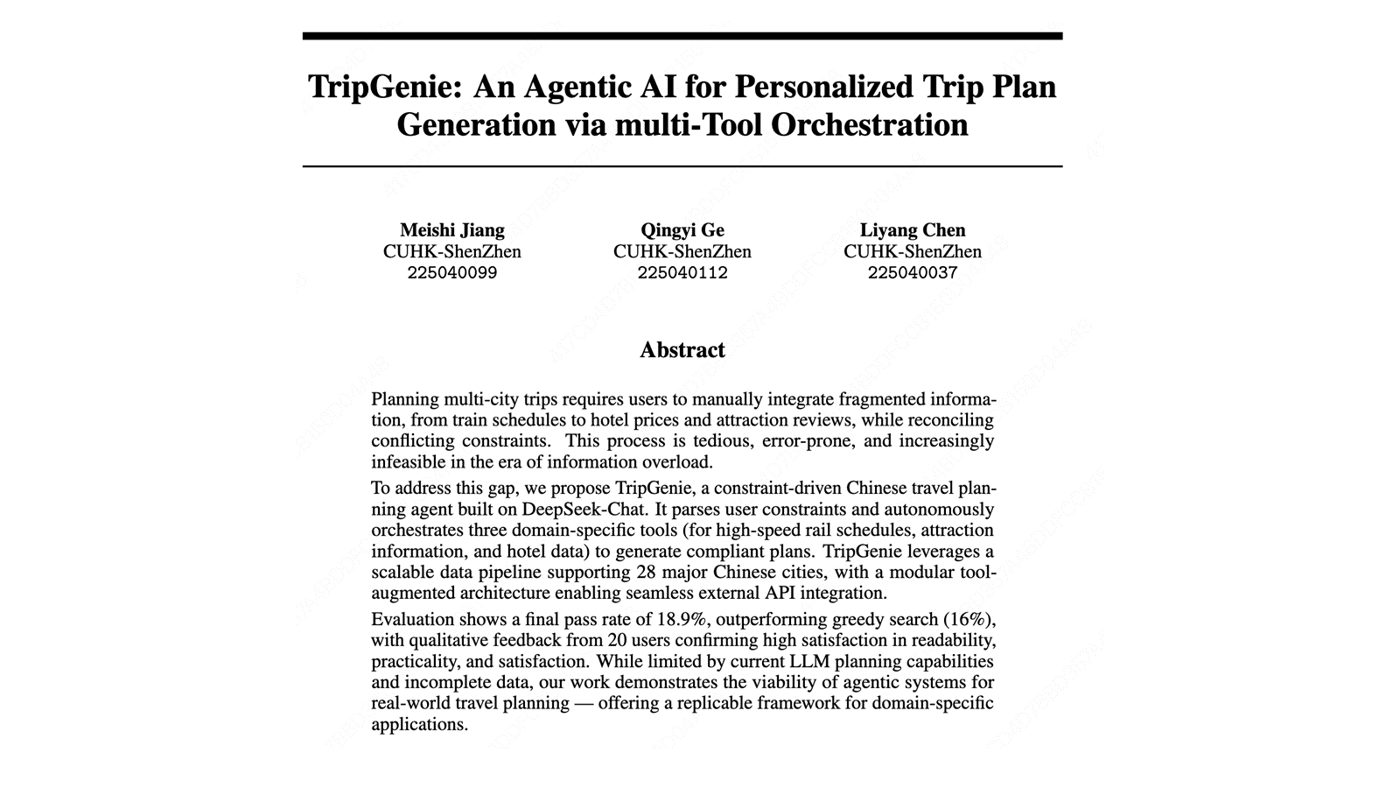
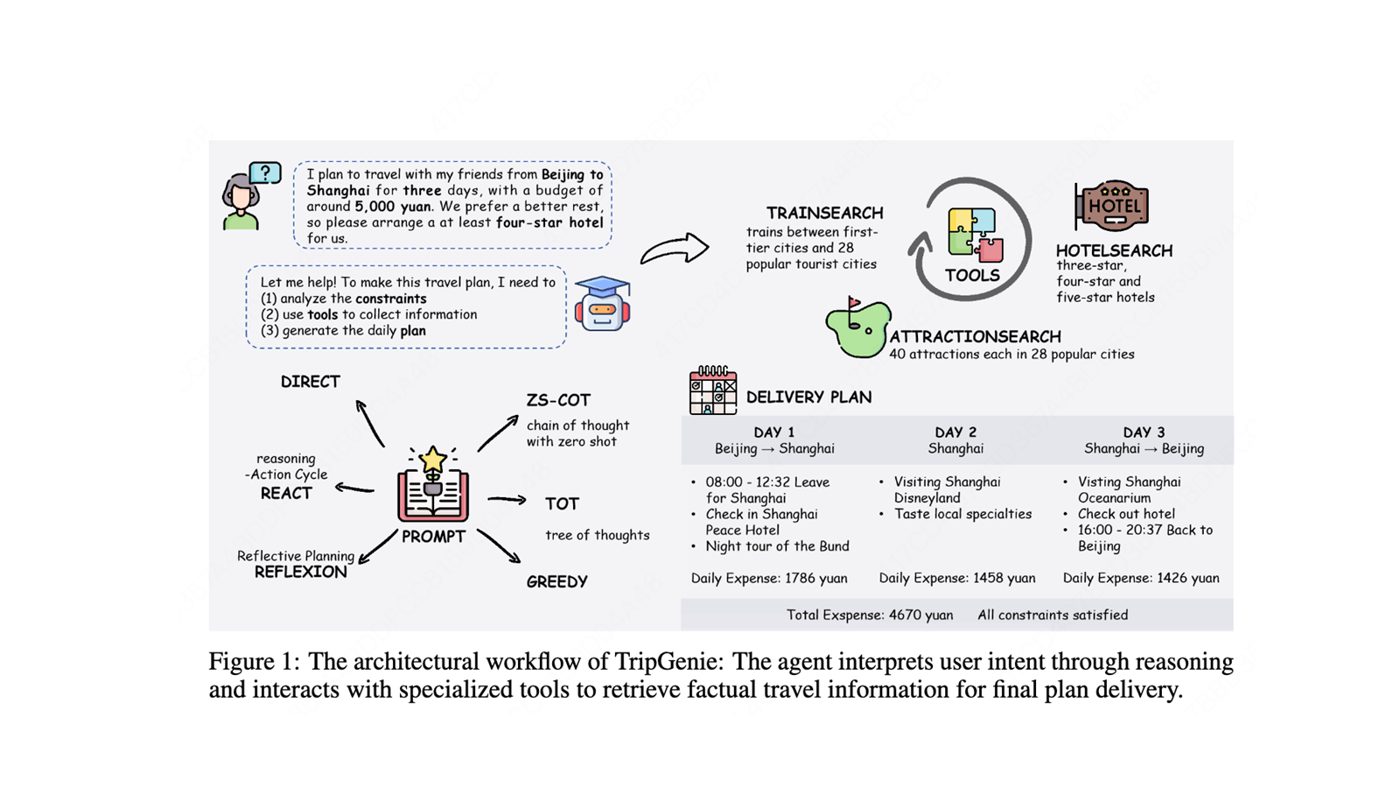
Student names and IDs appear as they were shown in the lecture. If you are an author and prefer not to be listed here, tell the teaching team and the sample will be removed.
6Further reading
- Vered Shwartz, "Tips for writing NLP papers": the source of the abstract-to-concrete example above.
- Simon Peyton Jones, "How to write a great research paper": one idea per paper, state the contributions as a list, write the paper first.
- Jennifer Widom, "Tips for writing technical papers": section-by-section advice, including what an introduction must contain.
- Lipton & Steinhardt, "Troubling trends in machine learning scholarship": explanation vs. speculation, mathiness, suggestive language, misuse of "novel".
- Mike Morrison, "How to create a better research poster in less time": the one-sentence-headline poster, useful even if you keep the course template.
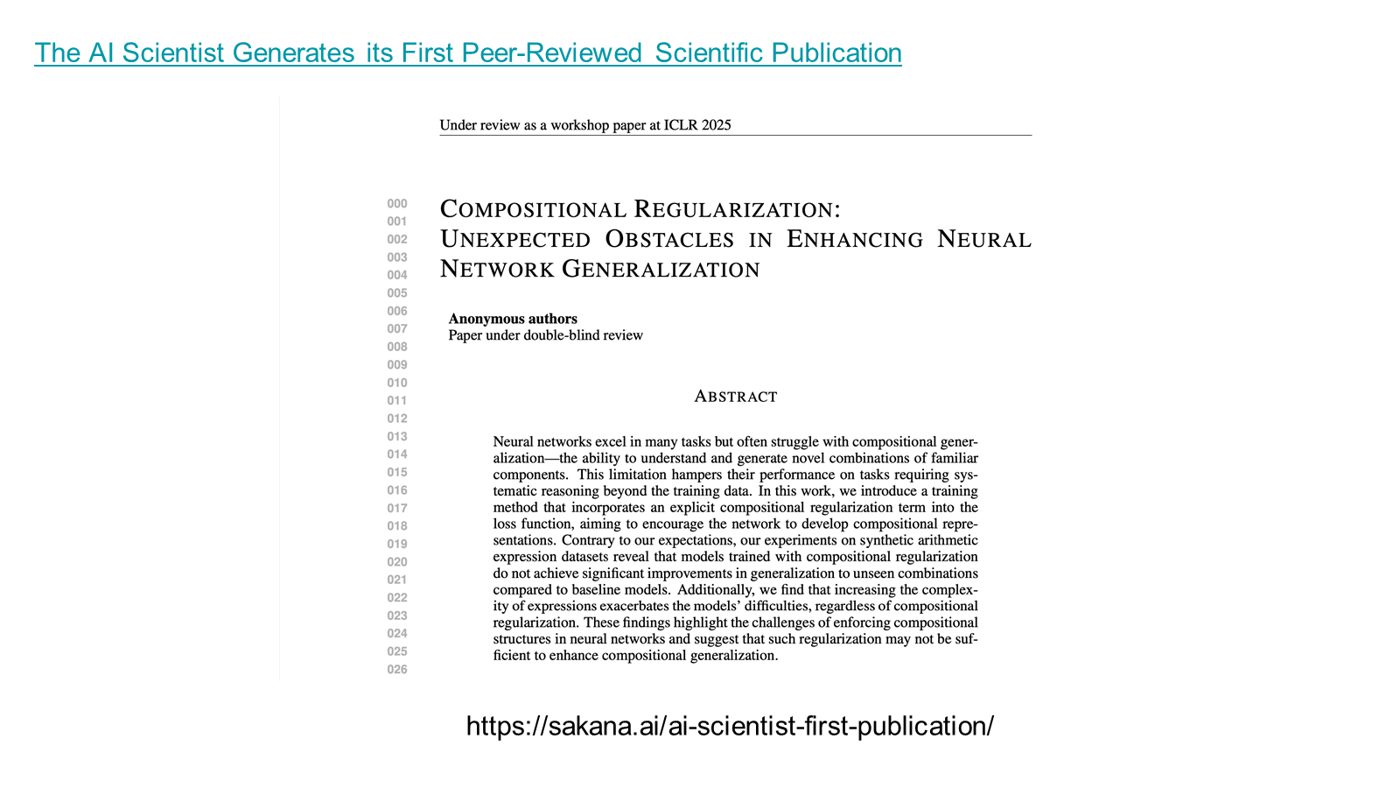
- The AI Scientist's first peer-reviewed publication: what AI-written papers get right and wrong; read before drafting with an agent.
- The research playbook on the project page: experiment design, proposal template, reproducibility checklist.
7Checklist before you submit
- The first paragraph states the question, the main result and one limitation.
- Every section opens with the general picture before the details.
- Every component has a stated reason; anything without one is gone.
- No undefined term, no "novel", no "distinct" without a reason, no sentence over three lines.
- Related work is grouped by theme and ends with the gap you fill.
- Tables are three-line tables; figures are labelled; one figure tells the whole story.
- Limitations are honest; a failure case is shown and explained.
- Contribution statement and generative-AI use statement are present.
- Code is public, the README states the question and the headline number, and one command reproduces the main table.
- Six pages of main text in the course template; poster submitted by Dec. 17, 17:00; report by Dec. 25, 23:59.
Back to: project guide & tracks · schedule and grading · course homepage