1Overview
Lecture 5 explained how LLMs are pre-trained; Lecture 6 explained why post-training uses reinforcement learning. This tutorial runs the whole post-training toolbox at small scale. The slides walk through SFT, parameter-efficient fine-tuning (LoRA, QLoRA) and the three feedback-based methods. The notebooks then train real models: each one isolates one way of turning a training signal into better behaviour.
| Notebook | Method | Model | Data | Training signal |
|---|---|---|---|---|
| A | SFT → reward model → PPO | Qwen3-4B-Base, 4-bit NF4 + LoRA | SST-2 movie reviews | next-token NLL; human sentiment labels → learned reward |
| B | GRPO | Qwen2-0.5B-Instruct + LoRA | 128 generated arithmetic questions | verifiable reward: correct answer + format |
| C | DPO | SmolLM2-135M-Instruct | UltraFeedback preference pairs | chosen ≻ rejected, relative to a frozen reference |
Learning objectives
- Explain the SFT loss and why only response tokens are graded; estimate GPU memory for full fine-tuning, LoRA and QLoRA.
- Explain why LoRA's update \(\Delta W = BA\) starts at zero, and how QLoRA stores the frozen base in 4-bit NF4.
- Train a reward model from human labels and use it, together with a KL penalty, as the reward for PPO.
- Follow one PPO iteration: rollouts, rewards, GAE advantages from a value head, clipped policy updates.
- Compute GRPO's group-relative advantage by hand and recognise when a group gives no learning signal.
- Write the DPO loss, interpret its training metrics, and say when DPO is preferable to online RL.
- Read training diagnostics critically: tell a real improvement from noise on a small evaluation set.
Time plan
| Part | What you do | Time (approx.) |
|---|---|---|
| Slides | SFT, LoRA/QLoRA, PPO, GRPO, DPO | 60 min |
| Notebook C (DPO) | Shortest run: 32 steps, about 40 s of training on a T4 | 15 min |
| Notebook B (GRPO) | Screening + 64 steps, about 3 min of training | 25 min |
| Notebook A (SFT + RM + PPO) | Longest run: three training stages on a 4B model; start it first and read while it trains | 60+ min |
2Slides: Training Your Own LLMs
52 slides in four parts — the big picture, SFT, efficient fine-tuning (LoRA & QLoRA), and learning from feedback (PPO, GRPO, DPO) — with a running example: turning a 7B base model into a helpful, safe medical assistant.
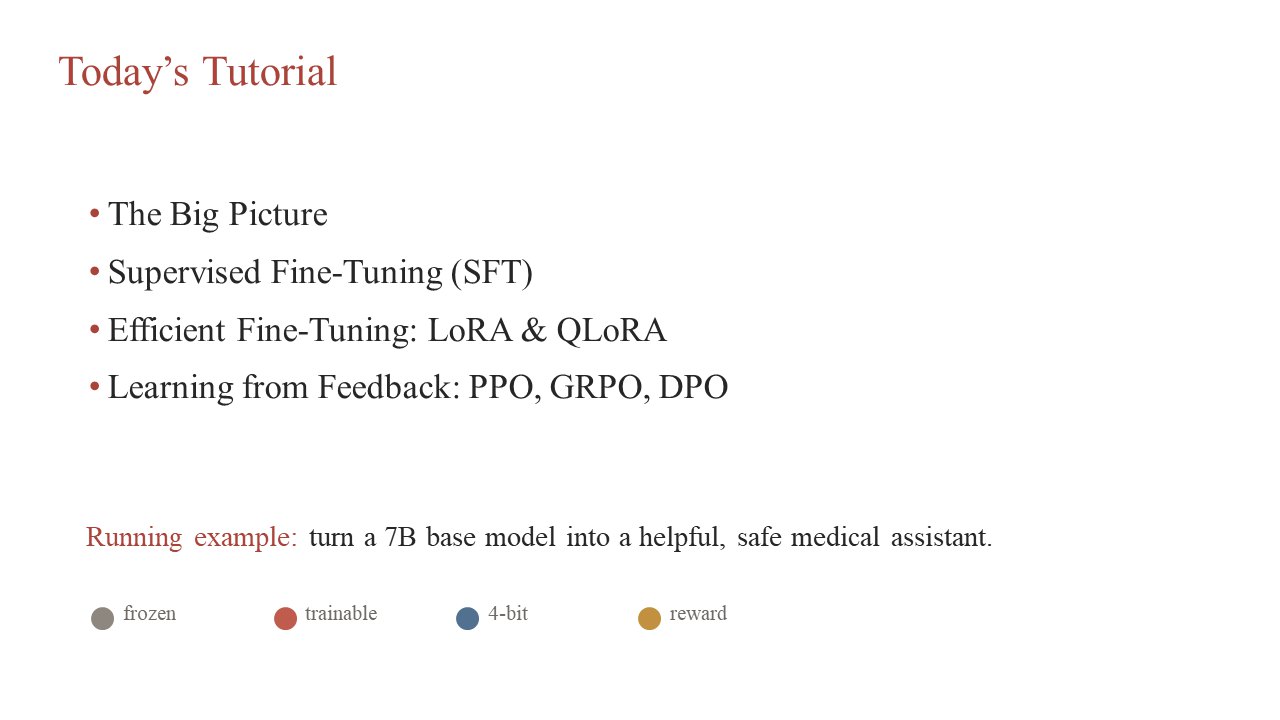
Slide 2 · Today's tutorial
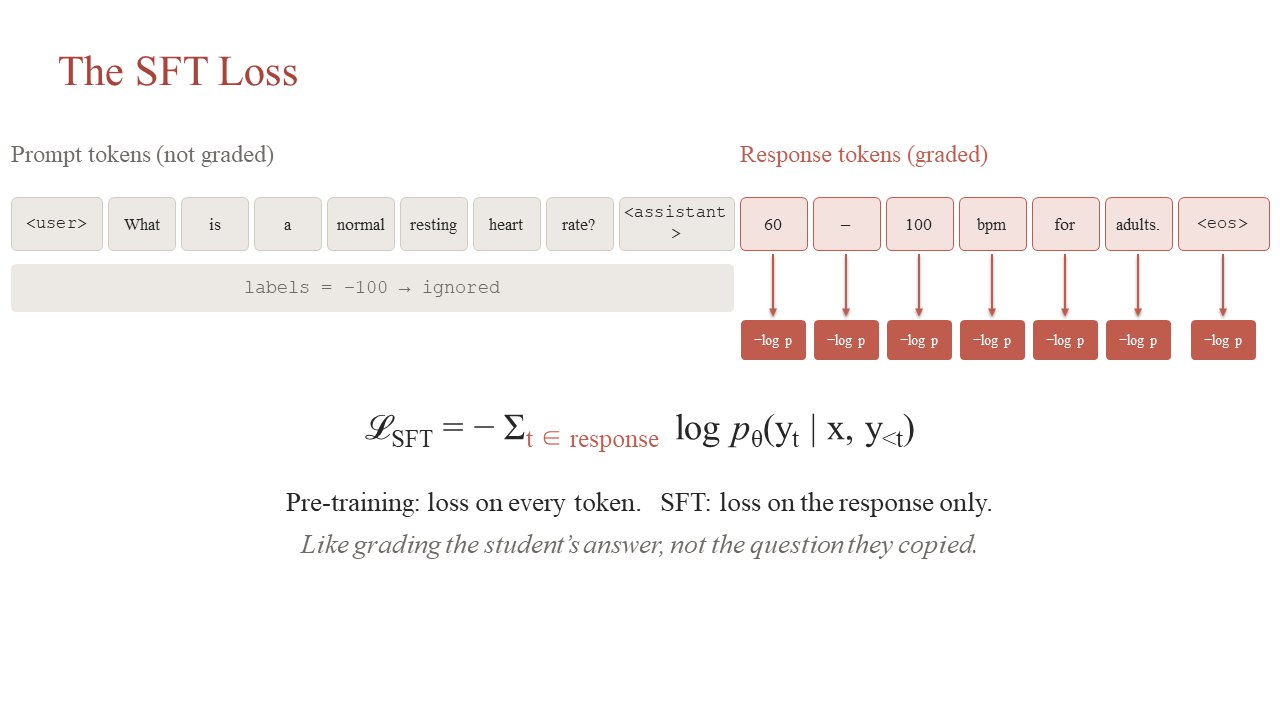
Slide 10 · The SFT loss
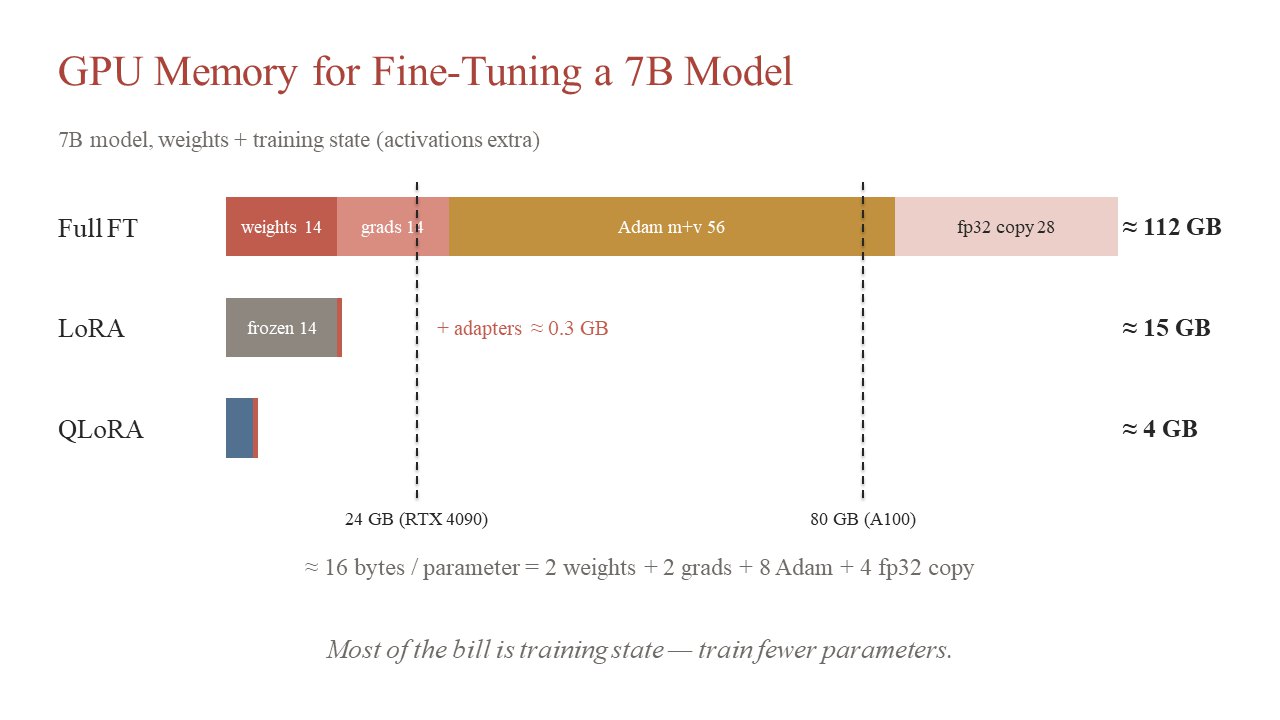
Slide 14 · GPU memory for a 7B model
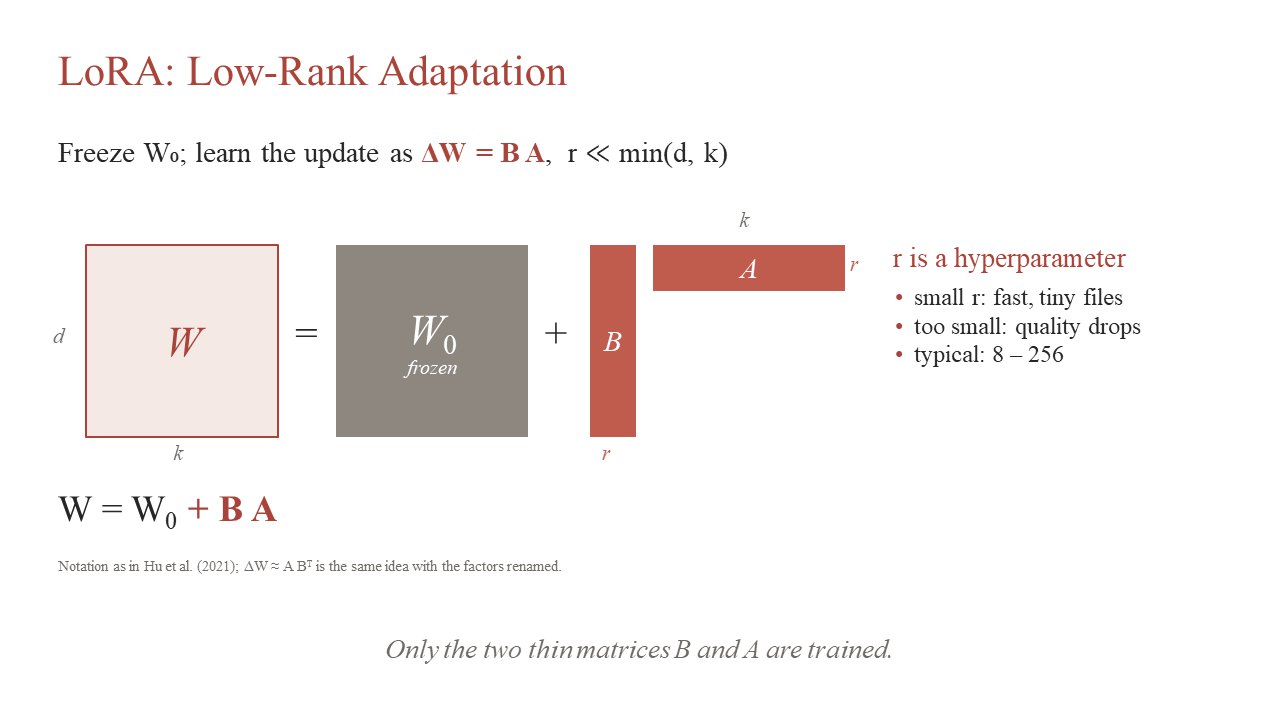
Slide 20 · LoRA: low-rank adaptation
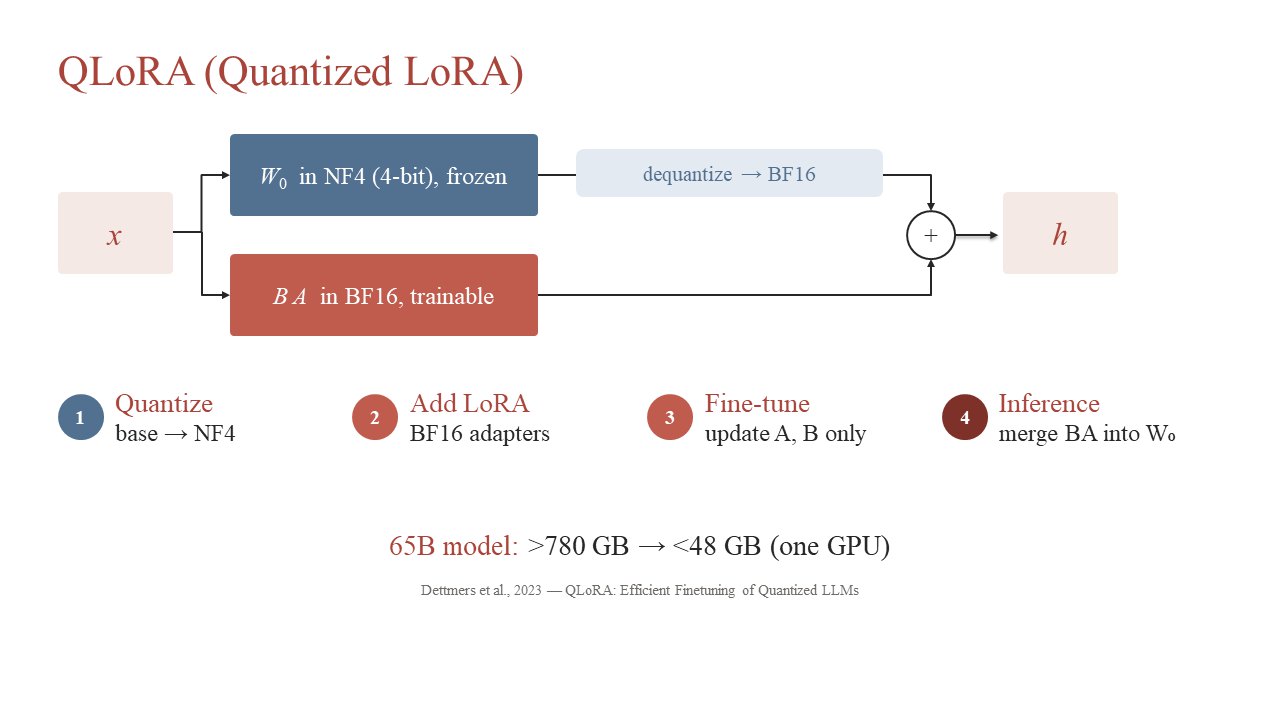
Slide 33 · QLoRA
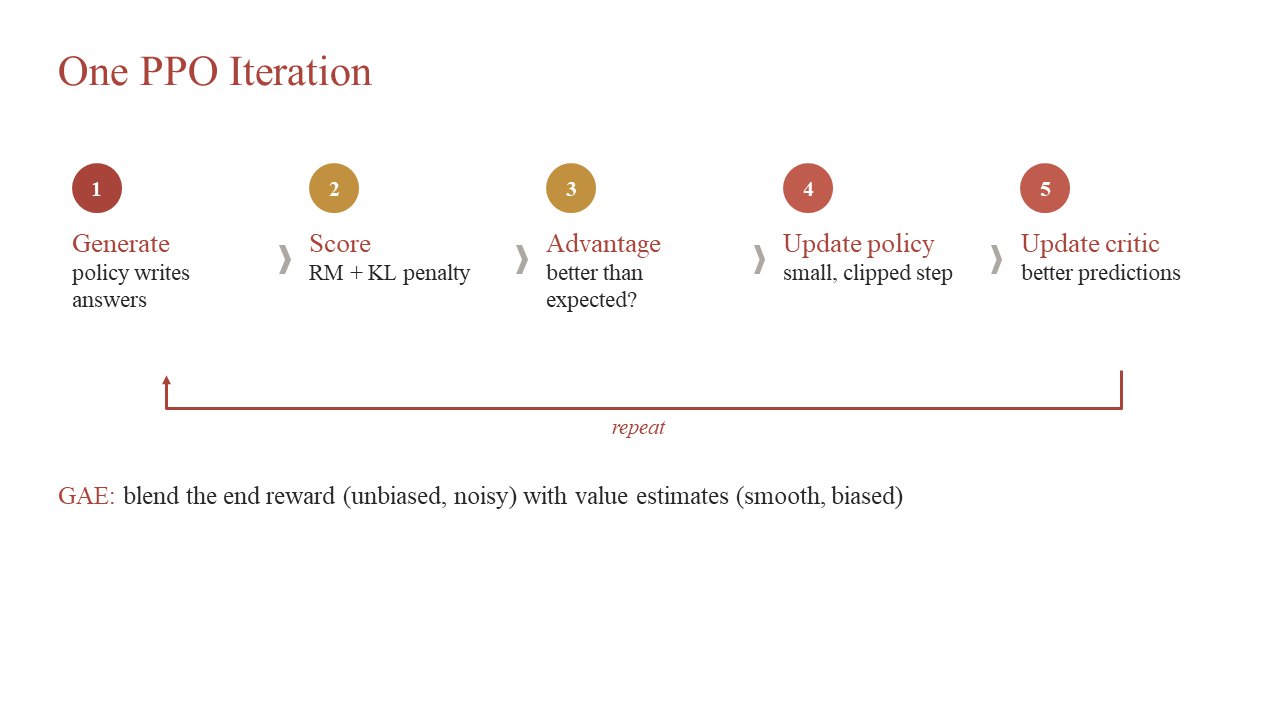
Slide 40 · One PPO iteration
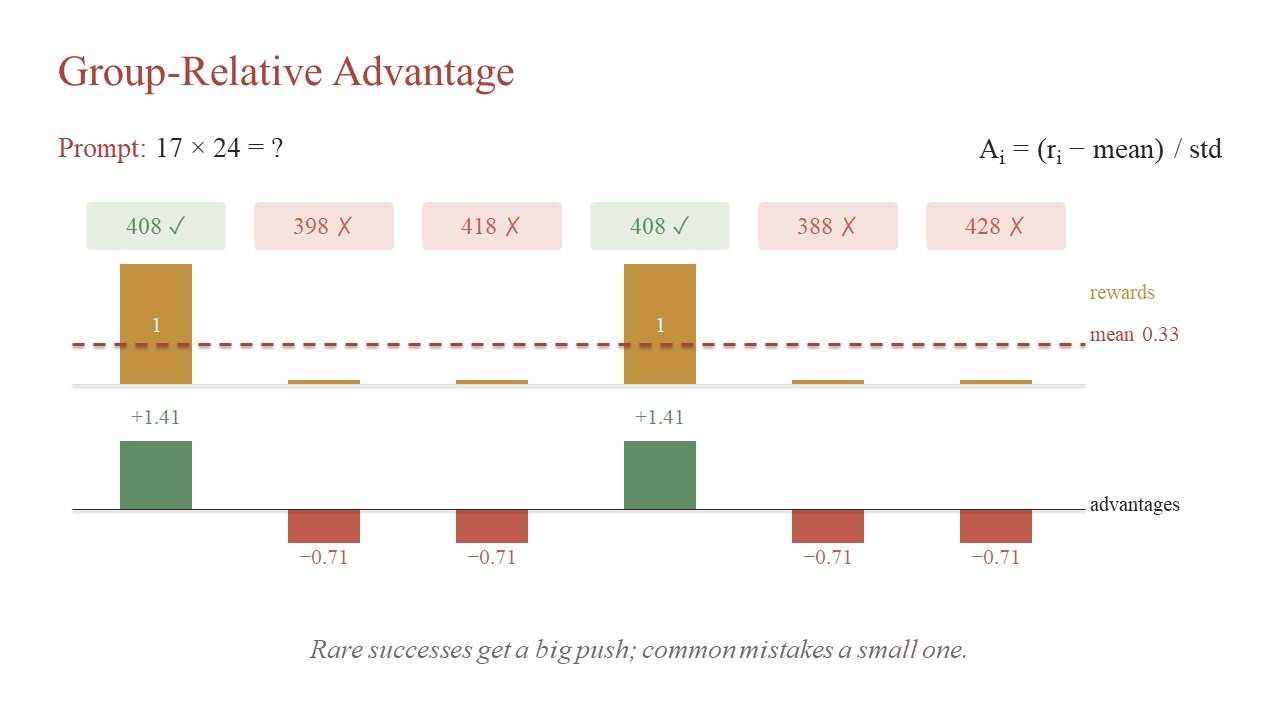
Slide 45 · Group-relative advantage
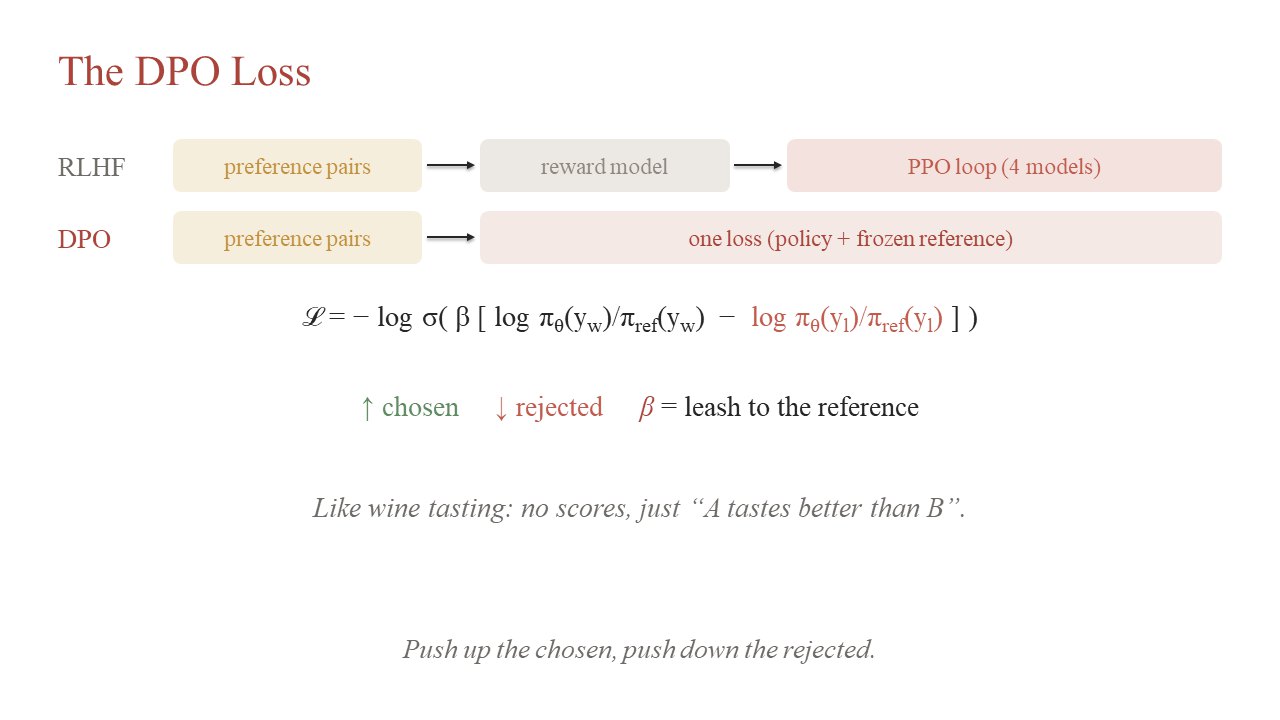
Slide 47 · The DPO loss
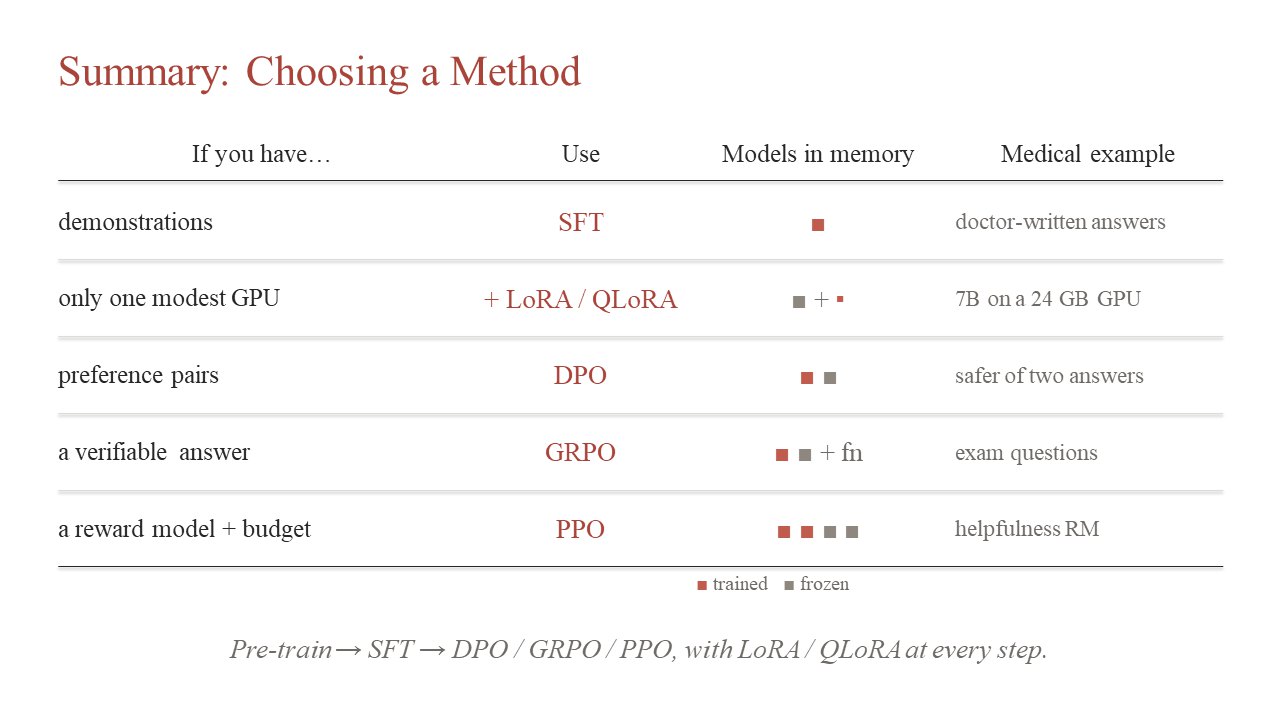
Slide 51 · Summary: choosing a method
Key ideas from the slides
SFT grades only the answer
Prompt tokens get label -100 and are ignored — like grading the student's answer, not the question they copied.
Most of the GPU bill is training state
Fine-tuning a 7B model needs about 16 bytes per parameter: 2 (weights) + 2 (gradients) + 8 (Adam) + 4 (fp32 copy).
LoRA: a low-rank update
With \(d=k=4096,\ r=16\): 131K instead of 16.8M trainable weights per matrix (128× fewer). \(B=0\) at start, so training begins exactly at the pre-trained model.
QLoRA: 4-bit base, 16-bit adapters
Store the frozen base in NF4 (4-bit levels placed at normal-distribution quantiles, dense near zero), dequantize on the fly, and train only BF16 adapters. A 65B model goes from >780 GB to <48 GB — one GPU.
3Before you start
Option A · Kaggle (recommended, tested)
- Click a Kaggle button above; Kaggle imports the notebook from this site's GitHub repository. Sign in and choose Copy & Edit if asked.
- In the right panel: Accelerator → GPU T4 (or T4×2; only one GPU is used) and Internet → On. Phone verification is required for both.
- Start a fresh session and run the first cell before anything else: it installs pinned library versions into a private environment.
- Run the remaining cells in order. Outputs (adapters, logs, ZIP backups) appear in Kaggle's Output panel.
Option B · Colab or your own GPU
The notebooks were tested on Kaggle (Python 3.13, PyTorch 2.11, CUDA 12.8). They write to /kaggle/working; on other
machines, change that path at the top of each notebook. Any CUDA GPU with ≥ 15 GB memory works.
pip install "transformers==4.51.3" \
    "trl==0.18.2" "peft==0.15.2" \
    "datasets==3.5.0" "accelerate==1.6.0" \
    bitsandbytes math-verify
These are the pins used by Notebooks B and C. Notebook A installs newer versions in its own first cell.
HF_TOKEN as a Kaggle secret.4Notebook A · SFT, reward model and PPO (RLHF)
Notebook A at a glance
transformerspeftbitsandbytesdatasets23 cellsKaggle T4
The classic InstructGPT recipe in miniature. A base model learns to write movie reviews (SFT), a reward model learns to score sentiment from human labels, and PPO steers the SFT model toward reviews the reward model scores as positive.
4.1 One frozen 4-bit base, three LoRA adapters
Instead of loading three copies of a 4B model, the notebook loads one base in 4-bit NF4 and attaches three independent LoRA adapters
(rank 8 on q,k,v,o projections). Switching the active adapter switches the “model”:
qconfig = BitsAndBytesConfig(load_in_4bit=True, bnb_4bit_quant_type="nf4",
                             bnb_4bit_use_double_quant=True, bnb_4bit_compute_dtype=DTYPE)
base = AutoModelForCausalLM.from_pretrained(MODEL_ID, quantization_config=qconfig, device_map={"": 0})
base = prepare_model_for_kbit_training(base, use_gradient_checkpointing=False)

lora = LoraConfig(r=8, lora_alpha=16, lora_dropout=0.0,
                  target_modules=["q_proj", "k_proj", "v_proj", "o_proj"], task_type="CAUSAL_LM")
model = get_peft_model(base, lora, adapter_name="sft")    # adapter 1
model.add_adapter("reward", copy.deepcopy(lora))           # adapter 2
model.add_adapter("ppo", copy.deepcopy(lora))              # adapter 3
reward_head = nn.Linear(H, 1)   # score from the last token's hidden state
value_head  = nn.Linear(H, 1)   # V(s_t) for every generated token
The SST-2 data are split once and frozen, so every stage sees different reviews:
4.2 Component 1 — SFT: learn the domain
SFT continues next-token training on real movie reviews (128 optimizer steps × 8 accumulated reviews, lr 1e-4). It teaches the style of reviews, not positivity: half of the reviews are negative.
| Review prefix | Base model continues… | After SFT |
|---|---|---|
| it 's just disappointingly | cheap . How would the previous sentence be correctly capitalized? … | portable fiction . |
| the film is beautifully mounted , | enthralingly photographed , expertly edited and confidently assembled . yet , overall , the movie falls short because of the shoestring budget … | enthralingly photographed and expertly edited . |
The base model drifts into web-text habits (a capitalization quiz); after SFT the continuations look like SST-2 reviews.
4.3 Component 2 — Reward model: learn what “good” means
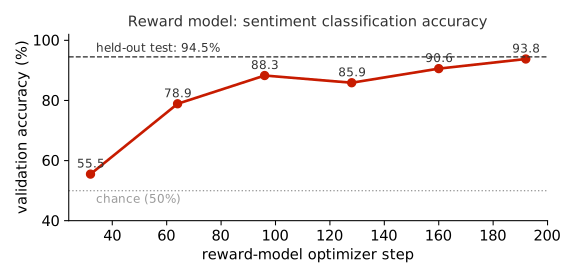
The reward model is the same backbone with its own adapter and a linear reward_head on the last token. It is trained with
binary cross-entropy on human sentiment labels:
4.4 Component 3 — PPO: optimise the reward, stay close to SFT
The reward model's score is mapped to \([-1, 1]\) and added at the last token; every token also pays a KL penalty for drifting from the SFT policy:
A value head estimates \(V(s_t)\); advantages come from GAE (\(\gamma=1,\ \lambda=0.95\)), and the policy is updated with the clipped objective (\(\epsilon=0.2\)):
# --- rollout: per-token KL penalty, reward-model score added at the last token
score   = 2 * reward_logits(sequence).sigmoid() - 1          # in [-1, 1]
rewards = -kl_beta * (old_logprobs - ref_logprobs) * mask
rewards[-1] += score

# --- GAE, computed backwards over the generated tokens
for t in reversed(range(T)):
    delta = rewards[:, t] + gamma * values[:, t + 1] - values[:, t]
    carry = delta + gamma * lam * carry
    advantage[:, t] = carry
returns = advantage + values
advantage = (advantage - advantage.mean()) / advantage.std()  # normalised

# --- clipped policy loss + clipped value loss
ratio = torch.exp(logprobs - old_logprobs)
pg = torch.maximum(-ratio * adv, -ratio.clamp(1 - clip, 1 + clip) * adv).mean()
vclip = old_values + (vpreds - old_values).clamp(-value_clip, value_clip)
vf = 0.5 * torch.maximum((vpreds - returns) ** 2, (vclip - returns) ** 2).mean()
loss = pg + value_coef * vf
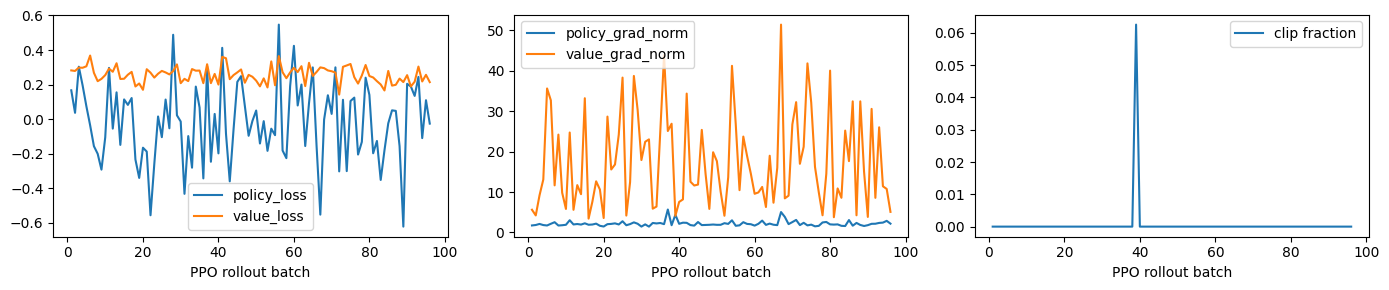
4.5 Results and how to read them
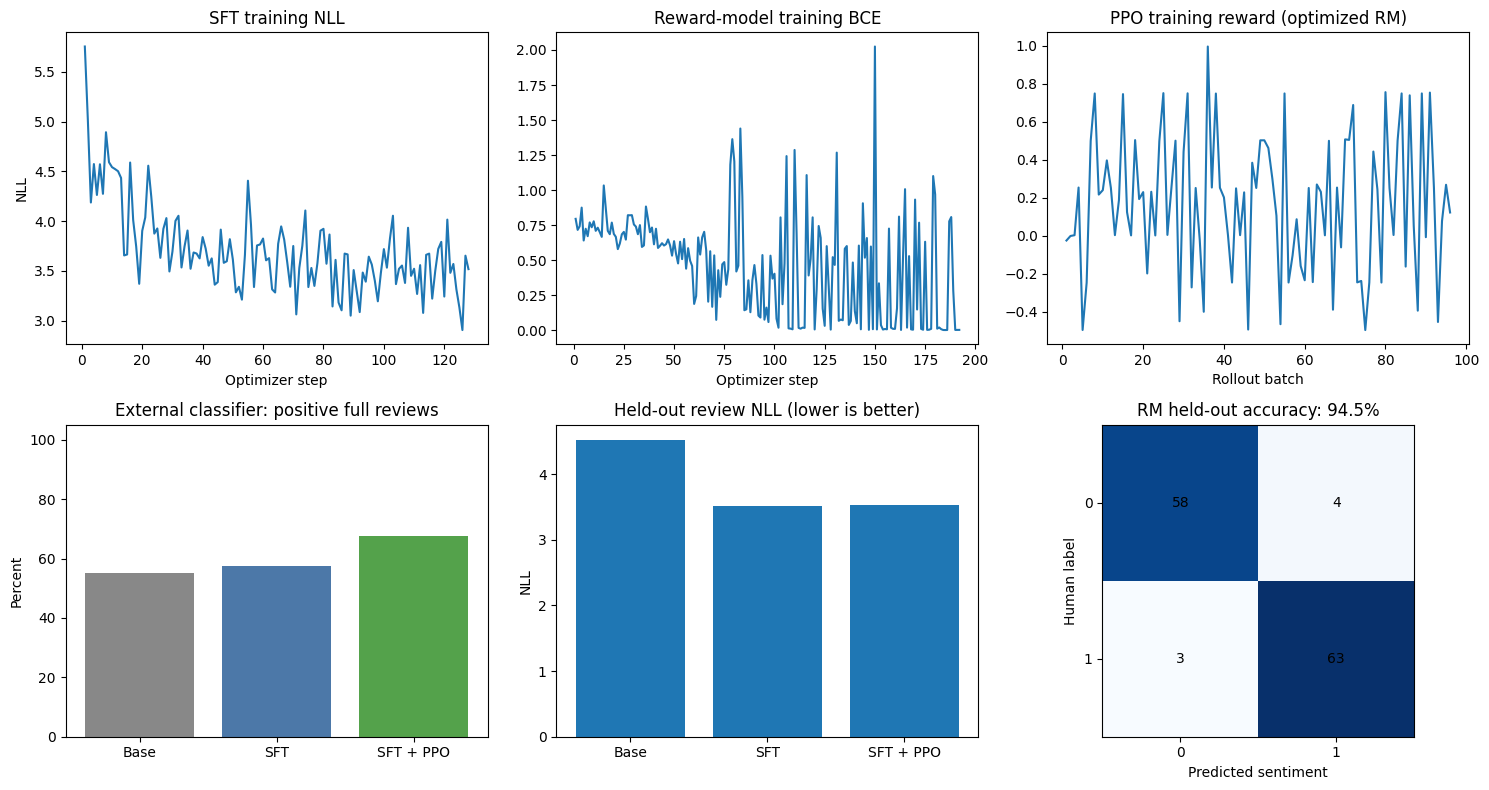
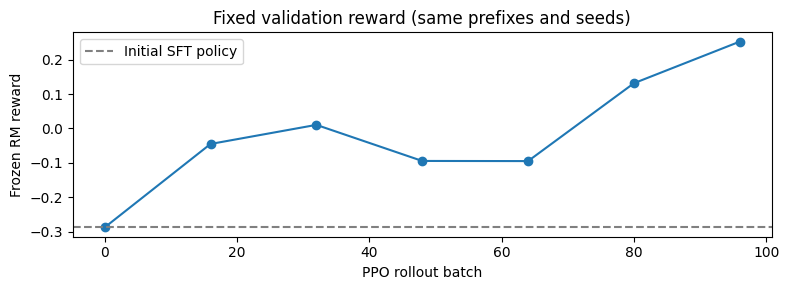
| Metric (40 test prefixes) | SFT | SFT + PPO |
|---|---|---|
| Positive full reviews (external DistilBERT judge) | 57.5% | 67.5% |
| Positive continuations only | 50.0% | 52.5% |
| Held-out review NLL | 3.52 | ≈ 3.52 |
5Notebook B · GRPO with verifiable rewards
Notebook B at a glance
trl GRPOTrainerpeftmath-verify19 cells≈3 min training
The DeepSeek-R1 recipe in miniature: no reward model and no critic. A Python function checks the final answer, and each answer is compared with the other answers sampled for the same question.
5.1 Task and verifiable rewards
The policy is Qwen2-0.5B-Instruct with a rank-16 LoRA (2.16M trainable parameters, 0.44% of the model). Training questions are 128 generated arithmetic problems (addition, subtraction with negative results, multiplication, two-step expressions, word problems); 12 fixed questions are held out. The system prompt asks for a short calculation and a final answer in tags:
Format reward \(r_{\text{fmt}}\in[0,1]\)
0.25 each for opening<think>, non-empty thinking,
opening <answer>, non-empty answer. Partial credit makes the signal less sparse.Correctness reward \(r_{\text{acc}}\in\{0,1\}\)
1 if the extracted final answer equals the reference (checked withmath-verify), else 0. Only the final answer is verified, not each step.5.2 Group-relative advantage
For each question GRPO samples a group of \(G=4\) answers and normalises their rewards within the group — the group mean replaces PPO's learned value model:
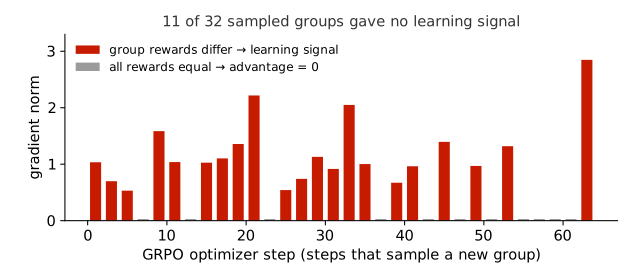
If all four answers get the same reward, every advantage is zero and the question teaches nothing. The notebook therefore screens training questions first and keeps 8 of the first 12 probes whose answers were mixed (some right, some wrong). Even so, groups often become uniform during training:
training_args = GRPOConfig(
    num_generations=4,            # group size G
    num_iterations=2,             # reuse each sampled group twice (needs the clip)
    max_steps=64, learning_rate=2e-5,
    temperature=0.9, top_p=0.95,  # sampling must be diverse to get mixed groups
    beta=0.02, epsilon=0.2,       # KL coefficient and clip range
    loss_type="grpo", scale_rewards=True,
    reward_weights=[0.1, 1.0],    # format, correctness
)
trainer = GRPOTrainer(model=model, args=training_args,
                      reward_funcs=[format_reward, accuracy_reward],
                      train_dataset=train_dataset, peft_config=lora_config)
trainer.train()
reward_std, frac_reward_zero_std, grad_norm and kl instead.5.3 Results on the 12 held-out questions
| # | Held-out question | Reference | Before GRPO | After GRPO |
|---|---|---|---|---|
| 1 | 27 × 34 | 918 | −888 | 888 |
| 2 | 387 + 568 | 955 | −955 | 955 ✓ |
| 3 | (17 + 26) × 8 | 344 | 344 ✓ | 344 ✓ |
| 4 | 27 − 64 | −37 | −37 ✓ | −37 ✓ |
| 5 | 144 / 12 + 7 × 3 | 33 | 165 | 33 ✓ |
| 6 | 18 boxes of 24 pencils, 157 sold: how many remain? | 275 | no answer | 275 ✓ |
| 7 | 46 × 17 | 782 | −742 | 742 |
| 8 | 623 − 278 | 345 | −345 | −345 |
| 9 | 39 − 82 | −43 | −43 ✓ | −43 ✓ |
| 10 | 23 × 7 − 48 | 113 | 113 ✓ | 113 ✓ |
| 11 | (63 − 28) × 6 | 210 | 210 ✓ | 210 ✓ |
| 12 | 14 bags of 18 marbles, 95 given away: how many remain? | 157 | no answer | 157 ✓ |
| Correct | 5 / 12 | 9 / 12 |
<think>.6Notebook C · DPO on preference pairs
Notebook C at a glance
trl DPOTrainertransformers17 cells≈40 s training
Offline preference learning: no reward model, no value head, no generation during training. The model learns from fixed pairs of a preferred and a rejected answer to the same prompt.
The data are 128 short pairs from trl-lib/ultrafeedback_binarized (16 more for evaluation). One example:
Prompt
Given two Swahili sentences, label the second as the “cause” or “effect” of the first.Chosen ✓
“EffectConfidence: 90%”
Rejected ✗
“Effect. The second sentence is an effect of the first one, as it explains the reason why the person is now working in Kenya.” (invents a fact)6.1 The DPO loss
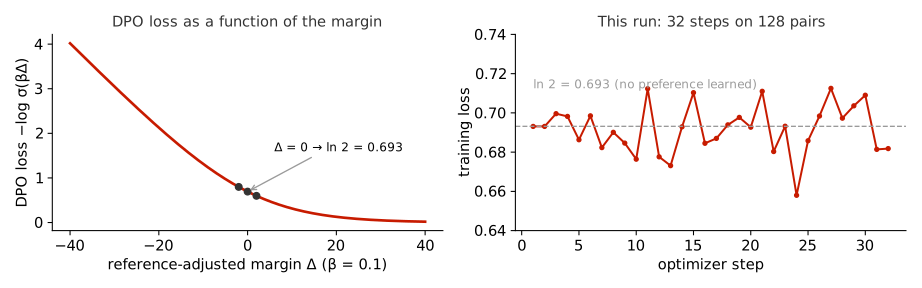
DPO measures how much more the policy prefers the chosen answer than the frozen reference does, and pushes that margin up:
training_args = DPOConfig(
    beta=0.1, loss_type="sigmoid",          # L = -log sigmoid(beta * margin)
    learning_rate=5e-6, max_steps=32,
    per_device_train_batch_size=1, gradient_accumulation_steps=4,
)
trainer = DPOTrainer(model=model, ref_model=None,   # None: TRL makes a frozen copy as reference
                     args=training_args, train_dataset=train_dataset,
                     eval_dataset=eval_dataset, processing_class=tokenizer)
trainer.train()
metrics = trainer.evaluate()   # rewards/accuracies, rewards/margins, loss
6.2 Results: a lesson in reading metrics
With 32 steps at learning rate 5e-6, the loss never leaves \(\ln 2\): the model has barely moved from the reference, and the evaluation margin is indistinguishable from zero. The answers do change (greedy decoding amplifies tiny probability changes) — for example the photosynthesis explanation became a numbered list — but these changes are not evidence of learned preferences.
7Choosing a method
| If you have… | Use | Models in memory | Generates during training? | Signal comes from |
|---|---|---|---|---|
| demonstrations (prompt, answer) | SFT | 1 | no | human-written answers |
| a modest GPU | + LoRA / QLoRA | 1 + small adapters | — | — |
| preference pairs (chosen, rejected) | DPO | 2: policy + frozen reference | no (offline) | pairwise human/AI judgments |
| a verifiable answer | GRPO | 2 + a reward function | yes, groups of \(G\) | rules: answer checks, tests |
| a reward model and a budget | PPO | 4: policy, reference, reward model, critic | yes | learned reward model |
In Notebook A the four PPO “models” share one 4-bit base: they are adapters and small heads, which is why a 4B model fits on a 16 GB T4.
8Practical AI tools for research
A short companion deck by Siqi Rao covers three tools you will need for assignments and the final project.
Codex and coding agents
An agent reads files, edits code, runs tests and iterates within the permissions you grant. Put project rules inAGENTS.md, reusable workflows in Skills, and always review with git diff and your tests.Cloud GPUs
AutoDL, Alibaba Cloud PAI, Virtai Cloud. Check GPU memory (model and batch size), budget, the CUDA/framework image and persistent storage. Calling a hosted LLM API needs no GPU.LLM APIs
DeepSeek, Alibaba Cloud Bailian, Volcano Engine Ark, SiliconFlow, Zhipu AI, OpenRouter. Many are OpenAI-compatible: switching providers is mostly a different base URL, key and model name.import os from openai import OpenAI # many providers speak the same protocol client = OpenAI(api_key=os.environ["LLM_API_KEY"], # never hard-code the key base_url="https://api.deepseek.com") # change for another provider reply = client.chat.completions.create( model="deepseek-chat", messages=[{"role": "user", "content": "Explain DPO in two sentences."}]) print(reply.choices[0].message.content)
9Pitfalls & troubleshooting
| Symptom | Cause and fix |
|---|---|
RuntimeError: Start a fresh Kaggle session and run this cell first | Libraries were imported before the pinned environment was set up. Run → Restart session, then run the setup cell first. |
Enable a Kaggle GPU accelerator / CUDA out of memory | Select GPU T4 in the session options. On a smaller GPU reduce MAX_COMPLETION_LENGTH,
GROUP_SIZE or the rollout batch. |
| Downloads fail or are very slow | Turn Internet on in Kaggle; add an HF_TOKEN secret to avoid Hub rate limits. |
| Notebook A session timed out mid-run | Each stage saves a verified ZIP. Download it from the Output panel, attach it as a private dataset and set
RUN_MODE = "ppo_retry" to resume PPO without retraining SFT and the reward model. |
| GRPO loss is ≈ 0 and nothing seems to happen | Normal for the logged loss (centred advantages). If frac_reward_zero_std is 1, all groups are
uniform: use questions of mixed difficulty or a larger group. |
| DPO loss stays at 0.693 | The policy has not moved from the reference: train longer, raise the learning rate, or use more pairs; check rewards/accuracies. |
| PPO reward goes up but outputs get worse | Reward hacking: the policy exploits the reward model (e.g. generic praise). Increase \(\beta\), inspect samples, and evaluate with an independent judge. |
| Results change between runs | Sampling, small data and few steps make runs noisy. Fix seeds, compare on the same prompts, and report intervals rather than single numbers. |
10Exercises
Not graded — but they map directly onto Assignment 2 and typical final-project experiments.
MAX_STEPS to 200 and the learning rate to 5e-5. Plot
rewards/margins and rewards/accuracies. Then vary \(\beta\in\{0.01, 0.1, 0.5\}\): what changes?GRPOTrainer. Report before/after accuracy with a confidence interval.11Self-check quiz
Click a question to reveal the answer.
1. Why are prompt tokens given the label -100 in SFT?
The loss should only teach the model to produce the answer. Positions
labelled -100 are ignored by the cross-entropy loss, so the model is not trained to reproduce the user's question.2. Why is LoRA's \(B\) initialised to zero?
So that \(\Delta W=BA=0\) at step 0: training starts exactly from the pre-trained model. \(A\) is random so that gradients for \(B\) are not zero.3. In Notebook A, what are the four “models” PPO needs, and how do they fit on one T4?
Policy (PPO adapter), reference (SFT adapter), reward model (reward adapter + head) and critic (value head). They share one frozen 4-bit base and differ only in small adapters and heads.4. What does the KL penalty \(\beta\) prevent?
It keeps the policy close to the SFT model, which preserves fluent language and limits reward hacking — exploiting weaknesses of the learned reward model.5. A GRPO group gets rewards [1, 1, 1, 1]. What is the learning signal?
Zero: every advantage is \((1-1)/(0+\varepsilon)=0\). Questions that are always solved (or never solved) teach nothing; this is why the notebook screens for mixed groups.6. Why does GRPO not need a value model?
The mean reward of the other answers to the same question serves as the baseline, replacing the learned \(V(s)\). This saves memory and avoids training a critic on sparse 0/1 rewards.7. The DPO training loss stays at 0.693. What does that mean?
\(-\log\sigma(0)=\ln 2\approx0.693\): the reference-adjusted margin is still about zero, so the policy has not learned to prefer chosen answers more than the reference does.8. PPO raised the positive rate from 57.5% to 67.5%, but the 95% interval of the gain includes zero. What should you conclude?
That the run is consistent with an improvement but does not establish one: 40 test prompts are too few. Use more evaluation prompts, several seeds, and report intervals.9. When would you choose DPO over GRPO?
When you have preference pairs but no automatic way to verify answers (e.g. helpfulness, tone, safety), and want a cheap, stable offline method. GRPO needs a reward you can compute on fresh samples.12Further reading & credits
Papers
Libraries and guides
- TRL documentation (SFT, DPO, GRPO trainers)
- PEFT documentation (LoRA, QLoRA)
- HF Cookbook: GRPO in TRL
- HF Smol Course
- Cameron R. Wolfe's deep-learning blog
Next steps: Lecture 6 slides (RL for LLM post-training) · Tutorial 1 · Course schedule